Writing a thesis proposal is one of the most critical steps in your academic journey. Whether you are pursuing a master’s degree or a doctoral program, the ability to write a thesis proposal that is clear, compelling, and well-structured determines whether your research idea gets the green light from your committee. Many students approach this task with anxiety, unsure of what their supervisors are looking for or how to present their ideas persuasively. The good news is that once you understand the core components and logic behind a strong proposal, you can write a thesis proposal that not only gets approved but sets you up for a successful research journey.
This comprehensive guide will walk you through every section of a thesis proposal, explain what examiners and supervisors look for, provide insider tips on avoiding common pitfalls, and offer a ready-to-use template you can adapt for your own discipline. Whether you are in the humanities, social sciences, hard sciences, or professional fields, the principles covered here apply universally. By the end, you will know exactly how to write a thesis proposal that stands out and earns the trust of your academic committee.
What Is a Thesis Proposal and Why Does It Matter?
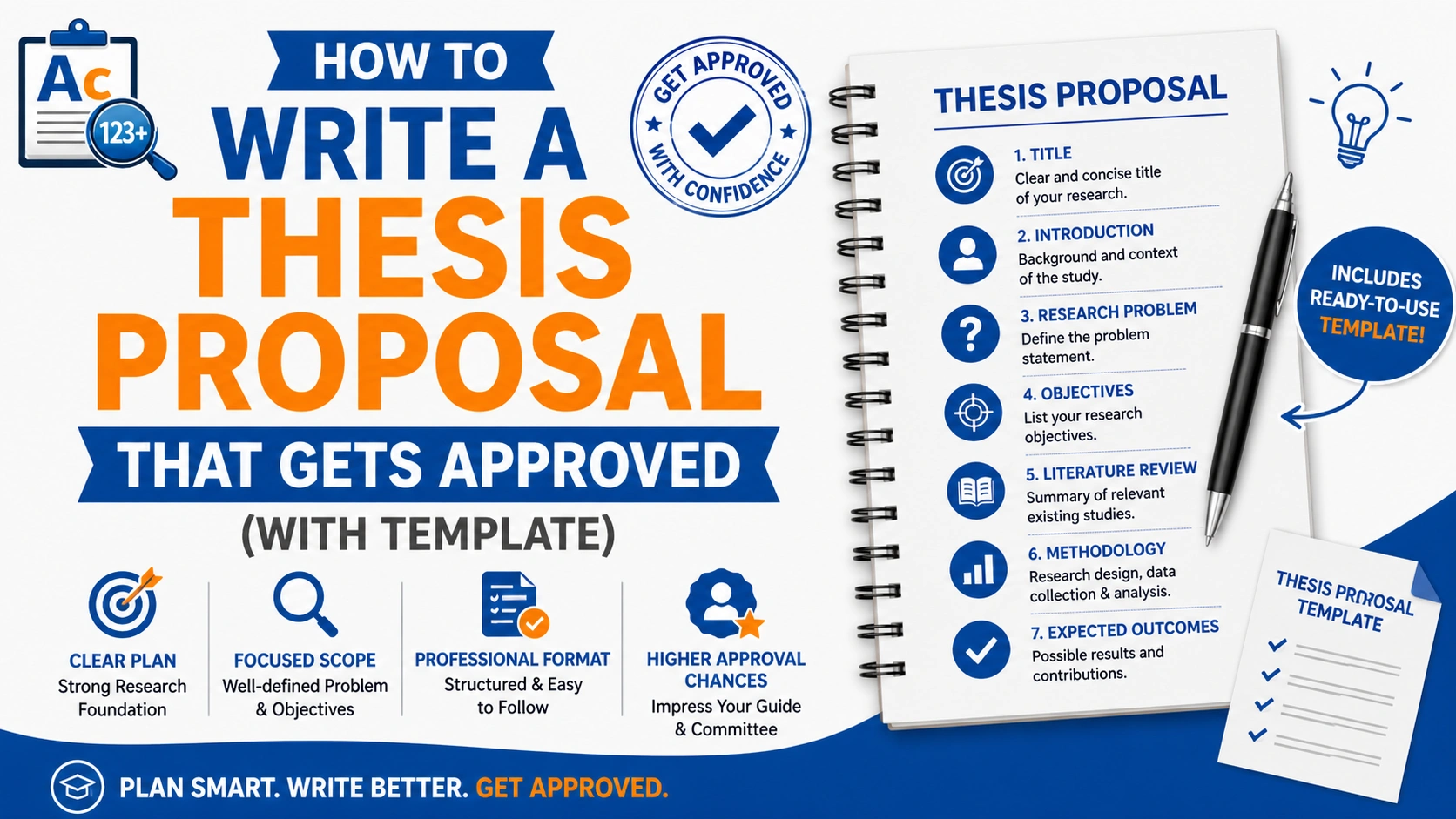
A thesis proposal is a formal document that outlines your intended research project. It describes the problem you want to investigate, the questions you aim to answer, the methods you plan to use, and why your research matters. Think of it as a research blueprint — a persuasive argument that convinces your supervisors and institution that your project is feasible, meaningful, and worthy of their support.
The proposal stage is not merely a bureaucratic hurdle. It is a rigorous intellectual exercise that forces you to refine your thinking before you invest months or years in data collection and writing. A poorly conceived proposal leads to approved projects that later collapse under the weight of unclear research questions or methodological confusion. When you learn how to write a thesis proposal properly, you save yourself enormous time and stress down the line.
Most proposals are between 1,500 and 5,000 words depending on your institution and level of study, though some doctoral proposals extend to 10,000 words or more. The key is not length but substance — every section must serve a clear purpose and demonstrate intellectual rigor.
The Core Components of a Winning Thesis Proposal
1. Title Page and Abstract
Your title should be specific, informative, and precise. Avoid vague titles like ‘A Study of Social Media’ and opt for something like ‘The Effect of Instagram Use on Body Image Satisfaction Among Female University Students Aged 18–24.’ A focused title immediately signals to your committee that you have a clear and manageable research scope.
The abstract, typically 150–300 words, summarizes your entire proposal. Though it appears first, write it last. It should cover your research problem, your key questions, your methodology, and your expected contribution. When you write a thesis proposal abstract, clarity matters more than complexity.
2. Introduction and Background
The introduction is where you establish the context for your research. Begin broadly by situating your topic within its wider academic or social landscape, then narrow down to the specific problem you are addressing. Your supervisors want to see that you have a firm grasp of the existing conversation in your field and that your research enters that conversation meaningfully.
Include relevant background information that a reader needs to understand your research. This is not a literature review — save that for its own section — but a contextual scene-setter that justifies why this topic deserves attention right now. Ask yourself: why is this topic important? Why is now the right time to study it? What events, trends, or gaps in knowledge make this research urgent?
3. Statement of the Problem
This may be the single most important part of your proposal. The problem statement explains what is missing, unclear, or unresolved in the current body of knowledge. It articulates a specific intellectual gap that your research will fill. Be direct and specific. Vague problem statements like ‘not much research has been done on this topic’ will not impress your committee.
A strong problem statement identifies the gap, explains why it matters, and positions your research as the appropriate response to that gap. Committees evaluating how to write a thesis proposal effectively always single out the problem statement as the section that separates average proposals from excellent ones.
4. Research Questions and Objectives
Your research questions are the engine of your thesis. They must be clear, focused, and answerable within the scope and timeframe of your study. Avoid questions that are too broad (‘How does education affect society?’) or too narrow (‘What did three students think about one teacher’s feedback style?’).
A well-constructed research question is specific enough to be answerable but broad enough to be significant. Most proposals include one primary research question and two to four sub-questions that break the main question into investigable components. Research objectives translate your questions into actions — what will you actually do in this study?
5. Literature Review
The literature review demonstrates that you have thoroughly engaged with existing scholarship and can position your work within it. This is not simply a summary of what others have written — it is a critical synthesis that shows how previous research has contributed to, and fallen short of, fully addressing your research problem.
Organize your literature review thematically rather than chronologically. Group sources around key themes or debates relevant to your topic, and show how your research will contribute something new. Committee members reading your proposal want to see scholarly confidence — demonstrate that you know the field well enough to identify exactly where your contribution fits.
6. Research Methodology
The methodology section explains how you will conduct your research. It covers your research design (qualitative, quantitative, or mixed methods), your data collection methods (interviews, surveys, experiments, archival research, etc.), your sampling strategy, and your analytical approach.
Be specific and justify each methodological choice. Why are you using semi-structured interviews rather than surveys? Why is a case study design more appropriate than a comparative study? Your committee needs to be convinced not just that your methodology is valid but that it is the best approach for answering your particular research questions.
Also address potential ethical considerations, particularly if your research involves human participants. Mention any required ethics approvals and how you plan to ensure participant confidentiality and informed consent.
7. Theoretical Framework
Many students overlook the theoretical framework, but it is crucial. This section identifies the theoretical lens through which you will interpret your findings. Are you drawing on feminist theory, social constructivism, rational choice theory, or postcolonial frameworks? The theoretical framework gives your analysis intellectual coherence and shows your committee that your research is grounded in established scholarly traditions.
8. Significance and Contribution
Here you explain why your research matters. What will it add to academic knowledge? Does it have practical implications for policy, practice, or society? Does it challenge existing assumptions, extend current theory, or fill a methodological gap?
When you write a thesis proposal, the significance section is your opportunity to make a persuasive case for your research’s value. Be specific — avoid generic statements about how your research will ‘benefit the field’ and articulate precisely what new knowledge or perspective it will generate.
9. Timeline and Work Plan
A realistic, detailed timeline reassures your committee that your project is feasible. Break your research into phases — literature review, data collection, analysis, writing, revision — and assign realistic timeframes to each. Use a Gantt chart or a clear table if possible. Demonstrating that you have thought carefully about how to manage your time is a mark of academic maturity.
10. References
Your reference list should be thorough, up-to-date, and formatted correctly according to your institution’s preferred citation style (APA, MLA, Chicago, Harvard, etc.). A strong reference list signals that you have done your homework and are conversant with the key literature in your field.
Common Reasons Thesis Proposals Get Rejected
Understanding why proposals fail is as instructive as knowing what makes them succeed. The most common reasons supervisors and committees reject proposals include the following.
A vague or overly broad research problem is the number one killer of thesis proposals. If your committee cannot identify a clear, specific intellectual gap that your research will address, they will ask you to revise and resubmit. Precision matters enormously.
An unsupported methodology is another common issue. Saying you will ‘interview people’ without explaining how many, why that number, how you will recruit them, or how you will analyze the data tells your committee that you have not thought through the research process carefully enough.
Weak engagement with existing literature undermines the credibility of your proposal. If you cite only a handful of sources or miss major works in your field, your committee will question whether you are ready to conduct original research.
Unrealistic timelines suggest poor planning. If your methodology involves 200 in-depth interviews but your timeline allocates only four weeks for data collection, your committee will doubt your practical understanding of research.
Misalignment between research questions and methodology is a structural flaw that is hard to overlook. If your research question asks about lived experiences but your methodology is purely quantitative, you have a fundamental contradiction that needs to be resolved.
The Thesis Proposal Template
Section 1: Title
[Your proposed thesis title — specific, descriptive, focused]
Section 2: Abstract (150–300 words)
[Brief overview of the problem, research questions, methodology, and expected contribution]
Section 3: Introduction
[Contextual background — situate your topic within the broader field. Explain why this topic is important and timely. Conclude with a clear statement of your research problem.]
Section 4: Statement of the Problem
[Clearly articulate the gap in existing knowledge that your research will address. Be specific and cite evidence of the gap.]
Section 5: Research Questions and Objectives
[Primary Research Question: …]
[Sub-questions: 1. … / 2. … / 3. …]
[Research Objectives: 1. … / 2. … / 3. …]
Section 6: Literature Review
[Organized thematic synthesis of relevant scholarship. Demonstrates knowledge of the field and identifies where your research fits.]
Section 7: Theoretical Framework
[Identify the theoretical lens guiding your research. Justify its relevance to your topic and research questions.]
Section 8: Methodology
[Research design, data collection methods, sampling strategy, analytical approach, ethical considerations]
Section 9: Significance and Contribution
[What new knowledge will this research generate? What are its practical, theoretical, or policy implications?]
Section 10: Timeline
[Phase-by-phase breakdown with approximate dates]
Section 11: References
[Full reference list in your institution’s required citation format]
Final Tips for Getting Your Proposal Approved
Before submitting, share your draft with a trusted peer or mentor and ask them whether the research problem is clearly stated, whether the methodology matches the research questions, and whether the proposal reads with intellectual confidence. Fresh eyes catch logical gaps that you have read past too many times.
Tailor your proposal to your supervisor’s intellectual interests where appropriate. If your supervisor has published extensively on a related topic, demonstrate familiarity with their work. This is not flattery — it is showing that you understand the scholarly conversation you are entering.
Finally, write clearly and concisely. Academic does not mean inaccessible. Proposals that are laden with unnecessary jargon or written in convoluted sentences are harder to evaluate positively. When in doubt, simplify. The mark of a strong thinker is the ability to explain complex ideas simply.
Learning how to write a thesis proposal is a skill that rewards careful practice, honest self-assessment, and willingness to revise. Follow the structure outlined here, take the template as your starting point, and remember that your committee wants to approve your proposal — make it easy for them to say yes.
Conclusion
Writing a thesis proposal that gets approved is not about using complex language or overly ambitious ideas—it is about clarity, structure, and intellectual precision. A successful proposal clearly defines a research problem, presents focused questions, aligns methodology with objectives, and demonstrates a strong understanding of existing literature.
Each section of your proposal plays a critical role in convincing your committee that your research is both meaningful and feasible. When your problem statement is specific, your methodology is well-justified, and your contribution is clearly articulated, your proposal becomes a compelling academic argument rather than just a formal requirement.
Ultimately, the key to approval lies in preparation and revision. By following a clear structure, avoiding common mistakes, and refining your ideas through feedback, you can confidently present a proposal that earns approval and sets a strong foundation for your entire research journey.
FAQs (Frequently Asked Questions)
What is a thesis proposal?
A thesis proposal is a formal document that outlines your research topic, questions, methodology, and significance. It acts as a blueprint for your research project and must be approved before you begin.
How long should a thesis proposal be?
Most thesis proposals range from 1,500 to 5,000 words for master’s programs, while doctoral proposals can be longer depending on institutional requirements.
What is the most important part of a thesis proposal?
The problem statement is often the most important section because it clearly defines the research gap your study aims to address.
How many research questions should a thesis proposal have?
Typically, a proposal includes one main research question supported by 2–4 sub-questions to guide the study effectively.
What are common reasons thesis proposals get rejected?
Common reasons include:
Vague research problem
Weak or unsupported methodology
Poor literature review
Misalignment between questions and methods
Unrealistic timeline
Do I need a theoretical framework in my proposal?
Yes, a theoretical framework helps position your research within existing academic theories and provides a lens for interpreting your findings.
How can I improve my chances of approval?
Focus on clarity, ensure all sections are aligned, justify your methodology, engage deeply with existing literature, and revise your proposal based on feedback before submission.