Freelancing comes with enormous freedom — but it also comes with risks that employees in traditional jobs rarely face. One of the most significant is the freelance scam: fake clients who waste your time, steal your work, or, in more sophisticated schemes, actually cost you money.
The freelance scam landscape has evolved significantly by 2026. The old “I’ll pay you with a check for more than your invoice and you wire back the difference” scam is still out there — but it’s been joined by sophisticated AI-generated personas, coordinated fake job postings, phishing campaigns targeting freelance platforms, and elaborate long cons designed to extract free work disguised as “test projects.”
Every year, thousands of freelancers lose hours, work, money, or sensitive personal information to these schemes. The freelancers who stay safe aren’t just lucky — they know the warning signs and they’ve built habits that protect them from the start.
This guide gives you everything you need to identify scams before they cost you, protect yourself when things feel off, and respond if you’ve already been targeted.
Why Freelance Scams Are a Growing Threat In 2026
Before diving into the tactics, it’s worth understanding how prevalent and sophisticated freelance fraud has become. According to the Freelancers Union, approximately 71% of freelancers report having experienced at least one form of non-payment or fraudulent client interaction. That’s not a fringe issue — it’s an industry-wide reality.
Scammers target freelancers specifically because the freelance relationship has structural vulnerabilities: there’s no employer intermediary, payment is often uncertain until delivered, the parties frequently don’t meet in person, and many freelancers — especially beginners — are eager enough to work that they’ll overlook early warning signs.
Understanding this context should make you appropriately vigilant — not paranoid, but professionally cautious in the way any smart business owner would be when dealing with new clients they haven’t yet verified.
Part 1: The Most Common Freelance Scams in 2026
The Fake Check / Overpayment Scam
This is the oldest freelance scam and it’s still running because it still works. The “client” agrees to hire you, sends a check or bank transfer for significantly more than your agreed rate, then asks you to refund the difference. Their story varies — it was an accounting error, the extra funds were meant for another freelancer, they accidentally sent too much.
You deposit the check, transfer back the “excess,” and a week later discover the original check was fraudulent. The bank reverses it. You’re out whatever you transferred.
Red flags: Client insists on paying by check rather than digital payment. Payment arrives before any work is discussed. The amount is “accidentally” higher than quoted. Any request to forward money to a third party.
Rule: Never send money back to a client for any reason. Legitimate businesses don’t make payment errors that require you to wire funds back.
The Portfolio/Spec Work Theft Scam
A “client” posts a highly detailed, interesting project. They request a detailed proposal including your specific approach, sample concepts, or “a brief mock-up to see how you’d approach this.” You invest hours creating something detailed and compelling. Then they ghost you — or hire you at a token rate while keeping all the conceptual work you did for free.
This scam has evolved with AI: scammers now collect conceptual spec work from multiple freelancers simultaneously, use AI to combine the best ideas, and never intend to hire anyone.
Red flags: Unusually detailed brief for an initial inquiry. Request for “concept samples” or “mock-ups” before any formal agreement or payment. Vague company identity with no verifiable online presence. Unrealistic timeline for “just a quick sample.”
Rule: Never create custom spec work for a client without a contract and a deposit. High-level thinking is fine in a proposal — actual deliverable-quality work requires payment.
The “Test Project” Trap
Similar to spec work theft but disguised as a paid trial. The client offers a “paid test project” to evaluate your skills — but the payment is suspiciously low or conditional on approval. You do the work, they find a reason to “not approve” it, and they keep your output without paying.
In more elaborate versions, the “test” is actually a real deliverable they need — a section of an actual project they’ve broken into “tests” to extract work without committing to pay.
Red flags: Test projects that happen to be exactly what the real project needs. Payment described as “conditional on quality” with no clear approval criteria. Client who can’t describe what “passing the test” looks like.
Rule: Any work you deliver has value and should be paid for regardless of whether the client “approves” it. Build clear approval criteria into any trial agreement before you start.
The Fake Platform / Phishing Scam
You receive an email that looks like it’s from Upwork, Fiverr, or another platform you use. It tells you there’s a message from a client, that your account needs verification, or that a payment is pending. You click the link, enter your credentials, and your account is immediately compromised.
In 2026, these phishing emails are increasingly convincing — they use the platform’s exact branding, correct logos, realistic sender names, and urgency-creating language (“Your account will be suspended in 24 hours unless you verify”).
Red flags: Email comes from a domain that isn’t the official platform (upwork-support.net instead of upwork.com, for example). Urgent language demanding immediate action. Links that don’t match the official platform URL when you hover over them. Requests for your password or payment information via email.
Rule: Never click links in emails about account issues — always go directly to the platform by typing the URL in your browser. Enable two-factor authentication on every freelance platform you use.
The Offshore Middleman Scam
A “client” tells you they’re an agency or middleman hiring on behalf of a larger client. They want you to complete the work, deliver it to them, and then they’ll “pass it along” and pay you after their client approves. They often ask you to sign documents that look legitimate and may even pay for a small initial deliverable.
The long game: they collect your work across multiple projects, then disappear before making the larger payment — sometimes taking significant completed work with them.
Red flags: Payment dependent on a third party’s approval you have no visibility into. Requests to complete significant work before any payment is processed. Reluctance to discuss the end client. Contracts that give them full rights to your work immediately without payment protection.
Rule: Require a deposit before any work begins. Structure larger projects into paid milestones. Never deliver final files before payment is secured.
The Personal Information Harvest Scam
This one doesn’t steal work — it steals identity. A “client” requests freelancer verification documents: a copy of your ID, your Social Security or tax ID number, your bank account details for payment setup, sometimes even a selfie with your ID. They frame this as standard compliance for large-scale or international contracts.
Red flags: Requests for government ID before any contract or payment is established. Requests for bank details outside of established platform payment systems. Pressure to provide documentation quickly “to not lose the opportunity.”
Rule: Never share government ID, Social Security numbers, or full bank account details with a client you haven’t thoroughly verified. Legitimate large clients have formal vendor onboarding processes — but they happen through secure, verified channels, not via email or messaging apps.
The AI Persona Scam
New to 2026: scammers using AI-generated profiles, headshots, and even video to impersonate real people or create completely fictional clients with rich, believable online histories. These fake personas can have LinkedIn profiles, social media accounts, and fake company websites that pass casual scrutiny.
Red flags: A client who communicates fluently in writing but seems evasive on video calls. Company websites that are very new, have stock photo employees, and lack genuine social proof. LinkedIn profiles that show a career history with no mutual connections and no genuine engagement history.
Rule: For any significant project, insist on a video call before signing a contract. An AI-generated persona cannot impersonate a real live video call convincingly — yet.
Part 2: Red Flags Every Freelancer Should Know
Beyond the specific scam types, there are universal red flags that should raise your guard with any new client:
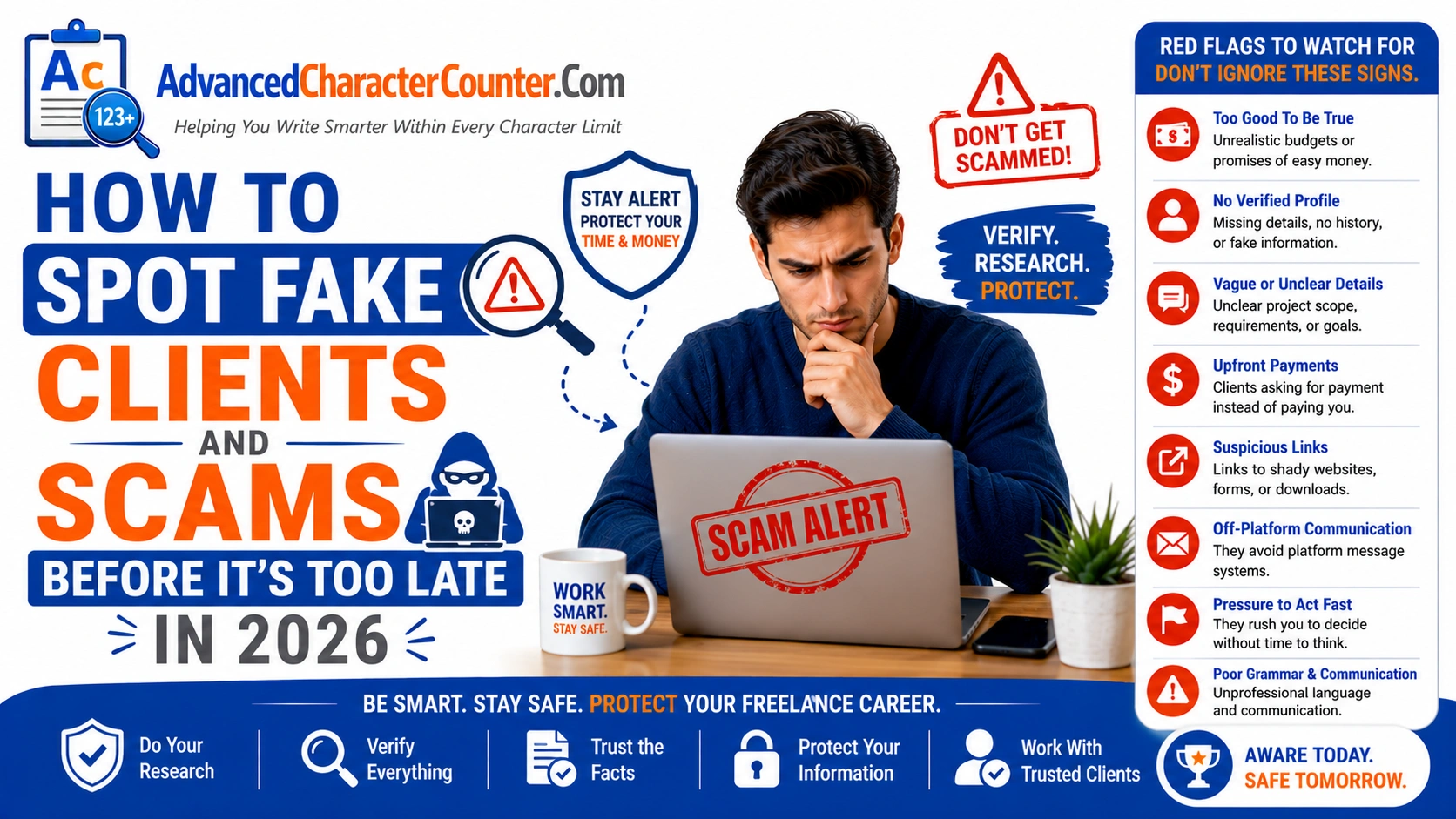
They found you on one platform and immediately want to move to email or WhatsApp. This is the single most common precursor to a scam. Moving off-platform removes the payment protections and dispute mechanisms that legitimate freelance platforms provide. Reputable clients have no reason to work outside the platform they found you on.
They’re vague about the company. A legitimate business will happily share their company name, website, and a LinkedIn presence. A client who deflects when asked basic questions about their organization is hiding something.
The project seems too good to be true. Exceptional pay for very easy work. A prestigious brand that somehow found you through an obscure channel. A long-term contract offered before any conversation or vetting. If your instinct says it’s too easy or too good, trust it.
They’re in unusual urgency. “I need this done today,” “I lost my last freelancer and have a crisis,” “can you start immediately without the usual paperwork” — urgency is a manipulation tactic that’s designed to get you to skip the due diligence steps that would expose the scam.
Communication feels off. Awkward phrasing, inconsistent details about themselves or their company, switching between different names, or responses that don’t quite address what you asked. These can indicate someone managing multiple scam conversations simultaneously or working from a script.
They push back on contracts or deposits. Every legitimate client will work with a contract and a reasonable deposit. A client who refuses both — especially while claiming to be a serious, funded business — has no intention of paying you properly.
Part 3: How to Protect Yourself Before Work Begins
Verify the Client Independently
Before committing to any project, do five minutes of research: Google the client’s company name, check their LinkedIn, look up their website’s domain age (a company with a two-week-old website claiming to be an established brand is a red flag). Search “[company name] + scam” or “[client name] + freelance.” The freelance community is vocal about bad actors and the evidence is often findable with a basic search.
Use a Contract Every Single Time
A contract doesn’t just protect you legally — it filters out scammers. Fraudulent clients hate contracts because they require real identification, create a paper trail, and introduce legal accountability. Most scammers will disappear the moment you send a contract. That disappearance is information worth having before you’ve done any work.
Your contract should include: scope of work, payment amount, payment schedule (with a deposit clause), revision policy, ownership and rights terms, late payment penalties, and a kill fee for project cancellation.
Require a Deposit
No deposit, no work — this is the single most protective policy you can have as a freelancer. For most projects, a 50% upfront deposit and 50% on delivery is standard and entirely reasonable. For larger projects, structured milestone payments (25%/25%/50%, for example) protect both you and the client.
Any legitimate client will accept this without protest. A client who refuses to pay a deposit before work begins is either financially unstable or not planning to pay you.
Keep All Communication on Official Platforms
If you met the client on Upwork, stay on Upwork until the contract is signed and the engagement is clearly established. Platform messaging creates a record, gives you access to dispute resolution, and keeps you within the payment protection system.
Use Secure, Traceable Payment Methods
Accept payment through platform escrow, PayPal Business, direct bank transfer, or a service like Wise or Stripe. Never accept cryptocurrency as the primary payment unless you fully understand it and have other protections in place. Never accept personal checks for significant amounts before work begins.
Part 4: What to Do If You’ve Been Scammed
Document Everything Immediately
Save all messages, emails, contracts, and payment records. Screenshot everything before the account is deleted or blocked. This documentation is essential for any dispute resolution or legal action.
Report to the Platform
If the scam happened through a freelance platform, report it immediately through the platform’s dispute and fraud reporting system. Platforms take fraudulent accounts seriously — both because of their reputation and because of regulatory requirements — and fast reporting may result in funds being frozen before they’re withdrawn.
Report to Authorities
For significant financial loss, report to:
- Your country’s cybercrime reporting body (IC3.gov in the US, Action Fraud in the UK)
- Your bank’s fraud department, especially if a payment reversal is possible
- The FTC (in the US) or equivalent consumer protection agency
Warn the Freelance Community
Post about the scam — with details — in relevant freelance communities (r/freelance, platform-specific forums, Facebook groups). This is one of the most effective ways to prevent other freelancers from being victimized by the same actor.Final Advice
Healthy skepticism is a professional skill, not a personality flaw. The freelancers who never get scammed aren’t suspicious of everyone — they’re just consistent. They always use contracts. They always take deposits. They always verify new clients before committing significant work. They always keep communication on official channels until the relationship is established.
These habits take no more than a few minutes per client and cost you nothing when clients are legitimate. The one time they prevent a scam, they save you hours of work, hundreds or thousands of dollars, and the emotional toll of being deceived.
Build these habits now, make them non-negotiable, and you’ll navigate freelancing with the confidence that comes from knowing you’re protected.
Frequently Asked Questions (FAQs)
Q1: What are the most common freelance scams in 2026?
The most prevalent are: fake check/overpayment schemes, spec work theft, phishing emails impersonating freelance platforms, fake client personas (increasingly AI-generated), test project traps, and requests for personal identification documents for identity theft.
Q2: How can I tell if a client is legitimate?
Verify their company independently (Google, LinkedIn, website domain age), insist on a contract and deposit, keep communication on the platform you connected through, and trust your instincts if something feels off. Legitimate clients can always be verified and have no reason to avoid normal professional protocols.
Q3: Is it safe to share my bank details with a new client?
No, not directly. Use a payment platform (PayPal Business, Wise, Stripe, or a freelance platform’s built-in payment system) that acts as an intermediary. Only share direct bank account details with clients you’ve thoroughly vetted and have an established relationship with.
Q4: What should I do if a client refuses to sign a contract?
Don’t do the work. A refusal to sign a contract is one of the clearest signals that a client doesn’t intend to pay you fairly. No legitimate business professional is unwilling to enter a simple service agreement.
Q5: Can scams happen on established platforms like Upwork or Fiverr?
Yes, though these platforms have detection and dispute systems that provide some protection. The most common platform scam is asking to move communication off-platform — once you leave the platform, you lose all payment protections and dispute options.
Q6: What’s the safest payment method for freelancers?
Platform escrow (Upwork, Fiverr, Contra) is the safest because funds are held before work begins and released on completion. Outside of platforms, PayPal Business (which has dispute resolution) and Stripe are safer than direct bank transfers with unknown clients.
Q7: How do I protect myself from spec work theft?
Never create custom deliverable-quality work without a signed contract and deposit. In proposals, share your approach and thinking (which demonstrates expertise) without creating the actual finished work. Watermark any samples you do share prior to contract.
Q8: I think I’m being scammed right now — what should I do?
Stop all work immediately. Do not deliver any additional files or content. Document everything. Report the account to the platform. If you’ve already provided personal information, contact your bank and consider placing a fraud alert with credit agencies. File a report with your national cybercrime authority.