In today’s evolving workforce landscape, two terms are frequently used interchangeably — yet represent fundamentally different ways of working: remote work and freelancing. Both allow you to work outside of a traditional office setting, but that’s often where the similarities end.
Understanding the distinction matters enormously if you’re deciding how to structure your career or professional services. The wrong choice — even if both seem equally ‘flexible’ on the surface — can lead to financial instability, burnout, or missed opportunities. This guide breaks down everything you need to know about remote work versus freelancing, covering structure, income, taxes, lifestyle, career trajectory, and more.
Defining Remote Work
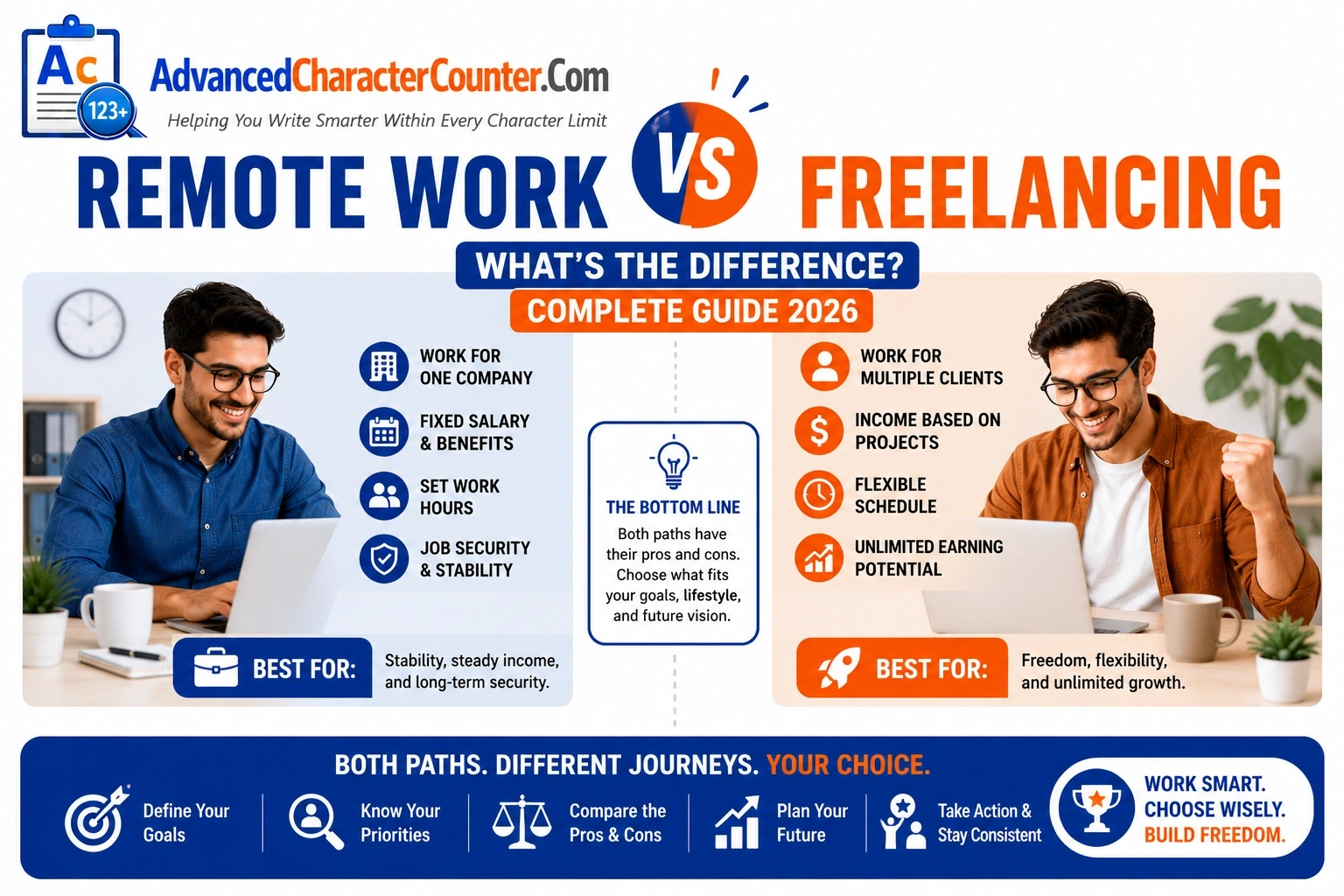
Remote work (also called telecommuting or working from home) refers to an employment arrangement where you work for a single employer but perform your duties from a location other than a traditional office. You’re an employee — with all that entails: a regular salary or hourly wage, company benefits (health insurance, paid leave, retirement contributions), and a reporting structure.
Remote workers typically have set working hours or at least core hours during which they must be available. They use company-provided tools and systems, attend scheduled meetings, and are accountable to a manager or team. The work arrangement is remote, but the employment relationship is conventional.
Examples of remote work roles include remote software engineers employed by a tech company, remote customer service representatives, remote project managers, and remote marketing coordinators — all working exclusively for one organization.
Defining Freelancing
Freelancing is a form of self-employment in which you offer services to multiple clients on a project or contract basis. You are your own boss — and your own business. You set your rates, choose which projects to take on, decide your working hours, and manage all aspects of your professional and financial operations.
Freelancers may work for dozens of clients simultaneously or sequentially. They typically don’t have employee benefits, guaranteed income, or a structured reporting relationship. Instead, they operate as independent contractors, entering into agreements with clients for specific deliverables or time periods.
Examples include a freelance graphic designer creating logos for multiple small businesses, a freelance writer producing articles for various publications, or a freelance developer building apps for different startups.
Key Differences: A Side-by-Side Comparison
Income and Financial Stability
Remote workers receive a predictable paycheck — typically biweekly or monthly — regardless of workflow fluctuations. This financial predictability is one of remote employment’s most significant advantages, particularly for people with fixed expenses, mortgages, or families.
Freelancers, by contrast, experience income variability. Busy months can be extremely lucrative, while slow periods may yield very little. Successful freelancers compensate for this by building retainer relationships, diversifying their client base, and maintaining a financial buffer — typically three to six months of living expenses.
Freedom and Flexibility
Despite what many assume, remote workers don’t necessarily have unlimited flexibility. They’re still employees with schedules, meeting obligations, and performance expectations. True autonomy over your time is more characteristic of freelancing.
Freelancers choose when they work, how many projects they take on, which clients they work with, and how they structure their days. This can be deeply liberating — but it also requires extraordinary self-discipline and time management.
Benefits and Protections
Remote employees typically receive the same benefits as office employees: health insurance, paid vacation, sick leave, parental leave, retirement contributions (401k matching, pension), and sometimes stock options or bonuses. They’re also protected by employment law — including protections against wrongful termination, discrimination, and harassment.
Freelancers receive none of these by default. They must fund their own health insurance, retirement savings, and pay for professional tools and equipment. They also have no job security protections beyond what’s written in their contracts.
Taxes
Remote employees have taxes withheld automatically from each paycheck by their employer. The process is largely handled for them, and they typically file a relatively straightforward annual tax return.
Freelancers are responsible for calculating and paying their own taxes, including self-employment tax (covering both employee and employer Social Security and Medicare contributions). They must make quarterly estimated tax payments to avoid penalties, and are responsible for tracking all business expenses, deductions, and income — often requiring accounting software or a professional accountant.
Career Development
Remote employees often benefit from structured career paths: performance reviews, promotions, mentorship programs, and company-funded training. They’re embedded in an organizational culture with opportunities for advancement.
Freelancers manage their own professional development entirely. They decide what skills to build, which industry events to attend, and how to position themselves in the market. While this requires more initiative, it also enables freelancers to pivot rapidly into new areas and build diverse, multi-dimensional skill sets.
Workload and Stress
Remote work can feel isolating, particularly for those who thrive in collaborative environments. Video call fatigue and the blurring of work-life boundaries are common challenges. However, the predictable workload of employment can reduce certain types of stress.
Freelancing introduces different stressors: client acquisition, contract negotiations, scope creep, late payments, and dry spells. On the other hand, the variety of projects and clients can make freelancing more stimulating and intellectually engaging than a single-employer role.
Who Should Choose Remote Work?
Remote work is an excellent fit if you value financial predictability and benefits security, prefer having a defined role with clear responsibilities and a career path, work best within a team structure with regular collaboration, dislike the business aspects of self-employment (marketing, invoicing, client acquisition), or want to separate work from your personal identity.
Who Should Choose Freelancing?
Freelancing is ideal if you’re entrepreneurial and enjoy running a business, have skills that are highly portable and marketable to multiple clients, value the ability to set your own rates and choose your projects, prefer variety over routine, are comfortable with financial variability and business administration, or want the freedom to work from anywhere without asking for permission.
Can You Do Both?
Absolutely. Many professionals begin with remote employment while building a freelance client base on the side — a strategy known as ‘side hustling.’ Over time, some transition fully to freelancing once their independent income reaches a comfortable level. Others freelance for years before taking a remote employment role for stability. The paths are not mutually exclusive, and your career doesn’t have to follow a single linear trajectory.
Final Advice
The choice between remote work and freelancing ultimately comes down to your personality, financial situation, risk tolerance, and professional goals. Neither is universally superior — both have genuine advantages and real trade-offs. The worst decision is choosing one without fully understanding the other.
If stability is your top priority right now, remote work provides a solid foundation. If autonomy and income potential matter most to you, and you’re ready to embrace the entrepreneurial demands of freelancing, you have everything to gain. Many people find that their preference changes over time as their life circumstances and career ambitions evolve — so stay open, stay informed, and choose what serves you best today.
Frequently Asked Questions (FAQs)
Is freelancing the same as being self-employed?
Yes. Freelancers are self-employed independent contractors. They’re responsible for their own taxes, benefits, and business operations, unlike employees (remote or otherwise).
Can a remote worker also take on freelance clients?
Technically yes, but review your employment contract first. Many remote employment contracts include non-compete or exclusivity clauses that restrict outside work, particularly in the same industry.
Which pays more — remote work or freelancing?
This varies widely by industry, skill level, and experience. Highly skilled freelancers often out-earn their employed counterparts, but only when accounting for the cost of benefits, self-employment taxes, and income variability. When all factors are considered, total compensation can be comparable.
Do freelancers have to register a business?
Requirements vary by location. In many countries, freelancers can operate as sole proprietors without formal business registration. However, forming an LLC (in the US) or equivalent structure can provide legal protection and tax advantages worth exploring.
What happens if a freelancer doesn’t have clients?
Income gaps are a real risk. The best freelancers mitigate this by building strong client relationships, maintaining a pipeline, saving during high-income periods, and developing passive income streams like courses or digital products.