
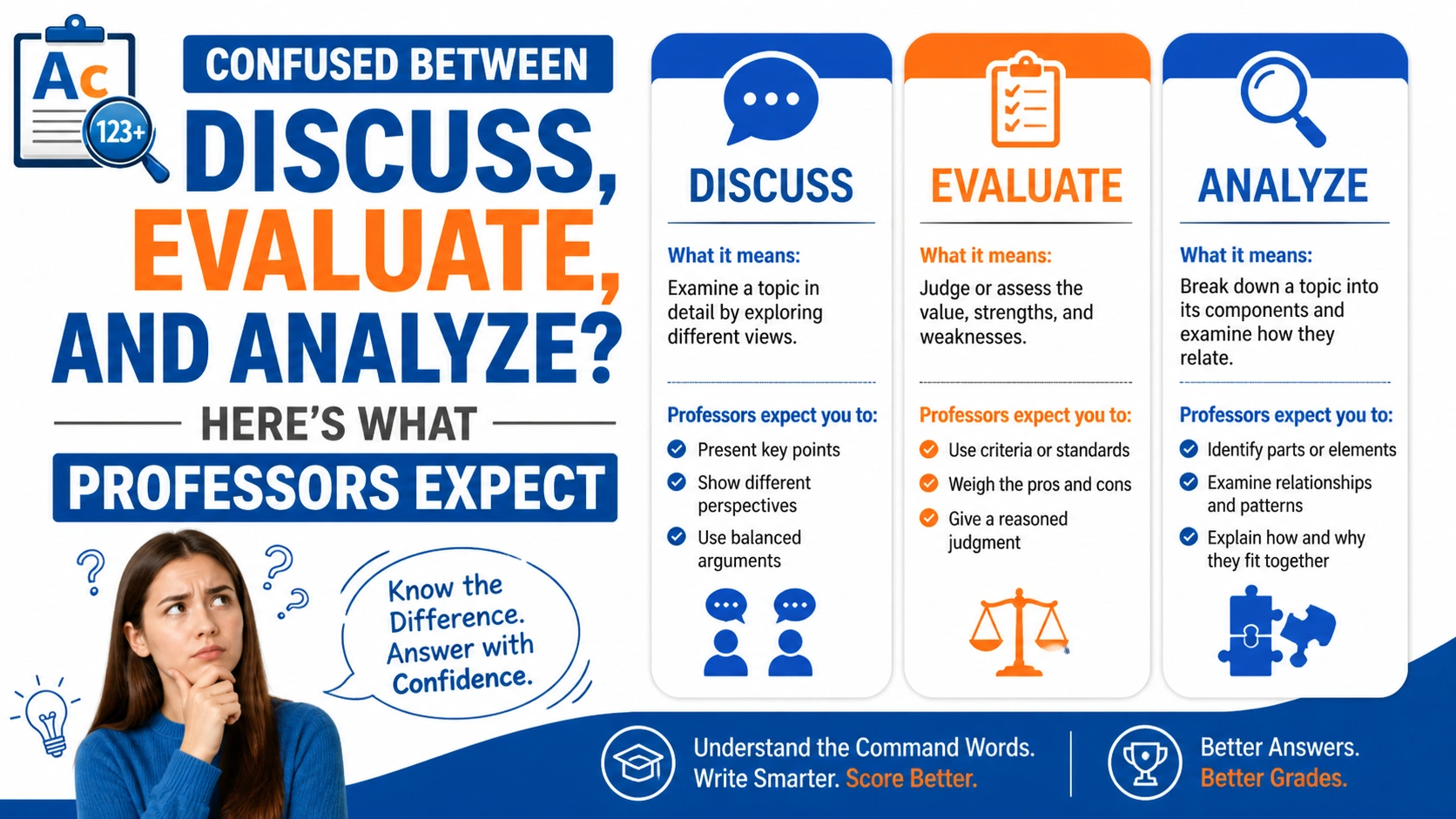
One of the most persistent sources of lost marks in academic writing is misunderstanding what essay instruction words actually require. When your professor writes ‘discuss the causes of the French Revolution,’ they mean something quite different from when they write ‘analyze the causes of the French Revolution’ or ‘evaluate the significance of the causes of the French Revolution.’ These are not interchangeable words. Each instruction carries a specific set of intellectual expectations, and responding to the wrong one, or conflating them, can cost you significant marks regardless of how well-researched your content is.
The challenge is that students often treat these words as loosely equivalent, assuming that any thorough response covering the topic will satisfy the requirement. Professors consistently report that this is one of the most common reasons why otherwise capable students receive lower grades than expected. Understanding the distinction between ‘discuss,’ ‘evaluate,’ and ‘analyze’, and between a dozen other commonly used instruction words — is one of the most valuable academic skills you can develop.
This article explains exactly what professors expect when they use the most common essay instruction words, how to identify the key signals in a question, and how to calibrate your response accordingly. Whether you are writing a short answer in an exam or a 5,000-word essay, these distinctions apply.
Why Instruction Words Matter So Much
Essay instruction words are not arbitrary stylistic choices made by professors who could equally have used any other word. They are precise signals about the type of intellectual task you are being asked to perform. Each word corresponds to a particular level of cognitive complexity and a particular type of argumentation.
Bloom’s Taxonomy, the widely used framework for categorizing educational learning objectives, maps different types of cognitive tasks to a hierarchy from lower-order to higher-order thinking. Some instruction words — like ‘describe’ or ‘list’ — correspond to lower-order tasks that involve recall and comprehension. Others — like ‘analyze,’ ‘evaluate,’ and ‘synthesize’ — correspond to higher-order tasks that require critical thinking, judgment, and original argument.
When your professor uses a higher-order instruction word and you respond with lower-order thinking — for example, when asked to ‘evaluate’ you only ‘describe’ — you have answered the wrong question. Your content may be accurate and even impressive, but it does not satisfy the intellectual requirement of the task. Professors are trained to identify this mismatch, and it directly affects your grade.
Discuss: What It Really Means
‘Discuss’ is one of the most commonly used and most commonly misunderstood instruction words. Many students interpret ‘discuss’ as an invitation to write everything they know about a topic without taking a clear position. This is incorrect.
When a professor asks you to discuss a topic, they expect you to examine the issue from multiple perspectives, consider different arguments and pieces of evidence, and — critically — arrive at a considered position or conclusion. Discussing is not the same as listing. It is not a brain dump of information. It is a structured, nuanced exploration of a topic that acknowledges complexity while still advancing an argument.
A good ‘discuss’ answer will typically present the strongest arguments for a position, acknowledge the strongest objections or counterarguments, engage with the tension between them, and draw a reasoned conclusion. The key word is ‘explore’ — you are expected to move through the intellectual landscape of the topic rather than simply describe it from a fixed vantage point.
Think of ‘discuss’ as the most open-ended of the major instruction words. It gives you intellectual latitude, but that latitude comes with the responsibility of demonstrating depth, balance, and argumentative coherence. A discussion that presents only one side of an argument without engaging with opposing views is not a discussion — it is an assertion.
Evaluate: What It Really Means
‘Evaluate’ is a higher-order instruction word than ‘discuss,’ and it requires a more explicit exercise of judgment. When a professor asks you to evaluate something — a claim, a theory, a historical decision, a policy, a piece of literature — they are asking you to assess its merit, its validity, its effectiveness, or its significance.
To evaluate is to weigh the evidence and arguments for and against a position and to arrive at a reasoned verdict. It is not sufficient to present both sides neutrally and leave the reader to draw their own conclusion. ‘Evaluate’ requires you to take a position based on your assessment of the evidence and justify that position explicitly.
Strong evaluative writing uses criteria. Before you can assess whether something is effective, significant, or valid, you need to establish the standards against which you are measuring it. In an evaluative essay, your introduction should signal what criteria you will use to make your assessment, and your conclusion should state your verdict clearly.
For example, if asked to ‘evaluate the effectiveness of the Marshall Plan in rebuilding post-war Europe,’ a strong response would define what ‘effectiveness’ means in this context (economic recovery? political stabilization? containment of communism?), apply those criteria systematically to the evidence, acknowledge where the plan succeeded and where it fell short by those criteria, and conclude with a reasoned overall judgment.
The key word in ‘evaluate’ is judgment. Your professor expects you to commit to a reasoned position. Hedging and refusing to make a clear assessment is a common weakness in evaluative writing. You do not need to be certain — academic judgment always acknowledges uncertainty, but you must demonstrate that you have weighed the evidence and arrived at a defensible conclusion.
Analyze: What It Really Means
‘Analyze’ is perhaps the most intellectually demanding of the three major instruction words, and it is the one that professors most frequently report seeing mishandled. To analyze is to break something down into its component parts, examine how those parts function and interact, and explain the underlying logic, structure, or mechanisms at work.
Analysis goes beyond description and beyond argument. It demands that you look beneath the surface of your subject and explain how and why things work the way they do. When you analyze a poem, you do not simply describe what happens in it — you explain how specific poetic choices (diction, imagery, rhythm, structure) create meaning. When you analyze a political event, you do not simply narrate what happened — you identify the forces, tensions, and logic that produced the outcome.
A common failure in analytical writing is stopping at description. Students write sentences like ‘The author uses the color red to represent danger.’ This is an observation. An analysis would continue: ‘By associating the color red with the protagonist’s moments of greatest agency, the author inverts the conventional symbolic logic that links red with external threat, suggesting instead that the true danger lies within the protagonist’s own capacity for violence.’ That is analysis — it explains the mechanism, the purpose, and the interpretive significance of the observation.
The signature moves of analytical writing are how and why. Whenever you make an observation, ask yourself: how does this work? Why is this significant? What does this reveal about the deeper logic or meaning of the subject? Answering those questions transforms description into analysis.
Other Common Instruction Words and What They Require
Compare and Contrast
Compare and contrast questions require you to examine the similarities and differences between two or more subjects systematically. The key is not simply to describe each subject separately but to structure your response around points of comparison that illuminate something meaningful about both subjects. The best comparative answers identify a thesis — a central argument about what the comparison reveals — rather than simply cataloguing similarities and differences.
Critically Evaluate
‘Critically evaluate’ is a step beyond ‘evaluate.’ The addition of ‘critically’ signals that you should interrogate not only the subject itself but the quality and reliability of the evidence and arguments used to support positions about it. Critical evaluation involves assessing the assumptions, methodological choices, and potential biases underlying claims, not just the claims themselves.
Justify
‘Justify’ asks you to provide reasons and evidence in support of a position. It is narrower than ‘evaluate’ — you are not asked to consider objections at length but to make the strongest possible case for a particular argument. Justification requires selecting and marshaling evidence purposefully and demonstrating logical coherence in your reasoning.
Outline
‘Outline’ asks for a structured overview of the main points without detailed explanation or argument. It is a lower-order task in terms of cognitive complexity, but it rewards clarity of organization and precision in identifying what is truly essential about a topic.
Examine
‘Examine’ sits between ‘describe’ and ‘analyze.’ It asks you to look carefully at a topic, explore its components, and demonstrate a thorough understanding of it. Like ‘discuss,’ it expects more than simple description, but it places less explicit demand on you to take a position than ‘evaluate’ does.
How to Read a Question Strategically
Before you begin writing, spend time identifying the instruction word and all other significant terms in the question. The instruction word tells you what intellectual operation to perform. The other terms — the subject, the scope, any qualifiers — tell you what material to apply that operation to.
Questions with qualifiers like ‘to what extent,’ ‘how far,’ or ‘in what ways’ are signaling that absolute answers are inappropriate. They expect nuance, qualification, and acknowledgment of complexity. Questions with specific terms like ‘in the context of’ or ‘with reference to’ are narrowing the scope of your answer and expect you to stay within that scope.
A useful strategy is to restate the question in your own words before beginning to write. If you can clearly articulate what the question is asking in a single sentence, you are ready to write a focused, appropriately calibrated response. If your restatement is vague or uncertain, spend more time with the question before opening your notebook.
One Topic, Three Approaches: How Instruction Words Change Your Answer
To illustrate these differences concretely, consider how the same topic — the causes of World War One — would be approached differently under different instruction words.
Discuss the causes of World War One. A strong response would present the major causal factors (militarism, alliance systems, imperialism, nationalism, and the immediate trigger of assassination), explore the evidence for each, acknowledge scholarly debate about their relative importance, and conclude with a reasoned argument about how these factors interacted to produce the war.
Evaluate the significance of nationalism as a cause of World War One. A strong response would define significance, establish criteria for measuring causal importance, assess the evidence for nationalism’s role, compare it against other causal factors, acknowledge counterarguments, and conclude with a clear judgment about whether nationalism was a primary, secondary, or relatively minor cause.
Analyze the role of the alliance system in causing World War One. A strong response would dissect the internal logic of the alliance system, explain precisely how a regional conflict escalated into a continental war through the mechanisms of treaty obligations and mobilization timetables, and show why the system produced this outcome rather than simply describing the fact that it did.
Notice how the same historical material is approached in three fundamentally different ways depending on the instruction word. The student who misidentifies the instruction and responds to the wrong one will lose marks regardless of their historical knowledge.
Understanding Instruction Words: The Key to Better Essay Writing
The most effective way to develop fluency with essay instruction words is to practice responding to the same topic using different instruction words and then compare your outputs. Notice where your natural tendencies lie — many students default to description or discussion because those feel safer than the more exposed intellectual territory of evaluation and analysis.
Push yourself to be more explicit about judgment, causal mechanisms, and structural analysis. Read feedback from previous essays carefully, especially comments that mention ‘needs more analysis,’ ‘too descriptive,’ or ‘fails to evaluate.’ These comments are almost always pointing to a mismatch between what the instruction word required and what you delivered.
Academic writing is a conversation with your professor about ideas. Understanding what they are actually asking when they use instruction words like discuss, evaluate, and analyze is the foundation of that conversation. When you respond to the right question with the right cognitive operation, your depth of knowledge and quality of research can finally shine through.
Conclusion
Understanding essay instruction words like discuss, evaluate, and analyze is not just a technical detail—it is a fundamental academic skill that directly impacts your grades. These terms define the exact type of thinking, structure, and argument your professor expects. When you misinterpret them, even well-researched answers can fall short because they fail to meet the intellectual requirement of the task.
By learning how to identify these instruction words and respond to them correctly, you gain clarity, precision, and confidence in your writing. Whether it’s exploring multiple perspectives, making a clear judgment, or breaking down complex ideas, each approach requires a distinct strategy. Mastering these differences ensures that your answers are not only accurate but also academically aligned with expectations.
Ultimately, strong academic writing begins with understanding the question itself. Once you learn to decode what is being asked, you position yourself to deliver more focused, analytical, and high-scoring responses every time.
FAQs (Frequently Asked Questions)
What are essay instruction words?
Essay instruction words are keywords in a question (like discuss, evaluate, or analyze) that tell you what kind of response your professor expects. They define the type of thinking and structure your answer should follow.
2. What does “discuss” mean in an essay?
“Discuss” means you should explore a topic from multiple perspectives, present different arguments, and arrive at a balanced conclusion rather than just listing information.
What is the difference between “evaluate” and “analyze”?
Evaluate requires you to make a judgment based on evidence.
Analyze requires you to break down a topic and explain how and why it works.
Evaluation focuses on judgment, while analysis focuses on explanation.
Why do students lose marks due to instruction words?
Students often lose marks because they misunderstand the instruction word and respond incorrectly—for example, describing instead of analyzing or failing to provide judgment when asked to evaluate.
How can I identify what the question is really asking?
Focus on the instruction word and key terms in the question. Try rewriting the question in your own words to clearly understand the required task before you start writing.
Are instruction words linked to different thinking levels?
Yes, instruction words are connected to cognitive levels (like in Bloom’s Taxonomy). Words like describe involve basic understanding, while analyze and evaluate require higher-order critical thinking.
7. What is the best way to improve using instruction words?
Practice writing answers to the same topic using different instruction words. This helps you understand how your approach changes and improves your ability to meet academic expectations.