
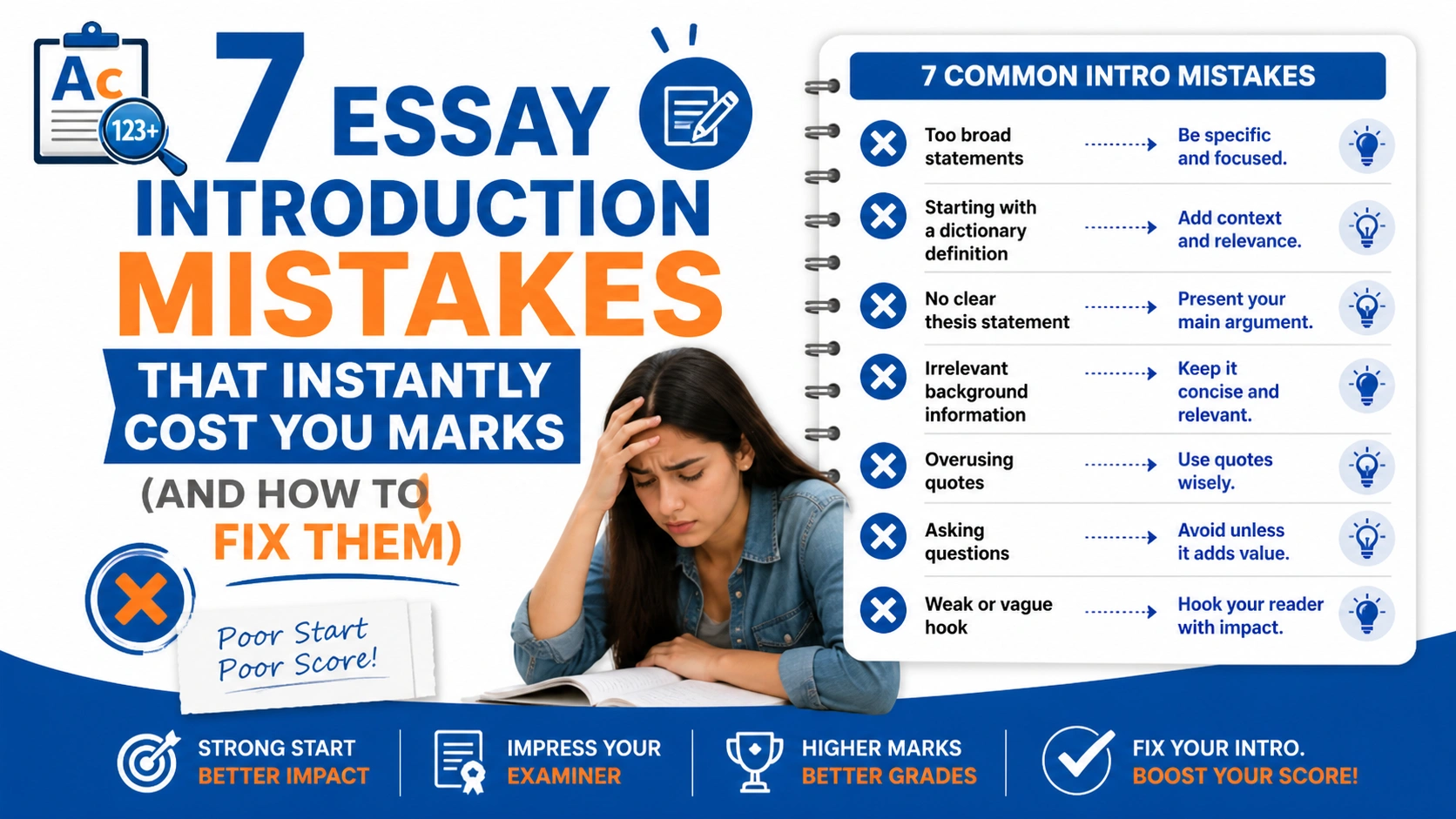
Your essay introduction is the first impression your teacher has of your argument, your analytical ability, and your understanding of the assignment. It sets the tone for everything that follows, and experienced teachers can identify weaknesses in an introduction within the first thirty seconds of reading. Yet the introduction remains one of the most commonly mishandled parts of student essays at every level — from secondary school to postgraduate study.
The frustrating reality is that many students who have strong arguments and solid evidence lose marks in the introduction before the marker has even read their thesis statement. Understanding the most common introduction mistakes that teachers notice instantly is the first step toward writing introductions that earn the marks your work deserves. This article breaks down the seven most damaging errors, explains why they lose marks, and shows you exactly how to fix them.
Whether you are writing a literary analysis, a historical essay, a science report, or a philosophical argument, these principles apply. The essay introduction is not a warm-up — it is a high-stakes first impression, and mastering it will immediately improve your grades.
Why the Essay Introduction Matters So Much
Before we examine the specific mistakes, it is worth understanding why teachers weight the introduction so heavily in their assessment. The introduction does several critical jobs simultaneously. It establishes the context for your argument, signals your understanding of the question, presents your thesis (your central argument), and outlines the structure of your essay. When any of these functions fail, the teacher reads the rest of the essay through a lens of reduced confidence in your capabilities.
Moreover, teachers read hundreds of essays. Introductions that are vague, generic, or structurally confused create an immediate cognitive burden — the teacher must work harder to understand what the essay is arguing and whether the student understands the question. Strong introductions, by contrast, create clarity and forward momentum that carries the reader through the entire essay with goodwill.
The essay introduction also reveals your critical thinking skills before you have written a single body paragraph. How you frame the question, position your argument, and signal your awareness of complexity tells a seasoned marker a great deal about the quality of the analysis that will follow.
Mistake 1: Opening With a Broad, Generic Statement
The single most common and most damaging introduction mistake is opening with an overly broad, generic statement that says nothing specific about the essay topic. Examples of this mistake include statements like ‘Throughout history, people have always disagreed about important issues,’ ‘In today’s world, technology plays a very important role,’ or ‘Since the beginning of time, humans have been fascinated by…’
These openings are known informally as ‘since the dawn of time’ statements, and experienced teachers identify them instantly as a signal that the student does not know how to begin. They waste precious words, contribute nothing to the argument, and actively annoy many markers who have read the same type of opening thousands of times.
The fix is straightforward: begin with your specific topic, not with a sweeping generalization about the world or human nature. If you are writing about the symbolism of light in Frankenstein, open with something about Gothic literature, Mary Shelley, or the role of light and darkness in the novel. Every word of your essay introduction should be relevant to the essay you are actually writing.
Mistake 2: Restating the Question Without Analyzing It
A closely related mistake is simply restating the essay question in different words without demonstrating any analytical engagement with it. For example, if the question asks ‘To what extent did economic factors cause World War One?’ a weak introduction might begin: ‘This essay will discuss the extent to which economic factors caused World War One.’ This adds nothing — it simply tells the reader what the question asked.
Teachers want to see you engaging with the question from the very first sentence, not describing what the question says. A stronger approach begins by acknowledging the complexity of the question, signaling your awareness of multiple interpretive positions, and stating your own argued position.
Turning the question into an analytical statement — ‘While economic rivalry between the great powers created long-term instability, the immediate outbreak of World War One was triggered primarily by political miscalculation and the rigid logic of military mobilization plans’ — immediately demonstrates critical thinking that a mere restatement cannot.
Mistake 3: A Vague or Missing Thesis Statement
The thesis statement is the heart of your essay introduction. It is the single sentence (or occasionally two sentences) that states your central argument — the position you will defend and develop throughout the essay. A vague or absent thesis is one of the most costly mistakes a student can make.
Vague thesis statements include things like ‘There are many factors that influenced Shakespeare’s portrayal of Hamlet’ or ‘Climate change is a complex issue with various causes and effects.’ These tell the teacher almost nothing about what your essay will argue. They are descriptive rather than argumentative, and they signal an absence of a clear analytical position.
A strong thesis is specific, arguable, and substantive. It takes a clear stance and implies the line of reasoning that will support it. Compare ‘Hamlet is a complex character’ (vague) with ‘Shakespeare uses Hamlet’s strategic performance of madness to expose the moral corruption of the Danish court, suggesting that sanity itself becomes subversive in a politically diseased world’ (specific, arguable, intellectually rich).
Every essay introduction must contain a clear, defensible thesis. Without it, your teacher does not know what argument to follow, and the essay lacks intellectual direction regardless of how well-researched the body paragraphs are.
Mistake 4: Announcing What You Will Do Instead of Doing It
Many students write introductions that narrate the essay rather than begin it. Phrases like ‘In this essay, I will argue…’, ‘This essay will first look at… and then it will discuss… before finally concluding that…’, or ‘I will be exploring the following three points…’ are common forms of this mistake.
While essay maps (brief signposts of structure) are sometimes appropriate at the end of an introduction in academic writing, narrating the essay instead of arguing from the first sentence is a significant weakness. It is the difference between saying ‘The capital of France is Paris’ and ‘In this essay, I will argue that the capital of France is Paris, and I will support this by presenting evidence of its historical, political, and geographical status.’
The essay introduction should demonstrate your argument, not describe it. Write with confidence and authority. State your thesis. Provide necessary context. Briefly signal your line of reasoning. Do not narrate the upcoming essay as though you are an announcer at a sporting event.
Mistake 5: Providing Too Much Background Information
Some students, anxious to demonstrate their knowledge, pack the introduction with extensive background information, historical context, biographical details, or definitions that belong in the body of the essay. The result is an introduction that runs to several long paragraphs before a thesis statement appears — if it appears at all.
The essay introduction is not a mini literature review or a history of the topic. It should be relatively concise — typically one paragraph for shorter essays, two or three paragraphs for extended essays — and it should move quickly from context to thesis. Background information should be provided selectively and only to the extent that it is necessary to understand the argument you are about to make.
A useful test: read each sentence of your introduction and ask whether removing it would make the essay harder to follow. If the answer is no, cut it or move it to a body paragraph where it can be properly developed and analyzed.
Mistake 6: Ignoring the Specific Terms of the Question
Essay questions are carefully worded, and the specific terms used carry meaning. Questions that ask you to ‘evaluate’ require a different kind of response than questions that ask you to ‘analyze,’ ‘compare,’ or ‘discuss.’ Questions that include qualifiers like ‘to what extent,’ ‘how far,’ or ‘in what ways’ are inviting a nuanced, measured response rather than an absolute one.
One of the mistakes teachers notice most quickly in an essay introduction is when the student’s framing ignores or misreads the specific terms of the question. If the question asks ‘to what extent’ and your introduction frames the answer as an absolute (‘X was entirely caused by Y’), you have already signaled that you may not have understood what was being asked.
Read the question carefully and ensure that your introduction addresses its specific framing. If the question asks about causes, your thesis should be about causes. If the question asks about the significance of a particular factor, your introduction should engage with what significance means and how you are going to assess it.
Mistake 7: Poor Writing Quality in the Opening Sentence
The opening sentence of your essay is the most scrutinized sentence you will write. It establishes your voice, your command of language, and your intellectual confidence. A weak opening sentence — whether grammatically confused, poorly phrased, or structurally clumsy — creates an immediately negative impression that is difficult to recover from.
Common opening sentence weaknesses include dictionary definitions (‘According to the Oxford English Dictionary, fascism is defined as…’), rhetorical questions that the essay then fails to answer meaningfully (‘Have you ever wondered why World War Two happened?’), or abrupt context-free statements that confuse the reader.
Crafting a strong opening sentence requires thought and revision. Aim for clarity, specificity, and intellectual authority. Introduce your topic with precision. Write it, then rewrite it, then rewrite it again. Many experienced writers revise their opening sentences more than any other part of their work.
How to Write an Essay Introduction That Earns Marks
A high-scoring essay introduction is not about sounding impressive, it’s about showing clarity, direction, and control from the very first lines. After identifying the common mistakes that cost marks, the next step is to follow a simple but effective structure that teachers consistently respond to. Your introduction should begin with a focused, relevant opening that directly connects to the topic, rather than a vague or overly broad statement.
From there, include only the essential background needed to understand your argument, nothing extra that distracts or dilutes your point. It’s equally important to establish the stakes by briefly explaining why the topic matters, which signals to the reader that your essay has purpose and relevance.
The core of your introduction is your thesis statement: a clear, specific, and arguable claim that defines your position. In longer essays, you should also provide a brief roadmap of your main points to guide the reader.
When done correctly, your introduction feels like the start of a thoughtful, well-informed discussion, one that assures the reader you understand the topic, have a strong argument, and are ready to support it with evidence and analysis. Mastering this skill not only improves individual essays but also builds a foundation for stronger academic writing overall.
A Simple Formula for a Strong Essay Introduction:
- Start with a precise opening: Avoid generic lines; directly engage with the topic.
- Provide focused context: Include only the background necessary to understand your argument.
- Explain the significance: Briefly show why the topic or question matters.
- Present a clear thesis: State your main argument in a specific and arguable way.
- Outline your structure (if needed): Give a quick preview of how your essay will develop.
How to Improve Your Introductions:
- Rewrite introductions from past essays and compare them to this structure.
- Identify which common mistakes you repeat most often.
- Focus your practice on eliminating those specific weaknesses.
- Read high-scoring sample essays to understand how strong introductions are crafted.
- Practice writing multiple introductions for the same topic to build flexibility and confidence.
The essay introduction is a skill that improves with deliberate practice. Students who learn to write clear, purposeful introductions not only gain higher marks but also make their entire essay more effective and easier to follow.
Conclusion
A strong essay introduction is not just a formality—it is a decisive factor in how your entire essay is perceived and graded. As discussed, common mistakes like vague openings, weak thesis statements, excessive background information, and misinterpreting the question can instantly reduce your marks, even before your main argument is fully developed.
By focusing on clarity, relevance, and precision from the very first sentence, you set the foundation for a high-scoring essay. A well-crafted introduction demonstrates that you understand the question, have a clear argument, and can guide the reader confidently through your ideas. Avoiding these seven mistakes is not just about improving one section—it strengthens your entire writing approach.
Ultimately, mastering essay introductions is about discipline and practice. When you consistently apply the right structure and eliminate common errors, your writing becomes sharper, more persuasive, and far more effective in meeting academic expectations.
FAQs (Frequently Asked Questions)
Why is the essay introduction so important?
The introduction creates the first impression of your essay. It shows your understanding of the topic, presents your argument, and sets the direction for the entire paper.
What is the biggest mistake in essay introductions?
The most common mistake is starting with a vague or generic statement that does not directly relate to the topic, which weakens your argument from the beginning.
What makes a strong thesis statement?
A strong thesis is clear, specific, and arguable. It should take a definite position and indicate how you will support that argument throughout the essay.
How long should an essay introduction be?
Typically, an introduction should be one paragraph for shorter essays and up to 2–3 paragraphs for longer assignments, depending on complexity.
Should I include background information in the introduction?
Yes, but only essential background. Avoid adding too much detail—keep it focused and directly relevant to your argument.
Is it okay to write “In this essay, I will…”?
It’s better to avoid this. Instead of announcing your argument, present it directly with confidence and clarity.
How can I improve my essay introductions?
Practice rewriting introductions, focus on eliminating common mistakes, study high-quality examples, and follow a clear structure: opening → context → significance → thesis.