
Writing a persuasive essay is one of the most misunderstood tasks in academic writing. Many students believe that a persuasive essay is simply about expressing a strong opinion or hammering an argument repeatedly until the reader submits. In reality, the best persuasive essays are carefully engineered documents — structured with precision, supported with evidence, and delivered with a confidence that feels natural rather than forced. If you have ever walked away from an exam wondering why your brilliant argument did not get the grade it deserved, the answer almost certainly lies in your structure.
In this guide, you will learn exactly how to structure a persuasive essay so that your examiner cannot help but be convinced. We will walk through every section of the essay, explain why each part matters, and show you real examples of what high-scoring writing looks like versus average writing. Whether you are preparing for a GCSE, A-Level, university assignment, or standardised test, the principles here apply across the board.
Understanding how to structure a persuasive essay is not just a skill — it is a strategic advantage that separates students who scrape a pass from those who consistently hit top marks.
Why Structure Is the Backbone of Persuasion
Before diving into the mechanics, it is worth understanding why structure matters so much in the first place. Examiners read dozens — sometimes hundreds — of essays on the same topic. They are not reading for entertainment. They are scanning for clarity, logical flow, and the ability to sustain an argument over several paragraphs. A student who has brilliant ideas but presents them in a chaotic order will score significantly lower than a student with average ideas presented with disciplined structure.
Think of the structure of a persuasive essay the way an architect thinks about a building. Without a solid blueprint, even the most expensive materials will produce something unstable and ugly. The structure of your essay is what makes your argument feel inevitable — like the reader could not possibly arrive at any other conclusion.
There is also a psychological dimension here. Human beings are wired to follow narratives and logical progressions. When your essay guides the reader smoothly from one point to the next, they experience your argument as intuitive rather than forced. When your essay jumps around or repeats itself, the reader becomes frustrated, and a frustrated examiner is never a generous marker.
The Classic Five-Part Framework — And How to Upgrade It
Most students learn the five-paragraph essay in school: introduction, three body paragraphs, conclusion. This is a useful starting framework, but if you want to write a persuasive essay that actually convinces your examiner, you need to go beyond the basics. The upgraded framework consists of five distinct sections, each with a specific job to do.
1. The Hook and Context (Introduction)
The opening paragraph of a persuasive essay serves two distinct purposes: to hook the reader’s attention and to establish the context of the debate. Many students write introductions that do neither. They begin with vague generalisations — ‘Throughout history, people have debated many important issues’ — which tells the examiner absolutely nothing and signals that the student does not know how to open with confidence.
Instead, open with a hook that does one of the following: presents a striking statistic, poses a thought-provoking question, makes a bold declarative statement, or offers a brief anecdote that leads directly into your argument. The hook should be immediately relevant to the topic and should make the examiner want to keep reading.
Weak Opening Example:
“Social media has been around for many years and people have lots of different opinions about whether it is good or bad for young people.”
Strong Opening Example:
“In 2023, the average British teenager spent over six hours per day on social media platforms — more time than they spent sleeping. Before we allow another generation to disappear into a screen, we owe it to ourselves to ask a serious question: are we treating a symptom or causing a disease?”
Notice how the second opening immediately establishes credibility through a specific statistic, creates urgency, and poses a question that sets up the argument to follow. It respects the reader’s intelligence while drawing them in. This is how to structure a persuasive essay opening that examiners remember.
2. The Thesis Statement — Your Anchor
Immediately following your hook, you need a thesis statement. This is the single most important sentence in your entire essay. It tells the examiner exactly what position you are taking and (briefly) what your main supporting reasons are. A weak thesis is vague and non-committal. A strong thesis is specific, arguable, and confident.
Weak Thesis:
“In this essay, I will argue that social media has both good and bad effects on young people.”
Strong Thesis:
“Social media companies must face mandatory regulation because their platforms are engineered for addiction, they actively damage adolescent mental health, and their commercial incentives are fundamentally at odds with the wellbeing of their youngest users.”
The strong thesis does three things at once: it states a clear position (mandatory regulation), it signals the essay’s three main arguments, and it uses precise, confident language. Every paragraph in your essay should connect back to this thesis. When your examiner reaches your conclusion, they should be able to look back at your thesis and see how you delivered exactly what you promised.
3. The Body Paragraphs — Where You Actually Persuade
This is where the majority of students either win or lose their argument. The body of a persuasive essay is not a place to dump every thought you have had on the subject. Each paragraph should make one clear point, support it with evidence, explain why the evidence matters, and link it back to your overall thesis. A reliable framework for achieving this is known as PEEL: Point, Evidence, Explanation, Link.
Point
Start each paragraph with a topic sentence that makes a clear, arguable claim. This is your mini-thesis for the paragraph. Do not bury it in the middle of the paragraph or lead up to it slowly. State it immediately and confidently.
Evidence
Support your point with concrete evidence. This can be statistics, quotes from experts, historical examples, case studies, or logical reasoning. The evidence should be specific and relevant — not vague gestures towards ‘many studies’ or ‘experts say’. Examiners reward students who demonstrate real knowledge of the topic.
Explanation
This is the step most students skip, and it is the step that costs them the most marks. After presenting your evidence, you must explain what it means and why it supports your point. Do not assume the examiner will make the connection for you. Walk them through your reasoning explicitly. This is where you show analytical thinking rather than just information retrieval.
Link
End each paragraph by linking your point back to the broader thesis and previewing the next paragraph. This creates the sense of logical progression that examiners love. It shows that your essay is a coherent argument rather than a collection of separate ideas.
PEEL Paragraph — Full Example:
Social media platforms are deliberately engineered to maximise the time users spend on them, making voluntary moderation by individuals virtually impossible. According to a 2021 report by the Centre for Humane Technology, platforms such as Instagram and TikTok use variable reward algorithms — the same psychological mechanism found in slot machines — to keep users scrolling. This design strategy means that the burden of self-restraint falls on developing teenage brains that neurologically lack the impulse control of adults, creating a profoundly unequal contest between billion-dollar engineering teams and vulnerable young people. If platforms are built to override the user’s ability to disengage, then calling for ‘digital literacy’ as a solution is as logical as teaching children to dodge traffic rather than building pedestrian crossings. Regulation, not individual responsibility, is the only intervention that operates at the correct level of the problem.
Notice how this paragraph opens with a clear claim, uses specific named evidence, explains why the evidence matters through an analogy, and closes by reinforcing the thesis. This is precisely how to structure a persuasive essay body paragraph for maximum examiner impact.
4. Addressing the Counter-Argument
One of the most powerful moves you can make in a persuasive essay is to acknowledge the opposing view — and then systematically dismantle it. Many students avoid counter-arguments because they worry that raising them will weaken their position. The opposite is true. When you engage with the strongest version of the opposing argument and show why it still fails, you demonstrate intellectual maturity and make your own argument appear more robust by comparison.
The counter-argument section typically appears after your main body paragraphs, just before your conclusion. It follows a three-step structure: present the opposing view fairly, concede any valid elements, then refute it with your strongest evidence.
Counter-Argument Example:
Proponents of self-regulation argue that government intervention in social media would constitute an unprecedented and dangerous restriction of free speech, stifling the open exchange of ideas that platforms enable. There is some merit to this concern — poorly designed regulation could indeed be used to silence legitimate political discourse. However, this objection conflates two entirely separate issues: the regulation of platform design and the regulation of content. The case for mandatory regulation presented here concerns the algorithmic architecture of these platforms — the deliberate engineering of addictive features — not the policing of individual speech. Regulating the mechanics of a slot machine does not silence the gambler; it simply ensures the machine operates within ethical boundaries. Freedom of expression remains wholly intact when we require that platforms operate without psychologically manipulative design.
This counter-argument technique is one of the most reliable ways to elevate your essay from good to excellent. Examiners marking a persuasive essay award the highest marks to students who demonstrate that they have thought critically about the topic from multiple angles.
5. The Conclusion — The Last Thing They Read
Your conclusion is your final opportunity to leave a lasting impression on your examiner. It is not the place to introduce new arguments or evidence. It is the place to synthesise everything you have argued, restate your thesis in fresh language, and leave the reader with a sense that your position is not just logical but urgent.
The best conclusions for a persuasive essay do three things: they briefly summarise the key arguments without simply repeating them word for word, they restate the thesis in a way that feels earned after all the evidence presented, and they end with a memorable closing statement — a call to action, a powerful image, or a question that stays with the reader.
Weak Conc5. lusion:
“In conclusion, I have argued that social media should be regulated. I talked about addiction, mental health, and why self-regulation does not work. Therefore, it is clear that regulation is needed.”
Strong Conclusion:
“The evidence is unambiguous: social media platforms have been engineered to exploit psychological vulnerabilities, and the casualties are a generation of young people whose mental health is deteriorating in plain sight. We do not wait for car manufacturers to voluntarily install seatbelts; we legislate for them because we recognise that public safety cannot be left to commercial incentive. The same logic applies here, with the same urgency. Mandatory regulation of social media platform design is not a radical proposal — it is the minimum that a society owes its children.”
The strong conclusion earns its emotional weight because it has been supported by evidence throughout the essay. It does not feel manipulative; it feels inevitable. That sense of inevitability is the hallmark of a truly persuasive essay structure.
Language Techniques That Elevate Your Persuasion
Structure provides the skeleton of your essay, but language choices are what bring it to life. A persuasive essay that is well-structured but written in dull, neutral language will not convince anyone. The following techniques are widely rewarded by examiners across all levels.
Rhetorical Questions
Rhetorical questions engage the reader by implicitly inviting them to agree with you. They create the feeling of a dialogue rather than a lecture. Used sparingly — no more than two or three per essay — they are extremely effective in introductions and conclusions. Used too frequently, they begin to feel like a debate club cliché.
The Rule of Three
Grouping ideas in threes creates a rhythm that feels complete and memorable. ‘Life, liberty, and the pursuit of happiness.’ ‘Blood, sweat, and tears.’ ‘Regulation, accountability, transparency.’ When you structure arguments in triads, they feel natural and authoritative. This is a technique you can deploy in your thesis statement, in topic sentences, and in your conclusion for maximum effect.
Anaphora
Anaphora is the repetition of a word or phrase at the beginning of successive clauses. ‘We cannot wait. We cannot hesitate. We cannot afford to look away.’ This technique builds momentum and emotional intensity. It is particularly powerful in the concluding paragraphs of a persuasive essay.
Concessive Language
Phrases like ‘While it is true that…’, ‘Admittedly…’, ‘One might argue…’, followed by a strong rebuttal, signal sophisticated thinking. They show the examiner that you are not simply ignoring the complexity of the issue but engaging with it from a position of confidence.
Specific, Named Evidence
Vague references to ‘studies’ or ‘experts’ undermine credibility. Naming specific organisations, studies, or individuals — even if approximate — demonstrates genuine engagement with the topic. Compare ‘research shows social media is harmful’ with ‘a 2022 study by the American Psychological Association found that daily social media use above two hours correlated with significantly elevated rates of anxiety in adolescents.’ The second version is infinitely more persuasive.
Common Structural Mistakes — And How to Avoid Them
Even students who understand the theory of persuasive essay structure often make the same predictable mistakes in practice. Knowing what to avoid is as important as knowing what to do.
1: The Listing Approach
Many students write body paragraphs that simply list arguments without developing any of them. ‘Firstly, social media is bad for mental health. Secondly, it wastes time. Thirdly, it spreads misinformation.’ This reads like a bullet-point list, not an argument. Each point needs development, evidence, and explanation. Depth beats breadth in a persuasive essay every time.
2: Emotional Appeals Without Evidence
Emotion is a legitimate persuasive tool — Aristotle called it pathos — but emotion without evidence is just manipulation, and examiners are trained to spot it. If you write ‘It is absolutely horrifying and disgraceful that companies are allowed to get away with this,’ without supporting that emotional charge with data or reasoning, you will appear to be substituting feeling for thought. Ground your emotional language in concrete evidence.
3: Inconsistent Point of View
A persuasive essay takes one clear side and defends it. Some students hedge excessively, presenting both sides with equal weight and arriving at a non-committal conclusion. This is the structure of a discursive essay, not a persuasive one. Know your position from the very first line and defend it consistently throughout.
4: Forgetting the Examiner’s Checklist
Every marking scheme for a persuasive essay rewards specific things: a clear argument, sustained persuasive writing, varied vocabulary and sentence structure, accurate use of language techniques, and proper paragraphing. When you understand what the examiner is marking for, you can consciously deliver those things. Read the mark scheme before you write, not after.
A Complete Persuasive Essay Structure at a Glance
For quick reference, here is the complete architecture of a high-scoring persuasive essay:
- Introduction: Hook (statistic, question, or bold statement) → Context → Thesis Statement
- Body Paragraph 1: Strongest argument — PEEL structure — link to thesis
- Body Paragraph 2: Second argument — PEEL structure — link to thesis
- Body Paragraph 3: Third argument — PEEL structure — link to thesis
- Counter-Argument: Present opposing view → Concede any merit → Refute strongly
- Conclusion: Synthesise arguments → Restate thesis (fresh language) → Memorable closing statement
This structure is not a creative limitation — it is a creative framework. The best persuasive essays use this architecture as a foundation while still expressing the writer’s individual voice, personal style, and genuine conviction. Structure and voice are not opposites; they work together.
Adapting Your Structure to Different Exam Contexts
It is worth noting that while the core principles of persuasive essay structure remain consistent, different exam boards and assignment briefs may require minor adaptations. In some contexts, you may be writing an opinion column for a newspaper, a formal letter to a politician, or a speech to be delivered in front of an audience. Each of these genres has its own conventions, but the underlying structure — clear thesis, supported arguments, acknowledged counter-argument, strong conclusion — remains the same.
In timed exam conditions, prioritise structure above all else. An essay with a clear, logical structure and solid paragraphing will always outscore a longer essay that wanders without direction. Use the first few minutes of your exam time to plan your essay structure on paper before you write a single sentence. A simple numbered list of your five sections with one or two bullet points for each is enough. This planning stage is what separates high-achieving students from the rest.
When writing for university-level assignments, your persuasive essay structure will need to accommodate longer arguments and more sophisticated use of academic sources. However, the same principles apply: one argument per paragraph, specific evidence, explicit analysis, and a conclusion that synthesises rather than summarises. At university, the counter-argument section often becomes more substantial, sometimes occupying two or more paragraphs, because the expectation of intellectual rigour is significantly higher.
Putting It All Together — Final Advice
Learning how to structure a persuasive essay is not a one-time lesson. It is a skill that improves with deliberate practice. After reading this guide, the best thing you can do is write a complete persuasive essay using the framework, then critically review each section against the criteria outlined here. Ask yourself honestly: does my introduction contain a genuine hook and a specific thesis? Does every body paragraph follow PEEL? Have I addressed the counter-argument fairly and refuted it effectively? Does my conclusion feel earned rather than tacked-on?
If you can answer yes to all of those questions, you have written a persuasive essay that gives itself every chance of convincing your examiner. The most important thing to remember is that examiners are not looking to be dazzled by unusual opinions. They are looking for clear thinking, disciplined structure, and confident use of language. Those are things that every student can develop, regardless of their natural talent for writing.
The secret to a persuasive essay is not that you feel more strongly than everyone else. It is that you have taken the time to organise your conviction into a structure that the reader cannot argue with.
Structure is not a cage. It is the scaffolding that allows your ideas to stand tall. Master it, and you will find that every persuasive essay you write — in exams, in applications, and in life — becomes measurably more powerful.
Conclusion
A persuasive essay is not won by strong opinions alone—it is won through structure, clarity, and strategic argumentation. When your essay follows a logical framework, presents well-supported points, and guides the reader step by step, your argument becomes far more convincing and impactful.
From crafting a compelling introduction and a precise thesis to developing structured body paragraphs and addressing counter-arguments, every part of your essay plays a critical role. The difference between an average and a high-scoring essay often lies not in ideas, but in how those ideas are organised and presented.
Ultimately, mastering persuasive essay structure gives you a powerful advantage in exams and assignments. When you combine clear thinking with disciplined structure and effective language techniques, you create arguments that feel not just persuasive—but inevitable.
FAQs (Frequently Asked Questions)
What is the structure of a persuasive essay?
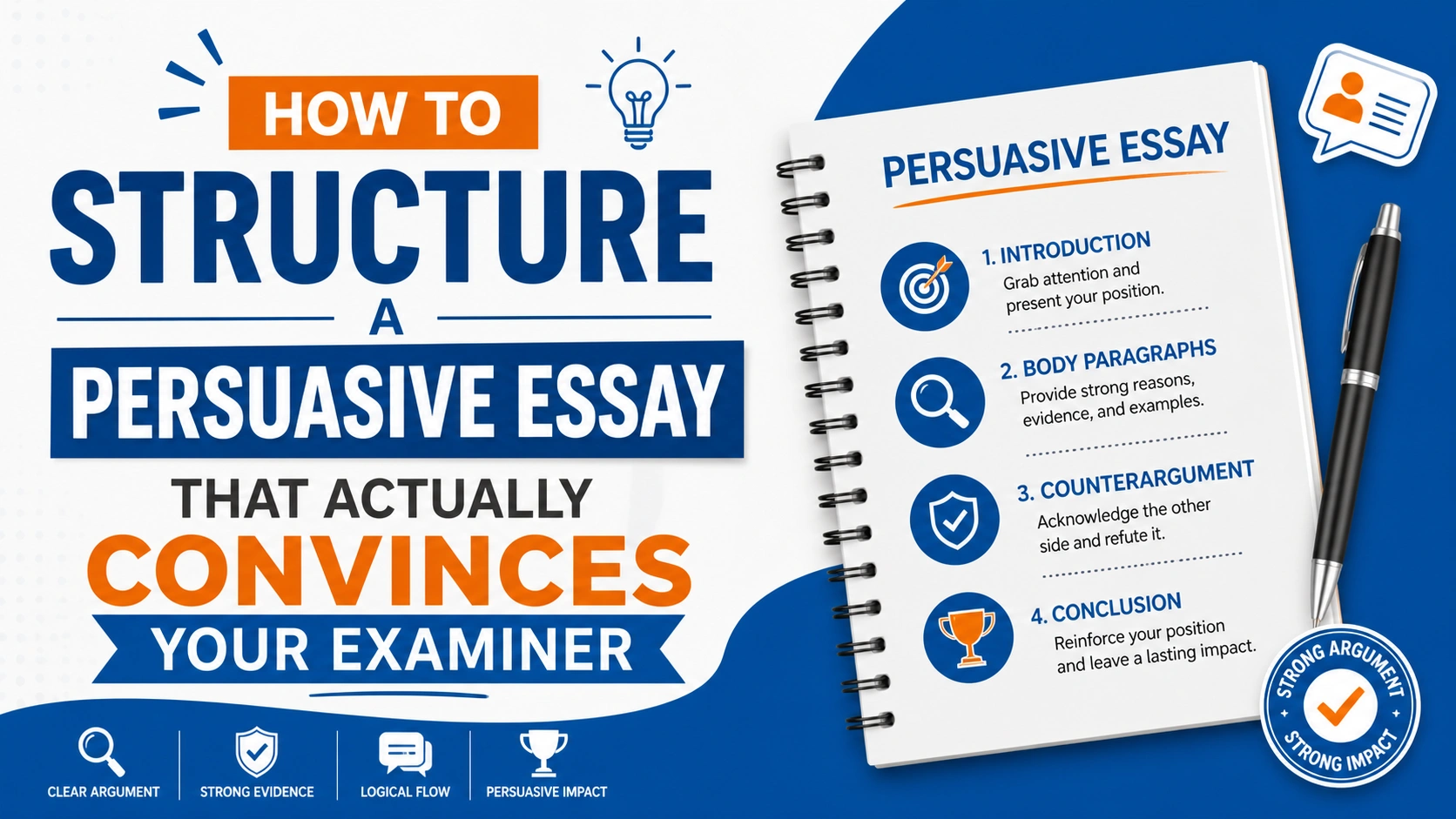
A persuasive essay typically follows this structure: introduction (hook + thesis), body paragraphs (arguments with evidence), counter-argument, and conclusion.
What makes a persuasive essay effective?
An effective persuasive essay uses clear arguments, strong evidence, logical flow, and a confident tone to convince the reader.
What is a thesis statement in a persuasive essay?
The thesis statement is the main argument of your essay. It clearly states your position and outlines the key points you will use to support it.
How many paragraphs should a persuasive essay have?
Most persuasive essays have 5–6 paragraphs, but longer essays can include more, depending on the depth of arguments and counter-arguments.
Why is the counter-argument important?
Including a counter-argument shows critical thinking and strengthens your position by addressing and refuting opposing views.
What is the PEEL method in persuasive writing?
PEEL stands for Point, Evidence, Explanation, and Link. It helps structure body paragraphs clearly and logically.
What are common mistakes in persuasive essays?
Common mistakes include:
Weak or vague thesis
Lack of evidence
Poor paragraph structure
Ignoring counter-arguments
Repeating ideas without analysis