Academic writing requires you to engage with sources — to read, understand, and integrate the ideas of others into your own argument. Two of the most essential tools for doing this are paraphrasing and summarising. Yet many students conflate the two, or misuse one where the other is more appropriate. Understanding the distinction between paraphrasing and summarising — and knowing when to deploy each — is a foundational academic writing skill that will serve you throughout your education.
What is Paraphrasing?
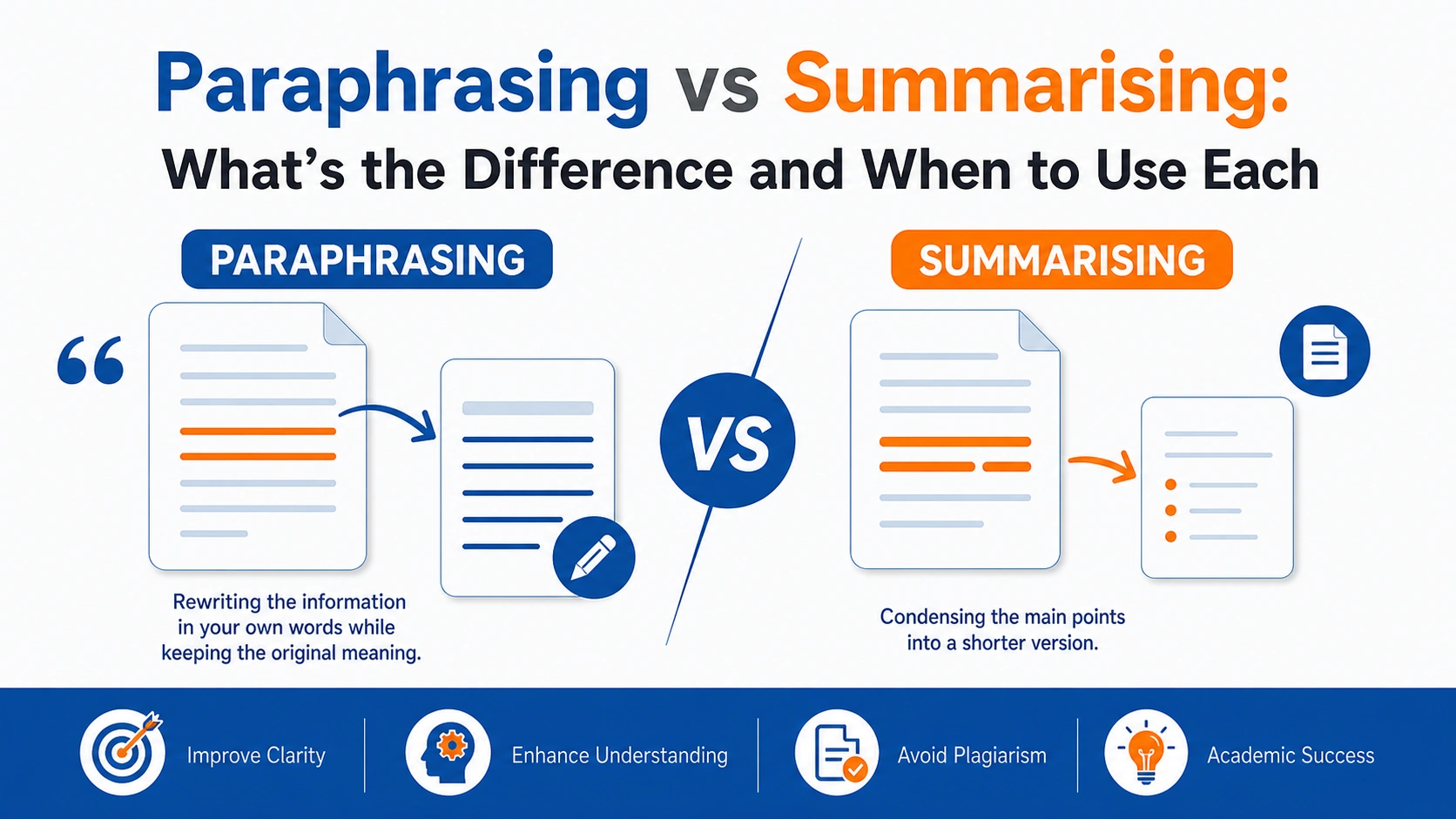
Paraphrasing means restating someone else’s ideas in your own words, staying close to the original text in scope and detail. When you paraphrase, you are not compressing or selecting — you are translating. You cover roughly the same amount of information as the original passage, but you rewrite it entirely in your own language and sentence structure.
A good paraphrase demonstrates to your reader (and your marker) that you have genuinely understood the source material. It shows comprehension, not just copying. It must also be accompanied by a citation, because even though the words are yours, the ideas belong to the original author.
Example of Paraphrasing
Original text: ‘Social media platforms have fundamentally altered the way in which political information is disseminated, allowing for the rapid spread of both accurate reporting and deliberate misinformation across global populations.’ (Mitchell, 2021, p. 89)
Paraphrase: The rise of social media has transformed how political content circulates, enabling both reliable journalism and false information to reach worldwide audiences far more quickly than before (Mitchell, 2021, p. 89).
Notice that the paraphrase covers the same territory as the original — the transformation of political information dissemination by social media, and the dual nature of this change — but the sentence structure, vocabulary, and phrasing are entirely different.
What Paraphrasing is Not
A common mistake is to paraphrase by changing only a few words — swapping synonyms while keeping the same sentence structure. This is called ‘patchwriting,’ and it is considered a form of plagiarism by most institutions. Compare:
Original: ‘Social media platforms have fundamentally altered the way in which political information is disseminated.’
Poor paraphrase (patchwriting): ‘Social networking sites have basically changed the manner in which political content is shared.’
This is not an acceptable paraphrase. The sentence structure is identical; only individual words have been changed. A genuine paraphrase requires rewriting from your own understanding of the idea.
What is Summarising?
Summarising means condensing a longer text — an article, a chapter, a book, a report — into a much shorter overview of its main points. A summary is broader and shorter than a paraphrase. It does not attempt to cover every detail but extracts the essential argument or findings, presenting them concisely.
When you summarise, you are exercising a different skill from paraphrasing: you must identify what is central and what is peripheral, decide what to include and what to leave out, and compress a large volume of information into a small space.
Like paraphrasing, a summary must be attributed to the original source with a citation.
Example of Summarising
Original source: A 12-page journal article arguing that social media has democratised political discourse by giving voice to marginalised groups, while simultaneously enabling the spread of misinformation and creating echo chambers that reinforce existing beliefs, with detailed analysis of five case studies across three continents.
Summary: Mitchell (2021) argues that social media has had contradictory effects on political discourse — empowering previously marginalised voices while also accelerating the spread of misinformation and entrenching political polarisation.
A full twelve-page article has been distilled into two lines capturing its essential argument. The reader understands the source’s position without needing to know every detail.
Key Differences at a Glance
- Length: Paraphrase is similar in length to the original passage; summary is significantly shorter.
- Coverage: Paraphrase covers all or most of the details in a passage; summary covers only the main points.
- Purpose: Paraphrase is used to engage closely with specific claims; summary is used to represent a whole work or section.
- Depth: Paraphrase goes into detail; summary stays at a high level.
- Source text: Paraphrase works from a short passage; summary works from a longer text.
When to Use Paraphrasing
Paraphrasing is most useful when you need to engage closely with a specific argument, piece of evidence, or claim. Use it when:
- You want to discuss a particular idea or finding in detail and apply it directly to your argument.
- The original passage contains an important claim that you want to analyse or critique.
- You want to show your reader you have understood a specific concept deeply enough to restate it in your own words.
- A direct quote would be too long or would interrupt the flow of your writing.
- You need to adapt the language level or technical terminology for your reader.
Paraphrasing is especially useful in disciplines like science, psychology, and social sciences where evidence is frequent and specific, and where you are expected to integrate sources fluidly rather than rely on direct quotation.
When to Use Summarising
Summarising is most useful when you need to give your reader an overview of a source rather than focus on a specific detail. Use it when:
- You are giving background or context by referring to a body of research.
- You need to establish what a particular author’s overall argument is before critiquing it.
- You are comparing the positions of multiple scholars and need to represent each concisely.
- A source supports your argument in a general sense, but you do not need to engage with its specifics.
- You are writing a literature review and need to cover many sources efficiently.
In a literature review, for example, you might summarise ten articles in a paragraph to establish the state of a field. You would only paraphrase when focusing on a specific claim from a single source.
When to Use Direct Quotation Instead
Both paraphrasing and summarising are generally preferred to direct quotation in academic writing. Direct quotes should be reserved for cases where the exact wording matters — for example, when analysing a literary text, when a definition or legal statement must be reproduced precisely, or when the original phrasing is so distinctive that paraphrasing would diminish it.
Over-reliance on direct quotation suggests you cannot process and restate ideas in your own words — a core academic skill. Aim for your own words in the vast majority of cases, using quotation sparingly.
How to Paraphrase Well: A Step-by-Step Process
- Read the original passage carefully until you understand it fully.
- Put the original away and do not look at it as you write.
- Write your paraphrase from memory, in your own words.
- Compare your version to the original. Check that you have not accidentally reproduced the sentence structure or too many of the same phrases.
- Add your citation.
The ‘put it away’ step is crucial. If the original text is in front of you as you write, you will be tempted to borrow its phrasing — sometimes without realising you are doing so.
How to Summarise Well: A Step-by-Step Process
- Read the full source (or section) carefully.
- Identify the main argument or thesis.
- Note the key supporting points — not the details, but the structure of the argument.
- Write a summary in your own words that captures the main argument and key points without unnecessary detail.
- Add your citation (typically at the end of the summary).
Avoiding Plagiarism When Paraphrasing and Summarising
The most important thing to remember: paraphrasing and summarising are not plagiarism-free by default. If you restate someone else’s ideas without citing them, that is still plagiarism — even if you used your own words.
Always cite when you paraphrase or summarise. The citation is what distinguishes legitimate academic engagement from plagiarism.
Many plagiarism detection tools (such as Turnitin) will also flag paraphrases if the sentence structure is too similar to the original, even if the words differ. Genuine paraphrasing — where the idea is understood and truly rewritten — protects you from this.
Final Words
Paraphrasing and summarising are two of the most important tools in your academic writing kit. Paraphrasing helps you engage closely with specific claims and demonstrate deep understanding, while summarising allows you to represent larger bodies of work efficiently and build context for your reader.
Neither is inherently superior to the other — they serve different purposes. The key is knowing which tool the moment calls for, deploying it well, and always citing your sources, regardless of which technique you use. Practising both regularly will make your academic writing more fluent, more credible, and more intellectually honest.
FAQs (Frequently Asked Questions)
Q1: Is paraphrasing the same as plagiarism?
No, when done correctly and with a citation. Plagiarism occurs when you present someone else’s ideas as your own without acknowledgement. A properly cited paraphrase is a legitimate and encouraged academic practice. However, patchwriting — changing only a few words while retaining the original structure — is considered a form of plagiarism.
Q2: How long should a paraphrase be compared to the original?
A paraphrase is typically similar in length to the original passage — it might be slightly shorter or slightly longer, but it covers the same level of detail. If your version is much shorter, you have likely summarised instead.
Q3: Do I need a page number when I paraphrase?
In APA and MLA, page numbers for paraphrases are optional but encouraged for precision. In Harvard, page numbers are recommended when paraphrasing a specific passage. For summaries of an entire work, a page number is not needed. Always follow your specific style guide.
Q4: Can I summarise my own writing?
Yes. When writing a conclusion or an abstract, you are essentially summarising your own essay or paper. This is expected and appropriate — no citation is needed because you are the author.
Q5: How do I know if my paraphrase is too close to the original?
A useful test: read your paraphrase, then read the original. If someone could tell which sentence came from which just by comparing vocabulary and structure, your paraphrase is too close. Aim for a version that sounds entirely like your own voice while accurately representing the original idea.