
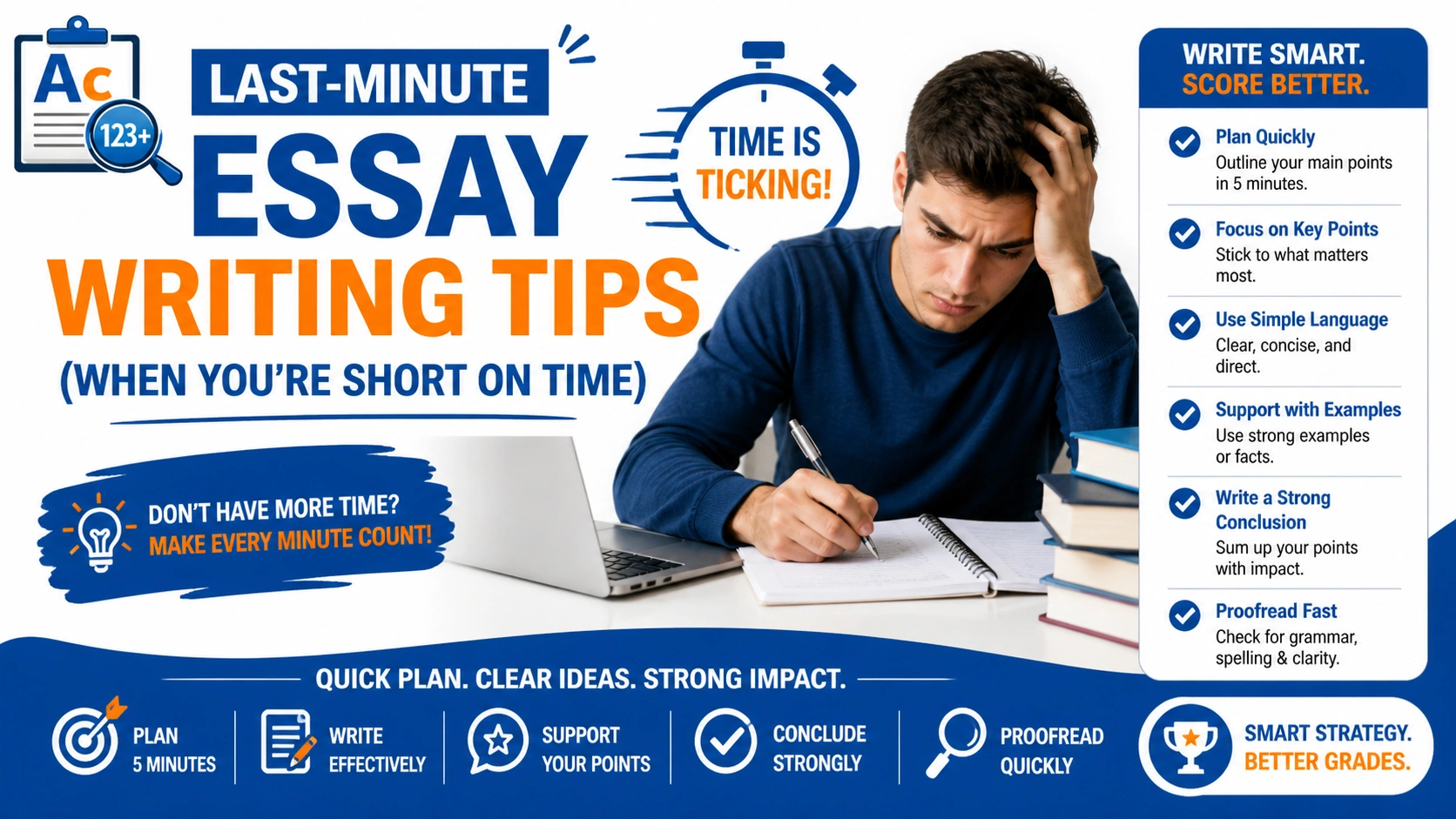
We have all been there. The deadline is looming — perhaps tomorrow morning, perhaps tonight — and the essay is either unstarted, half-finished, or nowhere near where it needs to be. Panic sets in, focus evaporates, and the temptation to do almost anything other than write becomes overwhelming.
The good news is that writing a solid essay under time pressure is absolutely possible. It requires a different mindset, a stripped-back strategy, and ruthless prioritisation. This guide will walk you through everything you need to know to produce your best possible work when time is your scarcest resource.
First: Do Not Panic — Prioritise
The first and most important step is to pause and take a breath. Panic is the enemy of productive writing. When you are anxious, your thinking becomes narrow and reactive — you either freeze or jump randomly between tasks without finishing any of them.
Before you type a single word, spend five to ten minutes getting organised. This is not wasted time — it is the investment that makes everything else faster.
Ask yourself:
- Exactly how many hours do I have?
- What does the essay require (word count, format, number of sources)?
- What do I already know or have available?
- What is the most important thing the marker is looking for?
Once you have answers, you can build a realistic plan. A plan, even a rough one, transforms a terrifying blank page into a series of manageable steps.
Understand the Question Before Anything Else
This is a step many time-pressured students skip — and it is the most costly mistake you can make. Writing 1,500 words that do not address the question is far worse than writing 1,000 words that do. No amount of polished prose or impressive vocabulary will compensate for a fundamental failure to answer what was asked.
Take five minutes to closely read the essay question. Identify the command word — ‘analyse,’ ‘evaluate,’ ‘discuss,’ ‘compare,’ ‘explain’ — and understand what it is asking you to do. Underline the key topic terms. Make sure you know exactly what the scope of the essay is.
Write the question at the top of your document and keep it visible as you write. Refer back to it after every paragraph to ensure you are staying on track.
Plan Your Essay — Even If It Takes 15 Minutes
When time is short, planning feels like a luxury you cannot afford. This is backwards thinking. A brief, clear plan makes your writing faster, more focused, and better structured. Without a plan, you will spend far longer staring at the screen wondering what to write next.
Your plan does not need to be elaborate. For most essays, a simple structure works:
- Introduction: State your thesis and briefly outline your main points.
- Body Paragraph 1: First main point with evidence and analysis.
- Body Paragraph 2: Second main point with evidence and analysis.
- Body Paragraph 3: Third main point (or counter-argument and response).
- Conclusion: Summarise the argument and answer the question directly.
Spend 10-15 minutes jotting down what you will say in each section. Even bullet points are enough. The act of planning forces you to think through your argument before you commit it to prose, which dramatically reduces the amount of rewriting needed.
Build a Strong Thesis First
Everything in your essay flows from your thesis — your central argument or claim. If your thesis is unclear, your essay will be unfocused. If your thesis is clear and specific, your essay almost writes itself.
A good thesis is not a statement of fact (which requires no argument) or a vague generalisation. It is a specific, debatable position that your essay will prove or defend.
Weak thesis: ‘Climate change is an important issue.’
Strong thesis: ‘Government subsidies for fossil fuel industries represent the single greatest barrier to meaningful climate action in developed economies.’
The strong thesis tells the reader exactly what position the essay takes and what it will argue. Every paragraph should contribute to proving or exploring that claim.
Write the Introduction Last (or Write a Placeholder)
Counterintuitively, the introduction is often the hardest part to write at the beginning, because you have not yet fully articulated your argument. Many professional writers write the introduction last for this reason.
When you are pressed for time, write a short placeholder introduction — two or three sentences stating the topic and a rough version of your thesis — and come back to it later. Get straight into your body paragraphs where you can build momentum. Once your essay is drafted, you will know exactly what your introduction needs to say.
Write Fast, Edit Later
The biggest time-waster in essay writing is trying to write perfectly on the first pass. Perfectionists often spend twenty minutes crafting a single sentence, only to delete it anyway during revision.
Give yourself permission to write badly at first. Set a timer and write as much as you can in that time without stopping to re-read or edit. Get your ideas on the page. A messy, rough draft that exists is infinitely more useful than a perfect draft that does not.
Once you have a complete draft — even a rough one — editing becomes a process of improvement rather than creation. That is a much less daunting task.
Use the PEEL Paragraph Structure
When time is tight, a reliable paragraph formula saves mental energy. PEEL is one of the most widely used and effective:
- Point: State the main point of the paragraph in a clear topic sentence.
- Evidence: Provide a supporting quote, statistic, or reference.
- Explanation: Explain what the evidence means and how it supports your point.
- Link: Connect the paragraph back to your thesis or forward to the next point.
Each paragraph should be self-contained and purposeful. If you can summarise what each paragraph does in one sentence, your essay has clear structure. If you cannot, the paragraph probably needs work.
Work With What You Have
When time is short, there is no opportunity for extensive reading. Do not attempt to read entire books or articles — use what you already know and supplement strategically.
Go through your lecture notes, seminar readings, and any annotated texts you already have. These are gold. You attended those classes; you engaged with that material; you are allowed to draw on it.
For any additional sources, use abstracts and conclusions first. The abstract tells you what a paper argues; the conclusion tells you what it found. If either is relevant to your essay, note the reference and use the source carefully.
Do not use sources you have not read. Misrepresenting a source is academically dishonest, and it will show in your writing. Use fewer sources well rather than many sources poorly.
Quality Over Quantity
If you are running out of time, do not pad your essay with filler sentences to reach the word count. Markers notice waffle immediately — it wastes their time and signals to them that you do not have enough to say. It rarely helps your grade.
Instead, focus on developing the points you do have more thoroughly. Add more analysis, engage more critically with your evidence, or develop your conclusion more fully. Three paragraphs with genuine insight are worth far more than five paragraphs of thin generality.
Most marking schemes reward critical thinking and argument quality far more heavily than sheer volume.
Manage Your Time in Blocks
If you have, for example, six hours to complete an essay, consider dividing the time something like this:
- 30 minutes: Read the question carefully, plan your essay, identify your thesis and main points.
- 15 minutes: Gather sources and note key evidence for each paragraph.
- 3 hours 30 minutes: Write the full draft (introduction, body paragraphs, conclusion).
- 1 hour: Edit for clarity, argument, and paragraph structure.
- 30 minutes: Proofread for grammar, spelling, and citation errors.
- 15 minutes: Format check — word count, font, spacing, references.
Adapt these proportions to your situation, but always preserve time for at least one editing pass. An unedited draft submitted under panic is rarely your best work.
Take Short Breaks
This seems counterintuitive when you are in a hurry, but a completely exhausted brain is a slow and error-prone brain. A five-minute break every hour — standing up, walking around, making a drink — is not wasted time. It restores concentration, prevents burnout, and often unlocks thinking that was blocked.
Avoid going on social media during breaks. Five minutes of scrolling very easily becomes forty. Set a timer, step away from your screen, and come back.
Cite as You Write
One of the biggest time sinks in last-minute essay writing is assembling citations at the end. You have written the essay; now you have to go back through every claim and work out which source it came from. This is chaotic and error-prone.
Instead, add citations as you write, even if they are approximate or in a placeholder format. Write (Smith 2020) as you draft the sentence that uses the claim. Then, at the final stage, you simply need to check and format the citation correctly rather than hunt for where it came from.
Build your reference list simultaneously. Every time you use a source, add it to the bottom of your document. This saves enormous time at the end.
What to Do in the Final Hour
If you have one hour left and the essay is drafted, use your time like this:
- Read through once quickly for obvious errors and missing argument.
- Check every paragraph has a clear topic sentence.
- Check your introduction states the thesis and your conclusion answers the question.
- Scan all in-text citations are present and correctly formatted.
- Check your reference list is complete.
- Run spell check — but do not rely on it alone; read through the final version yourself.
- Double-check word count and formatting requirements.
- Save and submit.
After the Essay: Learn for Next Time
Once the immediate crisis is over, take a moment to reflect. How did you end up in this situation? Was it poor time management, unclear assignment requirements, difficulty with the topic, or something else? Understanding the cause is the first step to preventing it next time.
Build a system: when you receive an assignment, immediately calculate how much time you have and divide it into stages — reading, planning, drafting, editing. Block out those stages in your calendar. Submit drafts to tutors or writing centres for early feedback where possible.
The students who consistently produce strong work are rarely more talented than their peers — they are more organised.
Final Words
Writing an essay under time pressure is stressful, but it does not have to be disastrous. With the right approach — calm prioritisation, a clear plan, a focused thesis, efficient drafting, and even a brief revision pass — you can produce work you are genuinely proud of, even on a tight deadline.
The strategies in this guide are not shortcuts or tricks. They are efficient versions of what good writers do anyway. When time is short, you simply do not have the luxury of being disorganised. Use the pressure as a catalyst for focus, work strategically rather than frantically, and trust that the skills you have built will carry you through.
And the next time you get an assignment brief, start early.
FAQs (Frequently Asked Questions)
Q1: Is it possible to write a good essay in one night?
Yes, if you use your time strategically. A focused, well-planned essay written in eight hours can be genuinely strong. The key is to spend adequate time on planning and argument development rather than simply writing as much as possible as fast as possible. Quality of argument matters more than quantity of prose.
Q2: Should I pull an all-nighter?
Generally, no. Sleep deprivation significantly impairs cognitive function, creativity, and proofreading ability. Writing at 3am when you are exhausted produces worse work than writing for six concentrated hours and sleeping for five. If the deadline is the following afternoon, sleep if you can and finish in the morning.
Q3: How do I stop procrastinating when I am already behind?
Start with the smallest possible action: open a new document and write the essay title. Then write one sentence. Procrastination thrives on the idea that you need to be in the perfect state before you begin. You do not. Starting — even badly — breaks the inertia. Use the Pomodoro technique: work for 25 minutes, rest for 5, repeat.
Q4: What if I genuinely do not understand the question?
If you have any time at all, email your lecturer or tutor. Briefly explain that you want to confirm your understanding of the question. Most tutors would rather clarify than mark an irrelevant essay. If you cannot reach anyone, use the exact wording of the question to guide you — every word in an essay question is deliberate.
Q5: Is it acceptable to ask for an extension?
Yes, in many institutions, extensions are available for legitimate reasons such as illness, bereavement, or serious personal circumstances. Check your institution’s policy, contact your tutor or academic administrator as early as possible, and provide documentation if required. Most institutions respond more sympathetically to early requests than to requests submitted at 11:59pm on the due date.