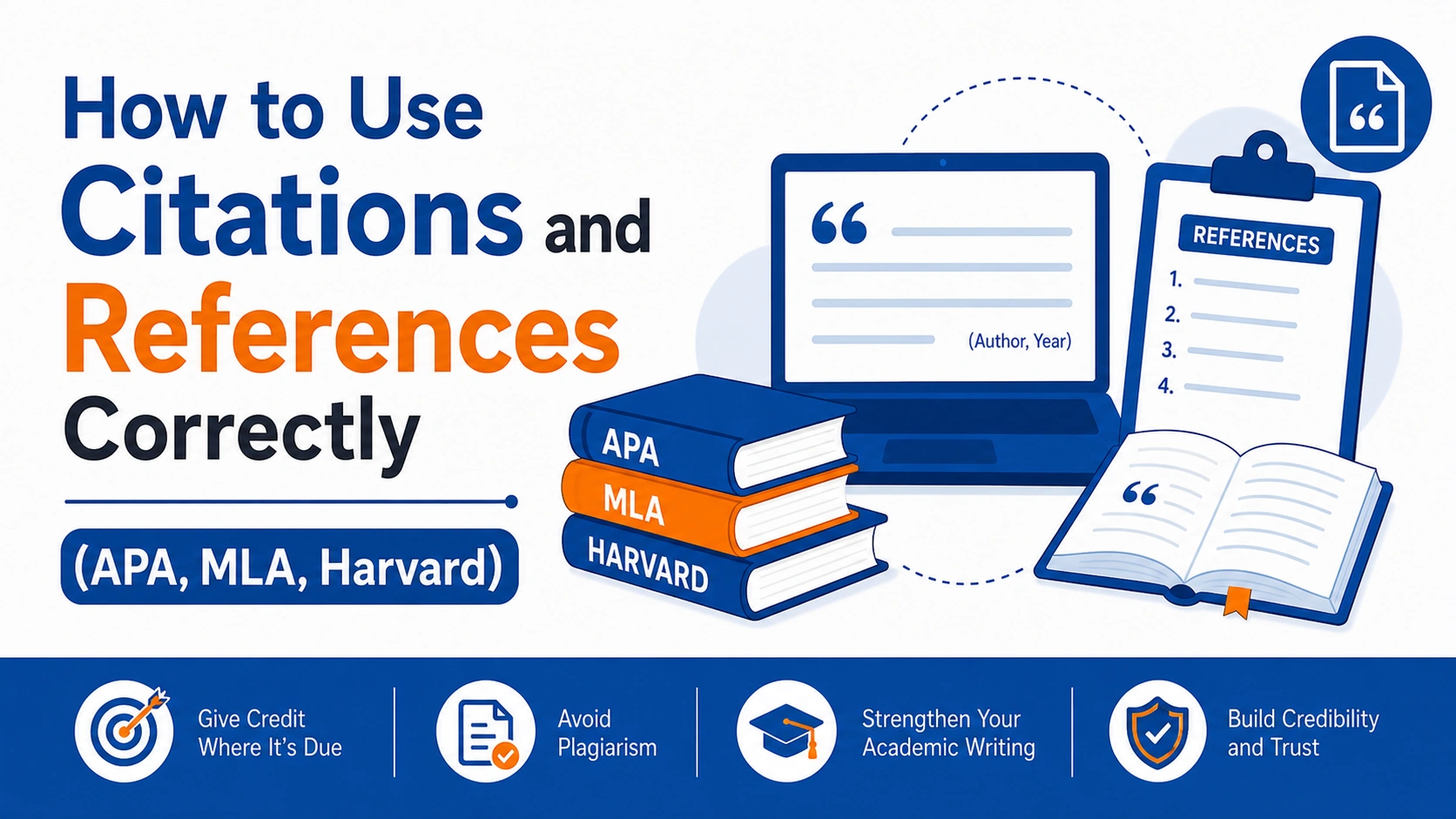
Whether you are writing an academic essay, a research paper, or a dissertation, one of the most important skills you need to master is citation. Citations are not just a formality, they are the academic world’s way of giving credit where credit is due, avoiding plagiarism, and allowing readers to trace your intellectual journey. Knowing how to use citations and references correctly is fundamental to your credibility as a writer and researcher.
This guide walks you through three of the most widely used citation styles, APA (American Psychological Association), MLA (Modern Language Association), and Harvard, explaining their structure, when to use them, and providing practical examples so you can apply them confidently in your own work.
Why Citations Matter
Before diving into the mechanics, it is worth understanding why citations exist. When you write academically, you are entering a long-running scholarly conversation. Citations acknowledge the voices of other scholars, demonstrate that your argument is grounded in research, and protect you from accusations of plagiarism. They also serve your reader, who may want to consult the sources you used.
Failing to cite correctly, even accidentally, can have serious consequences in academic settings, including failed assignments, loss of marks, or in severe cases, academic misconduct proceedings. Mastery of citation style is, therefore, not optional.
APA Style (American Psychological Association)
APA style is predominantly used in the social sciences, including psychology, education, sociology, and nursing. It emphasises the date of publication, which makes sense for fields where the recency of research is especially important.
In-Text Citations in APA
APA uses an author-date format for in-text citations. The basic format is:
(Author’s Last Name, Year of Publication)
Example: Research suggests that sleep deprivation significantly affects cognitive performance (Walker, 2018).
If you name the author in your sentence, place the year immediately after their name:
Walker (2018) argues that sleep deprivation significantly affects cognitive performance.
For direct quotations, you must also include the page number:
(Walker, 2018, p. 45)
When a source has two authors, include both names every time:
(Smith & Jones, 2020)
For three or more authors, use the first author’s name followed by ‘et al.’ from the first citation:
(Brown et al., 2019)
Reference List in APA
APA places a reference list at the end of the document. Entries are listed alphabetically by the author’s surname. Here is the format for common source types:
Book: Author, A. A. (Year). Title of work: Capital letter also for subtitle. Publisher.
Example: Walker, M. (2018). Why we sleep: Unlocking the power of sleep and dreams. Scribner.
Journal Article: Author, A. A., & Author, B. B. (Year). Title of article. Title of Periodical, volume(issue), page range. DOI or URL
Example: Brown, T., Smith, J., & Lee, P. (2019). The effects of caffeine on alertness. Journal of Sleep Research, 28(3), 112-120. https://doi.org/10.xxxx
Website: Author, A. A. (Year, Month Day). Title of page. Site Name. URL
Common APA Mistakes
- Forgetting the DOI or URL for journal articles
- Using the full date in the reference list for non-periodicals (only year is needed for books)
- Capitalising every word in a book title (only the first word and proper nouns are capitalised)
- Placing the reference list on a separate page but forgetting to title it ‘References’
MLA Style (Modern Language Association)
MLA is most commonly used in the humanities, particularly literature, language studies, and cultural studies. Unlike APA, MLA focuses on the author and the page number of the source, not the date.
In-Text Citations in MLA
MLA uses parenthetical citations with the author’s last name and page number:
(Author’s Last Name Page Number), with no comma between them.
Example: The novel explores the tension between individual desire and social expectation (Austen 134).
If you mention the author in the sentence, only the page number is needed in parentheses:
Austen explores the tension between individual desire and social expectation (134).
For sources without page numbers (such as websites), use only the author’s name:
(Smith)
For a source with no author, use a shortened version of the title in italics or quotation marks:
(“Understanding Climate Change” 3)
Works Cited Page in MLA
MLA uses a ‘Works Cited’ page at the end of the document. Entries follow a specific template with a set of core elements:
Author. Title of Source. Title of Container, Other contributors, Version, Number, Publisher, Publication Date, Location.
Book Example: Austen, Jane. Pride and Prejudice. Penguin Classics, 2002.
Journal Article Example: Garcia, Elena. “Memory and Identity in Postcolonial Fiction.” Journal of Literary Studies, vol. 44, no. 2, 2021, pp. 78-95.
Website Example: Smith, John. “The Ethics of AI.” TechReview, 15 Mar. 2023, www.techreview.com/ethics-ai.
Common MLA Mistakes
- Including a comma between the author’s name and the page number in parenthetical citations
- Forgetting to italicise book and journal titles
- Using abbreviations like ‘p.’ for page (MLA does not use them in in-text citations)
- Not double-spacing the Works Cited page
Harvard Style
Harvard referencing is widely used across UK universities and is common in business, economics, and the natural sciences. Like APA, it uses an author-date system, but there are subtle formatting differences.
In-Text Citations in Harvard
Harvard citations use the author’s last name and the year in parentheses:
(Author’s Last Name Year)
Example: Consumer behaviour is heavily influenced by social media advertising (Johnson 2022).
With a page number for direct quotes:
(Johnson 2022, p. 34)
For two authors: (Smith and Jones 2021)
For three or more authors: (Brown et al. 2020)
Note the key difference from APA: Harvard does not use an ampersand (&), it uses ‘and’ even within parentheses.
Reference List in Harvard
Harvard uses a ‘Reference List’ or ‘Bibliography’ at the end. Formatting differs slightly by institution, but the standard structure is:
Book: Author’s Last Name, First Initial. (Year) Title of Book. Place of Publication: Publisher.
Example: Johnson, R. (2022) Digital Marketing Strategies. London: Routledge.
Journal Article: Author’s Last Name, First Initial. (Year) ‘Title of article’, Journal Name, Volume(Issue), pp. page range.
Example: Brown, A., Smith, C. and Lee, T. (2020) ‘The influence of algorithms on news consumption’, Media Studies Quarterly, 15(2), pp. 45-62.
Website: Author or Organisation (Year) Title of page [Online]. Available at: URL (Accessed: Day Month Year).
Common Harvard Mistakes
- Using an ampersand (&) instead of ‘and’ between multiple authors
- Inconsistent punctuation, the exact punctuation rules in Harvard vary by institution, so always check your specific guidelines
- Forgetting the access date for websites
- Not placing the edition in parentheses after the title for a later edition
Choosing the Right Citation Style
The citation style you use is usually dictated by your institution, your department, or your tutor. If you are uncertain, always ask. Never assume. Here is a quick reference:
- APA: Psychology, Education, Social Sciences, Nursing
- MLA: Literature, Languages, Humanities
- Harvard: Business, Economics, Sciences, UK institutions broadly
Some disciplines use other styles, for example, Chicago style is common in history, and Vancouver style is used in medicine. Always confirm with your lecturer or the assignment brief.
Tools to Help You Cite Correctly
While understanding the principles of each citation style is essential, several tools can assist you:
- Zotero: A free reference management tool that auto-generates citations and reference lists in multiple styles.
- Mendeley: Similar to Zotero, popular in STEM fields.
- Cite This For Me / EasyBib: Web-based tools for quick citation generation.
- Microsoft Word’s built-in citations tool: Useful for smaller projects.
Use these tools as a convenience, but always double-check the output against your style guide, automated tools are not always perfectly accurate.
Final Advice
Mastering citation and referencing is a non-negotiable aspect of academic writing. Whether you use APA, MLA, or Harvard, the key principles are the same: acknowledge your sources, provide enough detail for your reader to find them, and be consistent throughout your work. Each style has its own logic, and once you understand that logic, the formatting becomes second nature.
Take the time to learn the style required by your institution, practise applying it in your work, and use reference management tools to support, not replace, your understanding. Academic integrity begins with correct citation.
Frequently Asked Questions (FAQs)
Q1: Do I need to cite everything I write?
No. You do not need to cite common knowledge (e.g., ‘the Earth orbits the Sun’), your own original ideas, or analysis you have developed yourself. However, any fact, claim, quote, statistic, or idea that comes from another source must be cited.
Q2: What is the difference between a reference list and a bibliography?
A reference list (used in APA and Harvard) includes only the sources cited in your text. A bibliography (often used in MLA and some Harvard contexts) may include sources you consulted but did not directly cite.
Q3: Can I use the same source multiple times?
Yes. You can cite the same source as many times as needed in-text. In your reference/works cited list, however, it only appears once.
Q4: What if there is no author listed?
Use the title of the work in place of the author’s name. In APA, this goes in the author position in the reference list. In MLA, use a shortened version of the title in the in-text citation.
Q5: Is it plagiarism if I cite incorrectly?
Incorrect citation is generally treated as poor academic practice rather than intentional plagiarism, though this depends on your institution’s policies. However, failing to cite at all, whether deliberate or not, is typically considered plagiarism. When in doubt, cite.