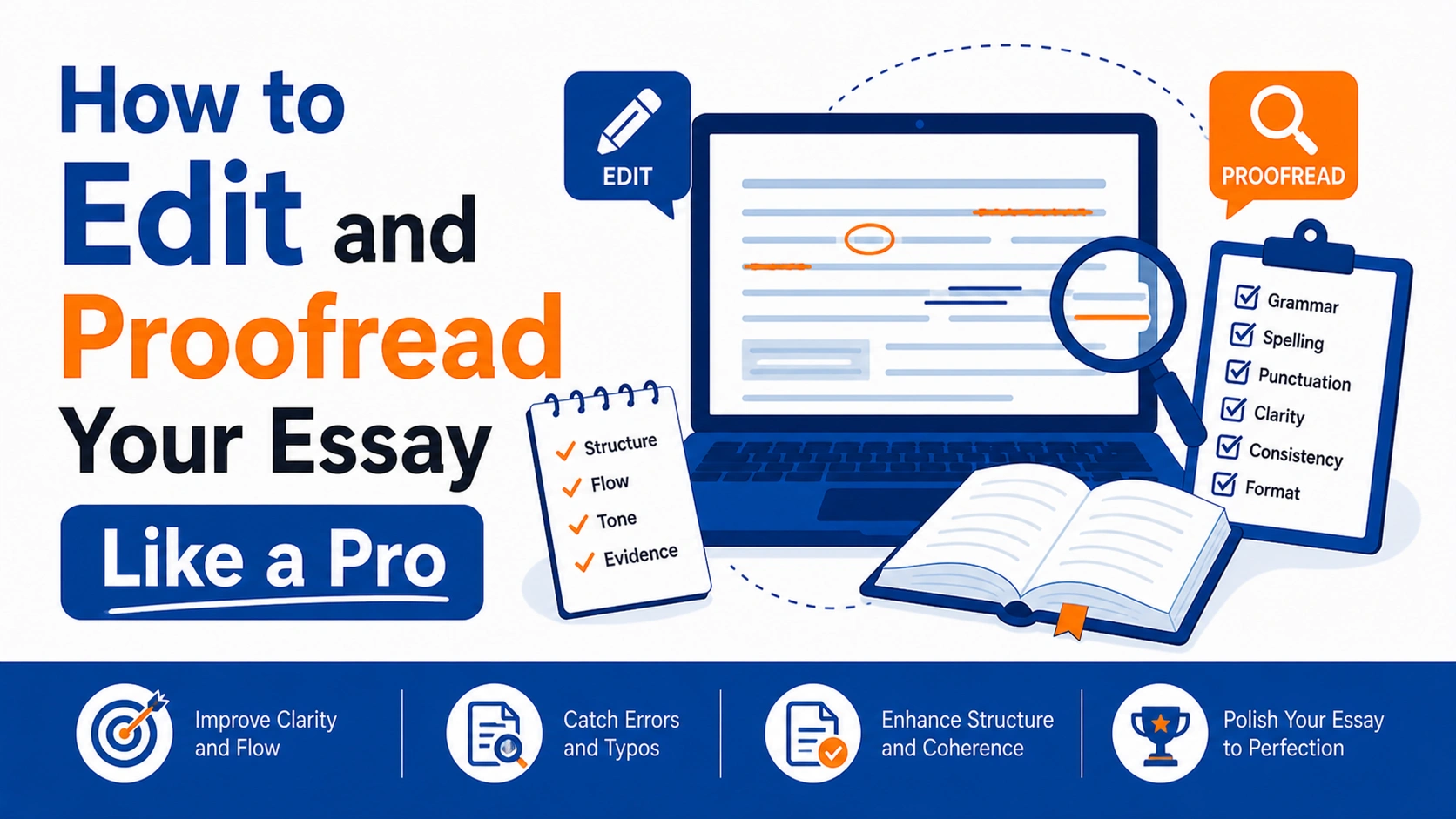
Writing the first draft of your essay is only the beginning. The real quality of your work emerges in the editing and proofreading stage — a stage that many students rush through or skip entirely. Professional writers know that polished writing is rewritten writing, and the difference between a mediocre essay and an excellent one often lies not in the ideas, but in how carefully those ideas have been refined and presented.
This guide will walk you through a professional, systematic approach to editing and proofreading your essay, covering everything from big-picture structural concerns to the smallest grammatical details.
Understanding the Difference Between Editing and Proofreading
Before diving into techniques, it is important to understand that editing and proofreading are two distinct processes, and they should be treated separately.
Editing is the big-picture process. It involves looking at the overall structure and flow of your essay — does your argument make sense? Are your paragraphs organised logically? Is your thesis clearly supported? Editing may involve moving, rewriting, or removing entire sections.
Proofreading is the detail-level process. It comes after editing and focuses on surface-level errors — spelling mistakes, grammatical errors, punctuation problems, and formatting inconsistencies. Proofreading is about polishing what is already structurally sound.
Never proofread before you edit. If you fix typos in a paragraph that you later decide to delete entirely, you have wasted time. Always work from large to small.
Step 1: Take a Break Before You Begin
One of the most underrated pieces of advice in academic writing is to step away from your work before reviewing it. When you have just finished writing, your brain is still filled with what you intended to say rather than what you actually wrote. You will miss errors, skip over weak arguments, and fail to see gaps in your reasoning because your mind fills them in automatically.
Ideally, leave your essay for at least one night before editing. Even a few hours can make a significant difference. When you return with fresh eyes, you will read what is on the page rather than what you think is on the page.
Step 2: Read for Structure and Argument
Your first editing pass should focus entirely on the macro level. Ignore spelling and grammar for now. Read through the whole essay and ask yourself:
- Does my introduction clearly state my thesis or central argument?
- Does each paragraph have a clear topic sentence that relates to the thesis?
- Does each paragraph contain evidence and analysis — not just summary?
- Does my argument flow logically from one paragraph to the next?
- Does my conclusion summarise the argument without introducing new ideas?
- Are there any paragraphs that feel out of place or redundant?
Consider creating a reverse outline at this stage. Read each paragraph and write one sentence summarising its main point. Then review those sentences in sequence. If they do not form a coherent, logical progression, your structure needs work.
Step 3: Check Your Argument and Evidence
Once you are satisfied with the structure, look more closely at the quality of your argumentation. Strong academic essays do not just present information — they analyse it, interpret it, and use it to support specific claims.
For each piece of evidence you present, ask:
- Have I introduced this source clearly?
- Have I explained what it says?
- Have I explained why it matters to my argument?
- Have I cited it correctly?
The common weakness in student essays is over-quoting without analysis — simply presenting what a source says without explaining its significance. If you find stretches of your essay where quotes outnumber your own words, revise those sections to add more analytical commentary.
Step 4: Check for Clarity and Concision
Academic writing should be clear and precise, not unnecessarily complex. This is a stage where many students struggle — there is a tendency to believe that longer, more complicated sentences signal intelligence. In fact, the opposite is often true. Your marker is not impressed by sentences that are difficult to parse; they are looking for clear, well-reasoned thought.
As you edit for clarity, watch out for:
- Unnecessarily long sentences — break them up
- Passive voice overuse — prefer active constructions where possible
- Vague language — words like ‘this,’ ‘it,’ ‘things,’ and ‘various’ are often lazy; replace them with specific terms
- Repetition — have you said the same thing twice in different words?
- Jargon without explanation — if you use technical terms, ensure they are defined or contextualised
Step 5: Paragraph-Level Editing
Now zoom into each paragraph individually. A well-constructed paragraph follows a clear pattern: it opens with a topic sentence, develops that point with evidence and analysis, and closes with a sentence that links back to the broader argument or transitions to the next paragraph.
Check each paragraph for:
- A clear topic sentence at the start
- Unity — does every sentence in the paragraph relate to the topic sentence?
- Development — does the paragraph go beyond surface-level description?
- A closing sentence that wraps up or connects forward
Paragraphs that are only two or three sentences are often underdeveloped. Paragraphs that stretch over a full page may need to be split.
Step 6: Sentence-Level Editing
At this stage, work sentence by sentence. Read each one carefully and ask whether it could be written more clearly or efficiently. Watch for these common problems:
- Run-on sentences: Two independent clauses joined without proper punctuation.
- Comma splices: Two independent clauses joined only by a comma — this is grammatically incorrect.
- Dangling modifiers: Phrases that refer to the wrong subject (‘Walking into the room, the lights were bright’ — the lights were not walking).
- Inconsistent tense: Pick either present or past tense for literary analysis and stick to it.
- Subject-verb agreement errors: Especially tricky with collective nouns and compound subjects.
Step 7: Proofread for Surface Errors
Now, finally, you can proofread for surface-level errors. This is distinct from editing — you are not looking at meaning anymore, just mechanics. Effective proofreading requires a different mindset and some practical techniques:
Read aloud. Reading your essay aloud forces your brain to process each word individually rather than scanning ahead. You will catch missing words, awkward phrasing, and sentences that are too long to read comfortably.
Read backwards. Start from the last sentence and read to the first. This disrupts the logical flow and forces you to look at sentences in isolation, making errors easier to spot.
Use a ruler or your finger. Physically tracking each line prevents your eyes from jumping ahead.
Print it out. Many people catch errors on paper that they miss on screen. If you can, print a copy and read it with a pen in hand.
Step 8: Check Formatting and References
Do not overlook the technical requirements of your essay. Check:
- Font, size, and line spacing match the required format
- Margins are correct
- Page numbers are included if required
- Your name, student number, and other required information are present
- All in-text citations are correctly formatted
- Your reference list/works cited page is complete, correctly formatted, and in alphabetical order
- Headings (if used) are consistently formatted
Many marks are lost not due to poor writing, but due to failure to follow formatting instructions. Always re-read the assignment brief before submitting.
Using Technology Wisely
Spell checkers and grammar tools like Grammarly, Microsoft Editor, or ProWritingAid can be helpful, but they are not infallible. They frequently miss context-specific errors (using ‘their’ when you mean ‘there’ in a phrase the tool does not flag), and they sometimes suggest incorrect changes. Use them as a first pass, not a final check.
Never rely on autocorrect or spellcheck alone. These tools catch obvious typos but will not tell you if your argument is incoherent or your citations are missing.
Get a Second Reader
One of the most effective editing strategies is to have someone else read your work. A fresh reader — a classmate, a tutor, a family member, even someone unfamiliar with your subject — will spot things you cannot see because you know too well what you meant to say. Many universities also offer writing centre services where trained staff will read and give feedback on drafts. Use these resources.
Final Advice
Editing and proofreading are not afterthoughts — they are essential stages of the writing process. By approaching your revision systematically, moving from the macro (argument and structure) to the micro (spelling and punctuation), you will catch far more errors and produce significantly better work.
Build editing time into your writing schedule from the outset. Aim to finish your first draft at least two days before the deadline, giving yourself time to step away, return with fresh eyes, and revise thoroughly. The essays that earn the highest marks are rarely first drafts — they are the result of careful, patient revision.
Frequently Asked Questions (FAQs)
Q1: How many times should I read through my essay before submitting?
Ideally, at least three times: once for structure and argument, once for clarity and sentence-level issues, and once for surface errors and formatting. Each pass serves a different purpose, and trying to do everything in one read is ineffective.
Q2: Should I edit as I write, or finish the draft first?
Finish the draft first. Editing as you write slows you down and can cause you to lose your flow. It also leads to over-polishing early sections while later sections remain rough. Write first, then edit.
Q3: Can I use AI tools to help edit my essay?
AI writing tools can help identify grammatical issues and suggest improvements to clarity. However, be cautious — many institutions have policies on AI use in assessed work. Always check your institution’s guidelines and ensure that any revisions you make are genuinely your own understanding.
Q4: What is the most common mistake students make in proofreading?
Reading too quickly and too familiar with the text. Students often read what they think they wrote rather than what is actually on the page. Strategies like reading aloud or reading backwards help counteract this.
Q5: Is it worth paying a professional editor?
For undergraduate essays, this is rarely necessary — and some institutions explicitly prohibit substantial editing assistance, treating it as academic misconduct. For longer, higher-stakes pieces like dissertations, light proofreading assistance may be permissible, but check your institution’s policy carefully.