
The research paper conclusion is often the last thing students write and, unfortunately, the last thing they think carefully about. After spending weeks or months conducting research, analyzing data, and building an argument, many writers treat the conclusion as a formality — a place to restate what they have already said before finally reaching the finish line. This approach is a costly mistake. A weak conclusion can undermine an otherwise excellent paper, while a powerful conclusion can elevate competent work to genuinely impressive scholarship.
Examiners and academic reviewers pay particular attention to the conclusion because it represents your final opportunity to demonstrate intellectual authority and to show that you understand the full significance of what you have found. A conclusion that merely summarizes the paper tells the examiner you have done the work. A conclusion that synthesizes, positions, and projects tells the examiner you understand the work. That distinction makes a real difference in assessment.
This guide explains in detail what a strong research paper conclusion must do, breaks down the key components, addresses the most common mistakes students and researchers make, and provides a practical framework for writing conclusions that leave examiners with a lasting positive impression. Whether you are writing an undergraduate paper, a master’s thesis, or a doctoral dissertation, these principles apply.
What Is the Research Paper Conclusion Actually For?
To write a strong research paper conclusion, it helps to understand its purpose clearly. The conclusion is not merely a summary of what you have already said — though it does involve briefly revisiting your main argument and findings. Its primary function is to bring your research full circle: to show how everything in the paper adds up to a meaningful, significant contribution to knowledge.
Think of your paper as an argument built from the introduction through the body. In the introduction, you posed a question and made a claim. In the body, you developed, evidenced, and defended that claim. In the conclusion, you demonstrate what answering that question means — for your field, for practice, for future research, for understanding a problem. The conclusion answers the question: so what?
Examiners often describe strong conclusions as moments of ‘arrival’ — the feeling that a long journey through evidence and analysis has reached a destination that was worth the trip. Weak conclusions, by contrast, feel like the paper simply stops rather than concludes. Creating that sense of intellectual arrival requires deliberate craft, and understanding the components of an effective conclusion is where that craft begins.
The Core Components of a Strong Research Paper Conclusion
1. Restate Your Thesis — But With Added Depth
The first move in most research paper conclusions is restating your thesis or central argument. But there is an important distinction between mechanical restatement and meaningful synthesis. Do not copy and paste your introduction’s thesis statement. Instead, restate it in light of everything you have demonstrated in the paper.
Your opening thesis was a prediction or proposition. Your conclusion’s thesis restatement is a finding — something you can now assert with the authority of the evidence and analysis you have built up across the paper. The language should shift from ‘This paper argues that…’ to ‘This paper has demonstrated that…’ The conclusion of a research paper is the first time you can speak with the full weight of your evidence behind you.
2. Synthesize Rather Than Summarize
There is a critical difference between summarizing and synthesizing, and examiners are acutely sensitive to it. Summarizing restates the main points of your paper sequentially. Synthesizing shows how those points connect to form a coherent whole that is greater than the sum of its parts.
A summary might say: ‘Chapter One examined X. Chapter Two analyzed Y. Chapter Three discussed Z.’ A synthesis would say: ‘The convergence of X, Y, and Z reveals that [central insight], which has significant implications for [field or problem].’ Synthesis demonstrates that you understand not just what each part of your paper found but what they all mean together. This is the hallmark of advanced academic thinking, and it is what separates good research paper conclusions from excellent ones.
3. Address the Significance of Your Findings
One of the most common weaknesses in research paper conclusions is the failure to adequately address significance. After presenting findings, students often simply state that the findings are ‘important’ or ‘valuable’ without explaining specifically why or for whom.
A strong conclusion articulates the significance of your findings on multiple levels. It addresses theoretical significance (what do your findings mean for existing theories or conceptual frameworks?), practical significance (what are the real-world implications for practitioners, policymakers, or communities?), and methodological significance (does your approach offer something new for how future research in this area could be conducted?).
When you write a research paper conclusion that speaks to significance on these multiple levels, you demonstrate intellectual maturity and show examiners that you understand the place of your work in the larger scholarly conversation.
4. Acknowledge Limitations Honestly
Many students avoid discussing limitations in the conclusion for fear that it will weaken their paper. In fact, the opposite is true. Acknowledging limitations demonstrates intellectual honesty and methodological sophistication. All research has limitations — constraints of scope, sample, methodology, time, or resources. Pretending these do not exist does not make your paper more impressive; it makes it less credible.
Present limitations briefly and constructively. Do not dwell on them to the point of undermining your findings, but acknowledge them clearly enough to show that you understand the boundaries within which your conclusions can legitimately be drawn. Then immediately pivot to what your research was able to establish within those boundaries, and use the limitations as a springboard for your recommendations for future research.
5. Provide Recommendations for Future Research
The future research section of your conclusion is one of the most important contributions you can make to your field. It demonstrates that you see your work not as an endpoint but as a contribution to an ongoing scholarly conversation. It also shows examiners that you understand the limitations of your own work and can think generatively about how the field might build on your findings.
Effective future research recommendations are specific. Rather than saying ‘future research should investigate this topic further,’ identify specific questions your work raises but could not answer, methodological approaches that might address the limitations of your own study, populations or contexts to which your findings might or might not generalize, and theoretical developments that your findings suggest but do not fully explore.
6. End With Intellectual Authority
The final sentences of your research paper conclusion are as important as the first sentences of your introduction. They are the last words your examiner reads, and they should leave a lasting impression of intellectual authority and confidence.
Avoid ending with a weak, hedging statement like ‘Overall, this topic is complex and further research is needed.’ This ending is so generic it could conclude any paper on any topic. Instead, end with a clear, assertive statement that encapsulates the significance of your contribution — something that makes the examiner feel they have just witnessed the arrival point of a genuine intellectual journey.
Some effective final moves include connecting your findings to a broader social, theoretical, or intellectual question; asserting the enduring significance of your research question in light of what you have found; or positioning your work as a foundation for a specific and important next step in the field’s development.
Common Mistakes That Weaken Research Paper Conclusions
Introducing New Information
One of the cardinal rules of conclusion writing is that you should not introduce new arguments, evidence, or claims that have not been developed elsewhere in the paper. The conclusion is a place for synthesis and reflection, not for new material. Introducing new information in the conclusion confuses the reader, raises questions that cannot be answered within the paper, and suggests that your structure is poorly planned.
If you find yourself wanting to introduce something new in your conclusion, ask yourself whether it belongs in the body of the paper. If it is important enough to mention, it is important enough to develop properly.
Excessive Hedging and Qualification
While intellectual humility is a scholarly virtue, excessive hedging in the conclusion — ‘possibly,’ ‘it might be suggested that,’ ‘it could perhaps be argued that’ — undermines the authority of your findings. By the conclusion, you have built your case. Present your findings with appropriate confidence.
The distinction between appropriate qualification and excessive hedging lies in whether the qualification adds meaningful precision or simply reflects the writer’s discomfort with making a clear statement. ‘These findings suggest that X holds in urban contexts but may not generalize to rural settings’ is appropriate qualification. ‘These findings might possibly indicate that X could perhaps be somewhat relevant’ is excessive hedging that erodes credibility.
Rehashing the Introduction
A conclusion that simply mirrors the introduction without demonstrating the intellectual journey of the paper is a missed opportunity. Your introduction stated a question and proposed an answer. Your conclusion should restate the answer in the light of the evidence and analysis that has been developed across the paper. If your conclusion reads identically to your introduction with minor word changes, you have not written a conclusion — you have written a second introduction.
The best research paper conclusions feel qualitatively different from the introduction. The introduction is tentative, propositional, and forward-looking. The conclusion is authoritative, evidenced, and reflective. That tonal and cognitive shift is what creates the sense of intellectual arrival that examiners respond to positively.
Being Too Brief
In proportion to the paper as a whole, the conclusion should be substantial enough to do its job properly. For a 5,000-word paper, a three-sentence conclusion is almost certainly too brief to adequately synthesize findings, address significance, and provide meaningful direction for future research. While conclusions should be more concise than body sections, they should not feel rushed or truncated.
A useful guideline is that your conclusion should be roughly proportional to your introduction in length, though it performs quite different functions. Give it the space it needs to leave the examiner with a clear, complete, and impressive sense of your work’s contribution.
The Research Paper Conclusion: A Practical Framework
Drawing together everything covered in this guide, here is a practical framework for writing a research paper conclusion that impresses examiners.
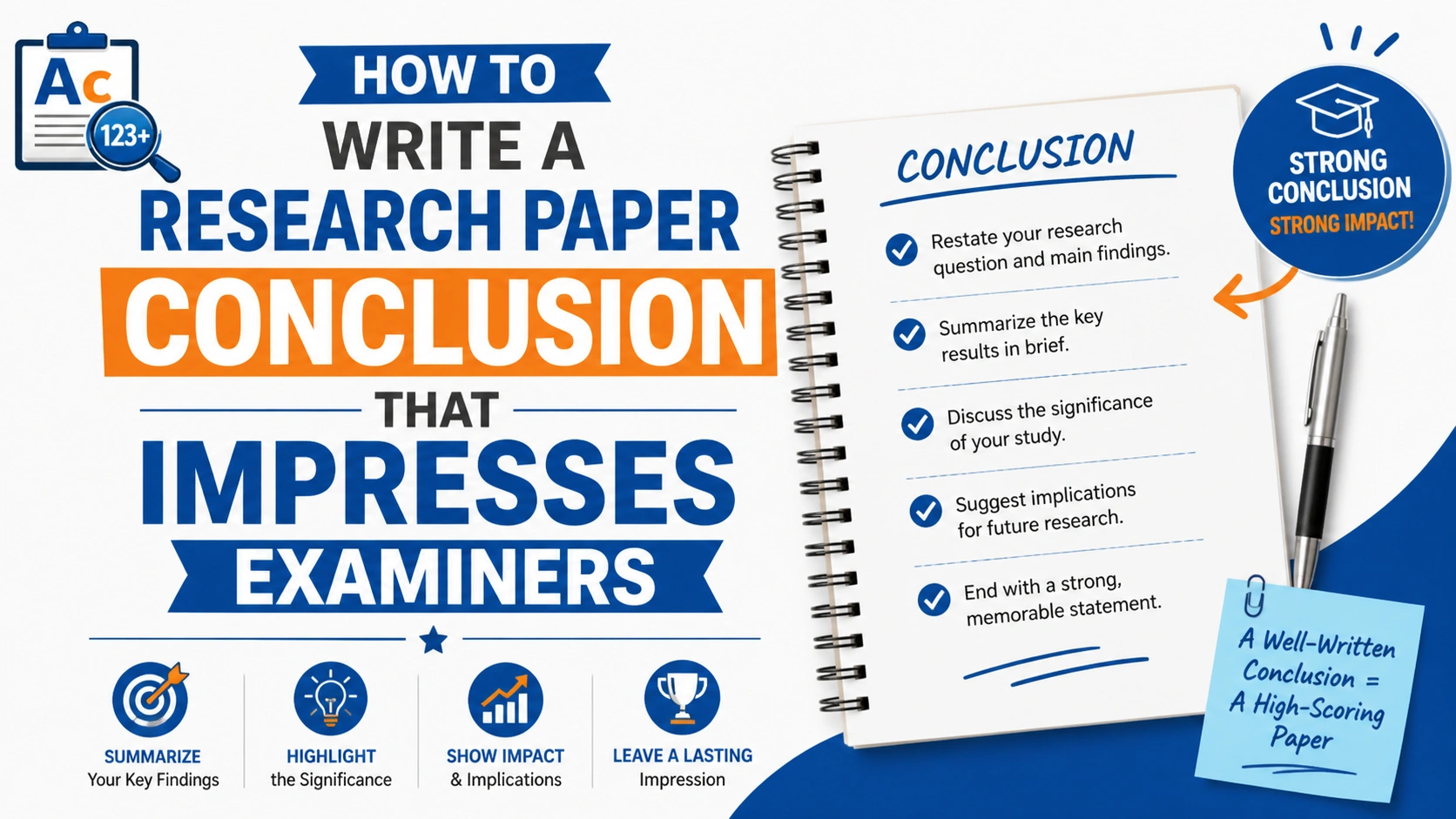
Begin with a synthesis of your central argument and findings, restated with the authority your evidence has earned you. Move to a synthesis of your main analytical points, showing not just what each found but how they connect and what they collectively reveal. Then address the significance of your findings across theoretical, practical, and methodological dimensions. Acknowledge limitations honestly and constructively, and use them as a bridge to your future research recommendations. Conclude with a clear, authoritative statement that captures the broader significance or enduring importance of your research.
This framework is not a rigid formula but a flexible architecture. Adapt it to the specific demands of your discipline, your research questions, and the nature of your findings. What matters is not the precise structure but the intellectual quality of each move — the depth of your synthesis, the specificity of your significance claims, the honesty of your limitations acknowledgment, and the authority of your final statement.
The Examiner’s Perspective
It can be helpful to think about the research paper conclusion from the examiner’s perspective. By the time they reach your conclusion, they have read your introduction, navigated your literature review, followed your methodology, and worked through your analysis and discussion. They have formed impressions of your intellectual capabilities and the quality of your work. The conclusion is your final opportunity to either confirm and enhance those impressions or disappoint them.
Examiners describe strong conclusions as producing a feeling of satisfaction — the sense that the paper has done what it promised to do, revealed something genuinely interesting, and opened up productive directions for future thinking. They describe weak conclusions as anticlimactic — the feeling that the paper simply ran out of energy rather than reached a meaningful destination.
Writing a research paper conclusion that impresses examiners means writing for that sense of arrival. It means treating the conclusion not as the place where you are finally allowed to stop but as the place where your intellectual argument reaches its fullest and most authoritative expression. When you approach the conclusion with that intention, and when you use the framework and principles outlined in this guide, you give your research paper its best possible ending — and your examiner their best possible last impression of your work.
The ability to write a research paper conclusion effectively is, like all elements of academic writing, a skill that develops with deliberate practice. Study the conclusions of papers you admire in your field. Notice how established scholars in your discipline handle synthesis, significance, limitations, and future directions. Apply those insights to your own writing, seek feedback, and revise. The investment in developing this skill will repay you every time you write.
Conclusion
A well-written research paper conclusion is far more than a formality—it is your final opportunity to demonstrate clarity, depth, and intellectual authority. Instead of simply repeating earlier points, an effective conclusion brings your entire argument together, highlights the true significance of your findings, and positions your work within a broader academic context.
By focusing on synthesis rather than summary, clearly explaining the importance of your research, acknowledging limitations, and offering meaningful directions for future study, you transform your conclusion into a powerful closing statement. This is what leaves a lasting impression on examiners and elevates your paper from average to exceptional.
Ultimately, mastering the art of writing strong conclusions is a skill that improves with practice. The more you apply structured thinking and critical reflection, the more confident and impactful your academic writing will become. As highlighted in this guide, a compelling conclusion is what ensures your research doesn’t just end—but resonates.
FAQs (Frequently Asked Questions)
What is the main purpose of a research paper conclusion?
The main purpose of a research paper conclusion is to bring your argument to a clear and meaningful close. It summarizes key findings, explains their significance, and answers the central research question—essentially addressing the “so what?” of your study.
How long should a research paper conclusion be?
A conclusion should typically be around 5–10% of your total word count. It should be long enough to synthesize your ideas effectively but concise enough to avoid repetition or unnecessary detail.
Can I introduce new information in the conclusion?
No, introducing new arguments, evidence, or data in the conclusion is a common mistake. The conclusion should only reflect on and synthesize ideas already discussed in the paper.
What is the difference between summarizing and synthesizing?
Summarizing repeats the main points of your paper, while synthesizing connects those points to show a deeper insight or overall meaning. A strong conclusion focuses on synthesis rather than simple summary.
Should I include limitations in my conclusion?
Yes, briefly acknowledging limitations adds credibility to your work. It shows that you understand the scope of your research and can critically evaluate your own findings.
How can I make my conclusion more impactful?
To make your conclusion stronger:
Restate your thesis with confidence
Highlight the significance of your findings
Avoid weak or generic closing lines
End with a clear, authoritative statement
What are common mistakes to avoid in a conclusion?
Some common mistakes include:
Repeating the introduction
Adding new information
Being too vague or overly brief
Using excessive hedging language