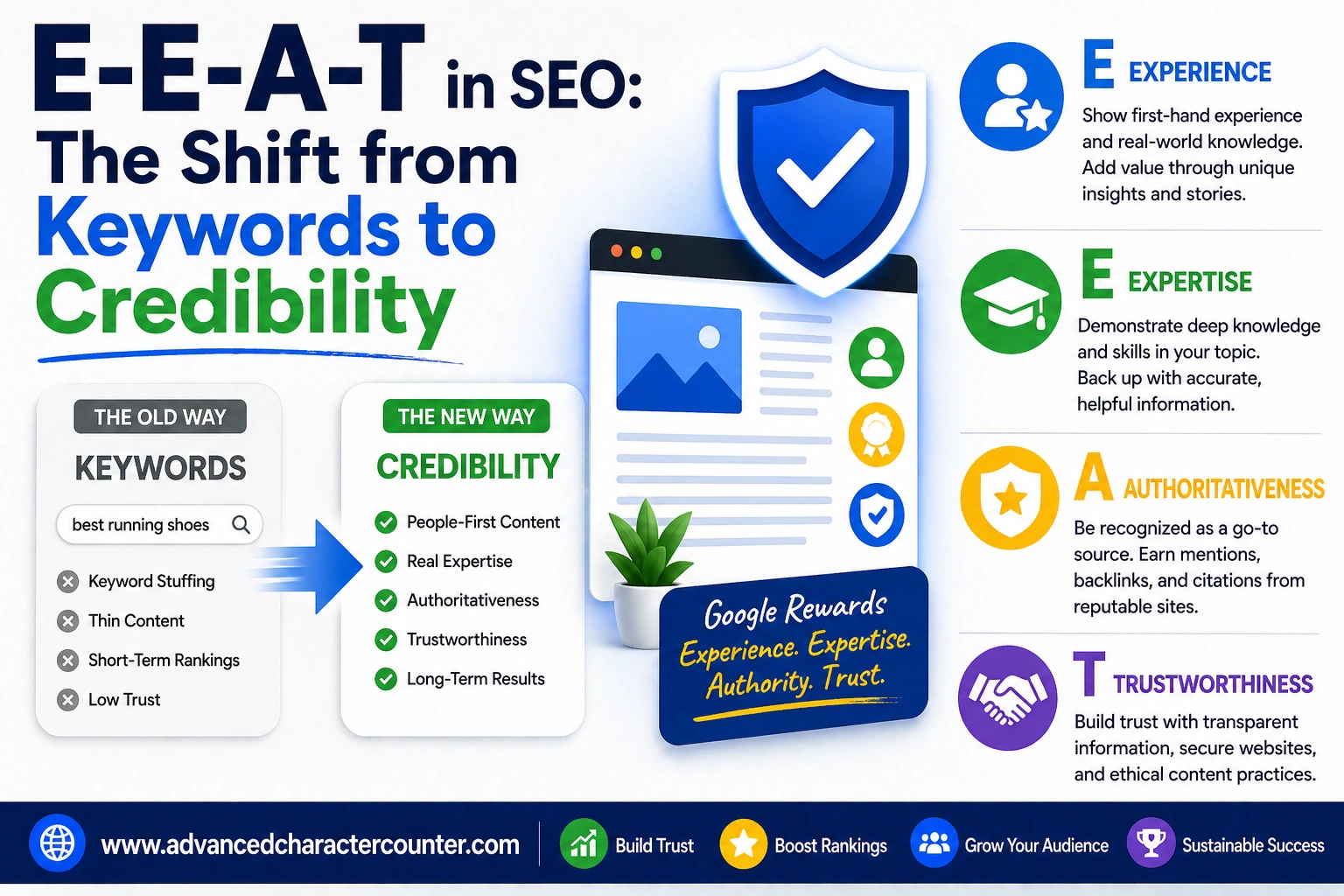
For a long time, SEO was primarily about keywords and backlinks. Write enough content with the right keywords, build enough links, and you would rank well. That era is not completely over — keywords and links still matter — but Google has made it increasingly clear that they are no longer enough on their own.
Since the landmark Medic Update of 2018, and even more so after the Helpful Content Updates of 2022 and 2023, Google has placed enormous weight on a concept called E-E-A-T. It stands for Experience, Expertise, Authoritativeness, and Trustworthiness. These four qualities are the framework Google uses to evaluate whether a piece of content is genuinely valuable — or just well-optimised noise.
If you have noticed that some older articles on your site have been losing rankings despite having good keywords and decent backlinks, E-E-A-T is very likely part of the reason. And if you are building a new blog or content platform in 2026, understanding E-E-A-T from the beginning will save you years of frustration.
This guide explains exactly what E-E-A-T means, why Google cares about it so deeply, and — most importantly — what you can do right now to strengthen every signal in your content, your author profiles, and your overall website. Whether you are a solo blogger in Bengaluru or a content team managing a national publication, this guide is written for you.
Official Source: Google’s E-E-A-T framework is detailed in the Search Quality Evaluator Guidelines (SQEG) — a document Google uses to train human quality raters. While E-E-A-T is not a direct ranking factor itself, the signals it represents very much are. The document is publicly available on Google’s website.
What Is E-E-A-T and Where Did It Come From?
A Brief History: From E-A-T to E-E-A-T
The concept was originally introduced as E-A-T — Expertise, Authoritativeness, and Trustworthiness — in Google’s Search Quality Evaluator Guidelines around 2014. It became widely discussed in the SEO community after Google’s August 2018 broad core algorithm update, which hit health, finance, legal, and wellness sites particularly hard. The pattern was clear: sites without clear expertise and trust signals lost rankings. Sites with strong author credentials and verifiable information gained them.
In December 2022, Google added a fourth E — for Experience — updating the concept to E-E-A-T. This addition signalled that Google now wants to see not just theoretical expertise, but real-world, first-hand experience with the topic. A travel writer who has actually visited the destinations they write about is more valuable than one who has only researched from a desk. A product reviewer who has used the product is more credible than one writing from a press release.
| Version | Time Period | What Changed |
|---|---|---|
| E-A-T | 2014 to December 2022 | |
| E-E-A-T | December 2022 onwards |
Breaking Down Each Component
Let us look at each of the four components in detail, with clear definitions and practical examples:
| Component | Definition | Who Needs It Most | Example |
|---|---|---|---|
| Experience (E) | Has the creator personally done, used, or lived what they are writing about? | Product reviewers, travel writers, health bloggers, personal finance writers | A food blogger who actually cooked and tested every recipe they publish |
| Expertise (E) | Does the creator have formal or demonstrated knowledge in the subject area? | Medical, legal, financial, technical content writers | A chartered accountant writing about income tax filing |
| Authoritativeness (A) | Is the creator and/or website widely recognised as a reliable source by others in the field? | News sites, educational platforms, established niche blogs | A cybersecurity blog cited regularly by major tech publications |
| Trustworthiness (T) | Is the content accurate, transparent, and safe for the user to rely on? | All content — this is the most fundamental of the four | A medical site that cites peer-reviewed studies and names its medical reviewers |
The Most Important Signal: According to Google’s own documentation, Trustworthiness is the most central of the four E-E-A-T components. A page can have high expertise but low trust (for example, a site that sells misleading supplements) and will be rated very low overall. Trust is the foundation everything else rests on.
E-E-A-T Is Not a Direct Ranking Factor — But It Deeply Influences Rankings
This is a common point of confusion. E-E-A-T itself is not a score that Google calculates and plugs into a ranking formula. There is no ‘E-E-A-T score’ in Google Search Console. Instead, E-E-A-T is a quality framework that Google’s human quality raters use to evaluate pages, and that framework shapes how Google’s algorithm is developed and refined over time.
Think of it this way: if Google’s quality raters consistently rate your content as high-quality and trustworthy, that pattern helps Google understand what signals in the data correlate with quality. Those signals — backlinks from authoritative sources, author credentials, accurate information, site transparency — then influence the algorithm. So while E-E-A-T is not a direct ranking dial you can turn, working to improve it produces real, measurable improvements in rankings.
YMYL Content and Why E-E-A-T Matters Even More There
What Is YMYL?
YMYL stands for Your Money or Your Life. It is Google’s label for content that could significantly affect a person’s health, financial stability, safety, or happiness if it is inaccurate. Google applies much stricter E-E-A-T standards to YMYL content because the stakes of getting it wrong are genuinely high.
If a travel blog gets a restaurant recommendation slightly wrong, the reader has a bad meal. That is unfortunate but not dangerous. If a health blog gives wrong advice about medication dosage, the consequences could be severe. Google understands this distinction and evaluates YMYL content with far greater scrutiny.
| YMYL Content Category | Examples |
|---|---|
| Medical and Health | Symptoms, treatments, medications, mental health advice, diet and nutrition |
| Financial and Legal | Tax filing, investment advice, loans, insurance, legal rights and procedures |
| News and Current Events | Political news, government policy, crime, disaster coverage |
| Safety Information | Emergency procedures, product safety warnings, child safety |
| Civic and Government | Voting, government benefits, legal processes like applying for a passport |
| Major Life Decisions | Adoption, career changes, divorce, choosing a college or university |
Does Your Blog Fall Into YMYL?
Many Indian bloggers are surprised to discover that their content qualifies as YMYL. Personal finance blogs, health and wellness sites, parenting blogs, education blogs covering competitive exams — all of these fall into YMYL territory. If your content influences decisions that could significantly affect someone’s wellbeing or finances, Google is applying YMYL standards to it.
This does not mean you cannot write about these topics. It means you need to be more diligent about demonstrating E-E-A-T — and the strategies in the sections below will show you exactly how.
How to Build the First E — Experience
Experience is the newest addition to the framework, and in many ways it is the most accessible for individual bloggers and content creators. You do not need a university degree to demonstrate experience. You need to show that you have personally done the thing you are writing about.
What Google Looks for as Proof of Experience
- First-person accounts and personal anecdotes integrated naturally into the content
- Specific, granular details that only someone who has actually done the thing would know
- Original photographs, screenshots, or videos from personal use or visits
- Personal results, outcomes, or case studies with real numbers
- Acknowledgement of difficulties, failures, or unexpected outcomes — not just polished success stories
- Reviews of products, places, or services that include nuanced observations beyond what a manufacturer’s spec sheet would contain
Practical Ways to Demonstrate Experience in Your Content
Here are specific, actionable techniques you can implement in your next article:
- Start your articles with a personal experience hook. For example, if writing about a budgeting app, open with: ‘I used this app for 90 days to manage my monthly expenses in Mumbai. Here is exactly what happened — including what surprised me.’
- Include an ‘Author’s Note’ or ‘My Take’ section at the end of each article where you share your personal perspective or experience summary.
- Add original photos or screenshots wherever possible. A review of a restaurant with your own photos is infinitely more credible than one with downloaded stock images.
- Share specific results. Instead of ‘this technique improved my traffic’, write ‘this technique increased my monthly organic visitors from 4,200 to 11,800 in 90 days’.
- Mention the context of your experience. When you did it, how long you used it, what your specific situation was. Context makes experience real and verifiable.
- Update articles to reflect ongoing experience. An article updated after 12 months of using a product signals far more credibility than one written after a 3-day trial.
Indian Context: For Indian audiences specifically, sharing experiences rooted in the Indian context is doubly powerful. Mentioning that you filed ITR using a specific tool, or that you visited a specific government office to verify information, makes your content immediately relatable and trustworthy to an Indian reader.
How to Build the Second E — Expertise
Expertise is about demonstrating that you genuinely know your subject — not just at a surface level, but in depth. It encompasses both formal qualifications (degrees, certifications, professional licences) and informal, demonstrated expertise (years of practical experience, published work, industry recognition).
Formal vs. Everyday Expertise
| Type of Expertise | What It Looks Like | How to Signal It |
|---|---|---|
| Formal / Credential-Based | Medical degree, CA certification, law degree, engineering qualification | |
| Professional Experience | 10 years as a software engineer, former bank manager, practising nutritionist | |
| Demonstrated / Informal | Self-taught developer with a popular open-source project, blogger with 500+ published articles on one topic | |
| Collaborative Expertise | Content reviewed or co-written by a credentialled expert |
Building Topical Authority — The SEO Expertise Strategy
Topical authority is the concept that a website can become an expert ‘in Google’s eyes’ on a specific subject by publishing a comprehensive, interconnected body of content about that subject. Rather than writing about ten different topics at a surface level, you write deeply and systematically about one or two core topics.
Google’s algorithm increasingly rewards sites that own a topic — meaning they have answered virtually every meaningful question a reader might have about that subject. This is why niche blogs often outperform general lifestyle blogs on their core topics despite having fewer total articles.
Here is how to build topical authority deliberately:
- Choose your core topic or niche and commit to it. A personal finance blog for young professionals in India. A food blog exclusively about South Indian cuisine. A tech blog focused only on Indian startups.
- Create a topic cluster structure. Write one comprehensive ‘pillar’ article on the main topic (for example, ‘Complete Guide to Personal Income Tax in India 2026’) and then write multiple supporting articles on related subtopics (how to file ITR online, deductions under Section 80C, how to save tax as a freelancer, and so on).
- Link all supporting articles to the pillar article and to each other. This internal linking structure signals to Google that your site has deep, interconnected expertise on the topic.
- Go deeper than your competitors. If the top-ranking article on a topic has 1,200 words, write 2,500 words that cover every angle the competitor missed. Depth is a proxy for expertise.
- Regularly update existing content to reflect current information. An article about income tax that is updated every year signals ongoing expertise far better than one that has not been touched in three years.
How to Build the A — Authoritativeness
Authoritativeness is the most external of the four signals. While experience and expertise can be demonstrated within your own content, authoritativeness is built through recognition by others — other websites, publications, organisations, and individuals in your field.
In practical SEO terms, authoritativeness is closely linked to the quality and relevance of your backlink profile. When high-quality, relevant websites link to your content, they are essentially vouching for your authority. This is why link building remains an important part of SEO even in the E-E-A-T era.
Signals That Build Authoritativeness
| Authority Signal | How to Build It |
|---|---|
| High-Quality Backlinks | Earn links from reputable sites in your niche by publishing research, data, or genuinely helpful resources that others naturally want to reference |
| Media Mentions | Get quoted or featured in online publications, newspapers, or industry magazines — even small regional ones build authority |
| Guest Posts on Reputable Sites | Publish articles on established platforms in your niche; your byline on credible sites transfers authority |
| Social Proof and Citations | When your data or research is cited by others — even in social media posts by verified accounts — this builds recognition |
| Speaking or Podcast Appearances | Being invited to speak at industry events or on podcasts signals that peers recognise your expertise |
| Awards and Recognition | Industry awards, ‘top blogger’ lists, or community recognition are external signals of authority |
| Wikipedia or Knowledge Graph Presence | If your brand or name appears in Wikipedia or Google’s Knowledge Graph, this is a very strong authority signal |
Building Authority on a Budget — Practical Steps for Indian Bloggers
You do not need a large PR budget to build authoritativeness. Here are practical, cost-effective strategies:
- HARO and similar platforms: Use Help a Reporter Out (HARO) or its Indian equivalents to get quoted in media articles. This earns high-quality backlinks and media mentions simultaneously.
- Collaborate with other bloggers: Guest posting on well-established Indian blogs in your niche earns both exposure and quality links.
- Create original data or research: Conduct surveys, publish industry statistics, or produce original studies. Data is highly linkable — other writers will naturally cite your research.
- Build relationships in your niche community: Active participation in niche communities — LinkedIn groups, Twitter/X discussions, Reddit threads, Indian SEO forums — builds recognition among peers.
- Publish case studies with real numbers: Case studies that show measurable results attract links from people who want to reference your proof points.
- Contribute to Wikipedia where relevant: If your niche has relevant Wikipedia articles, contributing accurate, sourced information (following Wikipedia’s editorial guidelines) can eventually lead to your site being cited.
How to Build the T — Trustworthiness
Trustworthiness is, as Google itself states, the most important of the four E-E-A-T components. A page that lacks trust — regardless of how expert or authoritative the author is — will be rated as low quality. Trust is about accuracy, transparency, and safety.
On-Site Trust Signals Every Website Needs
These are the foundational trust elements that every website should have in place. If any of these are missing from your site, fixing them is your highest priority:
| Trust Element | Why Google and Readers Care |
|---|---|
| HTTPS (SSL Certificate) | Google will not feature HTTP sites in top results. HTTPS signals that data transmitted on your site is encrypted and secure. |
| Clear ‘About Us’ Page | Who runs this website? What are their qualifications? Without an About page, the site feels anonymous and untrustworthy. |
| Contact Information | A real email address, phone number, or contact form signals that a real person or organisation stands behind the content. |
| Privacy Policy and Terms of Service | Required for legal compliance in most countries, and expected by Google as basic transparency. |
| Clear Editorial Policy | Explain how content is created, reviewed, and updated. This is especially important for YMYL topics. |
| Author Bios on Every Article | Anonymous content is inherently less trusted. Every article should have a named author with credentials. |
| Publication and Update Dates | Show when content was published and when it was last updated. Outdated content without update dates erodes trust. |
| Visible Corrections Policy | If you make an error and correct it, acknowledge the correction. This builds trust rather than hiding mistakes. |
Content-Level Trust Signals
Beyond site structure, the content itself must demonstrate trustworthiness through its quality, accuracy, and sourcing:
- Cite authoritative sources: Link to government websites (like income.gov.in, mohfw.gov.in), peer-reviewed research, official reports, and established media. External links to credible sources show you are not making claims in isolation.
- Avoid unverified claims: Every factual claim in your article should be backed by a source you can link to. If you cannot source it, do not publish it.
- Acknowledge limitations and nuance: Trustworthy content does not pretend to have all the answers. Saying ‘this depends on your specific situation — consult a professional’ is a trust signal, not a weakness.
- Correct errors promptly: If a reader points out a factual error, correct it immediately and note the correction at the bottom of the article. This transparency builds trust more than pretending the error never happened.
- Avoid affiliate link overload: Excessive affiliate links — especially when they are the primary purpose of an article — signal to Google that the content is commercially motivated rather than genuinely helpful.
- Use original images and data: Stolen images or plagiarised content are among the most direct trust destroyers. Use original visuals wherever possible and always credit others’ work properly.
Author Bios — The Single Most Actionable Trust Improvement
If there is one change you can make to your blog today that will have an immediate positive impact on E-E-A-T, it is this: add a comprehensive, credible author bio to every article.
A good author bio for E-E-A-T purposes should include:
- The author’s full name (not a pen name or ‘Admin’)
- A professional headshot photograph
- Relevant qualifications, certifications, or professional experience
- How many years they have been writing or working in this field
- Links to their professional profiles — LinkedIn, Google Scholar, official organisation pages
- A brief statement of their personal experience with the topic (linking back to the Experience signal)
- For YMYL content: the name and credentials of any professional who reviewed the article
Quick Win: If you use WordPress, install a plugin like Simple Author Box or Co-Authors Plus to display rich, structured author bios on every post automatically. This one technical setup can improve E-E-A-T signals across your entire site.
E-E-A-T Strategy by Website Type
The specific E-E-A-T actions that matter most vary depending on the type of website and content you produce. Here is a practical breakdown:
| Website Type | Biggest E-E-A-T Challenges | Priority Actions |
|---|---|---|
| Solo Blogger / Personal Blog | Anonymous content, no formal credentials, low domain authority | Add detailed author bio, add About page, build topical focus, earn first backlinks |
| Niche Blog (Health, Finance, Legal) | YMYL scrutiny, high expertise bar, accuracy demands | Add expert reviewers, cite official sources heavily, update content regularly, display credentials prominently |
| News and Current Events Site | Accuracy, speed vs verification trade-off, source credibility | Named journalists with profiles, clear corrections policy, link to primary sources, editorial standards page |
| E-Commerce Blog | Commercial intent vs helpful content tension, product bias concerns | Honest reviews including negatives, clear disclosure of affiliates, real user testimonials, transparent pricing |
| Educational / Tutorial Blog | Keeping technical content accurate and up-to-date | Regular content audits, technical reviewer credits, version/date stamps on tutorials, hands-on demonstration |
| Corporate / Brand Blog | May feel overly promotional, lacks personal voice | Use real employee authors with bios, publish original research, share honest industry perspectives |
How to Conduct an E-E-A-T Audit on Your Website
An E-E-A-T audit is a systematic review of your website to identify gaps in your experience, expertise, authority, and trust signals. Here is a structured process you can follow:
Site-Level Audit Checklist
- HTTPS is active and working across all pages
- About Us page exists with real names, photos, and credentials of the team or owner
- Contact page has a working email address or contact form
- Privacy Policy and Terms of Service pages exist and are accurate
- Editorial guidelines or ‘How We Create Content’ page exists (especially important for YMYL sites)
- No manual penalties in Google Search Console
- Core Web Vitals pass — site loads fast on mobile
- No major technical errors flagged in Google Search Console
Content-Level Audit Checklist
- Every article has a named author (not ‘Admin’ or anonymous)
- Author bios include relevant credentials and experience
- All factual claims are linked to credible sources
- Publication date and last-updated date are visible on every article
- No articles contain unverified or outdated medical, legal, or financial information
- Affiliate disclosures are present where required
- Original images or properly credited images are used throughout
- No duplicate content issues (use Copyscape or Siteliner to check)
Authority Audit Checklist
- Backlink profile reviewed in Ahrefs or Semrush — note the quality and relevance of linking sites
- Any toxic or spammy backlinks have been disavowed in Google Search Console
- At least some backlinks come from recognised, reputable sites in your niche
- Brand name returns relevant, positive results when searched in Google
- Author names return professional results in Google (LinkedIn profile, published articles, etc.)
Tools to Help You Improve E-E-A-T
| Tool | How It Helps With E-E-A-T |
|---|---|
| Google Search Console (Free) | Check for manual actions, indexing issues, Core Web Vitals, and search performance — the foundation of technical trust |
| Ahrefs or Semrush (Paid) | Analyse your backlink profile, identify authority gaps, find link-building opportunities, and track keyword rankings affected by E-E-A-T updates |
| Copyscape or Siteliner (Freemium) | Detect duplicate content on your site or across the web — a direct trust negative that must be addressed |
| Schema Markup Generators (Free) | Generate Article, Person, and Review schema markup to help Google understand who wrote your content and what qualifications they hold |
| PageSpeed Insights (Free) | Measure Core Web Vitals — slow, frustrating pages signal poor quality regardless of content excellence |
| Grammarly or Hemingway Editor (Freemium) | Poor grammar and readability undermine the perception of expertise. Clear, well-written content is a trust signal in itself |
| LinkedIn (Free) | Build a professional author profile that Google can find and associate with your content — strong E-E-A-T signal for named authors |
| Google’s Search Quality Evaluator Guidelines (Free) | Read the full SQEG document to understand exactly how Google’s human raters evaluate content — it is publicly available and invaluable |
Common E-E-A-T Mistakes That Are Hurting Your Rankings
| Mistake | Why It Matters and How to Fix It |
|---|---|
| Publishing content under ‘Admin’ or no author name | Completely anonymous content has no trust or expertise signals. Fix: assign a real named author to every article, even retrospectively. |
| No About page or a vague, generic About page | If Google cannot identify who is behind your website, it cannot assess your authority or trustworthiness. Fix: write a specific, detailed About page. |
| Covering too many unrelated topics | A blog that writes about cooking, cryptocurrency, astrology, and cricket all in one place signals no topical expertise in any area. Fix: narrow your focus or create clearly separated content sections. |
| Copying content from other sites | Plagiarised content is a direct violation of trust and Google’s guidelines. Fix: use only original content, use Copyscape to check existing articles. |
| Not citing sources for factual claims | Unsourced facts — especially in YMYL content — signal low credibility. Fix: link every factual claim to a verifiable source. |
| Buying low-quality backlinks | Spammy backlinks actively damage authority and can result in manual penalties. Fix: disavow toxic links in Search Console and focus on earning quality links organically. |
| Never updating old content | Outdated information — especially on fast-moving topics — is a trust negative. Fix: conduct quarterly content audits and update articles with new data and dates. |
| Ignoring negative reviews of your brand online | If your brand has significant unresolved complaints online, this affects how Google perceives your trustworthiness. Fix: respond professionally to all reviews and resolve genuine complaints. |
Final Thoughts: E-E-A-T Is Not a Tactic — It Is How You Build a Content Business
The most important thing to understand about E-E-A-T is this: it is not a loophole to exploit or a checklist to game. It is Google’s attempt to reward content that is genuinely valuable, genuinely credible, and genuinely created by people who know what they are talking about. That is not a punishment for shortcuts — it is an opportunity for writers who are doing the work properly.
Every time you publish an article from personal experience, every time you cite a credible source instead of making an unverified claim, every time you update an old article with new information, every time you write an honest review instead of a promotional puff piece — you are building E-E-A-T. It accumulates over time, and it compounds.
For Indian content creators specifically, this is an enormous opportunity. India has some of the world’s most qualified professionals, most experienced practitioners, and most passionate subject-matter experts who are also creating digital content. The frameworks in this guide exist to help you demonstrate that expertise in a way that Google recognises and rewards.
Start with the audit checklist in Section 8. Identify your biggest gaps. Fix the quick wins first — author bios, About page, source citations. Then work systematically on the longer-term signals — topical authority, backlink quality, content depth. Review your progress quarterly.
In a world where anyone can publish anything online, the content creators who will win the next decade are those who build genuine authority — one credible, experience-backed, carefully sourced article at a time.
Your Action Step Today: Open Google Search Console right now and check your Performance report. Find the three articles with the highest impressions but the lowest average position. These are your biggest E-E-A-T improvement opportunities. Start with those — add a proper author bio, strengthen the sourcing, add an update date, and deepen the content. Come back in 30 days and check whether the average position improved.
Frequently Asked Questions (FAQs)
Q: Is E-E-A-T a Google ranking factor?
A: Not directly. Google has clarified that E-E-A-T itself is not a single ranking factor that the algorithm plugs into a formula. However, the signals that E-E-A-T represents — backlinks from authoritative sites, author credentials, content accuracy, site transparency — very much do influence rankings. Working to improve E-E-A-T produces real ranking improvements, even though there is no ‘E-E-A-T score’ you can measure directly.
Q: Can a new blog with no backlinks have good E-E-A-T?
A: Yes — in part. A new blog can demonstrate strong Experience and Expertise signals from day one through detailed author bios, credentialled authorship, thorough sourcing, and high-quality writing. Authoritativeness, which depends heavily on recognition by others (backlinks and citations), takes longer to build and cannot be rushed. Focus on Experience, Expertise, and Trust first, and Authoritativeness will follow as your content earns recognition over time.
Q: How long does it take to see results after improving E-E-A-T?
A: Results vary significantly. Some improvements — like adding author bios and fixing technical trust issues — can have a positive effect within a few weeks of Google recrawling your pages. Others, like building topical authority and earning quality backlinks, can take three to twelve months to show measurable ranking improvements. E-E-A-T is a long-term investment, not a quick fix. Consistency over months is what produces sustainable results.
Q: Does E-E-A-T matter for small, personal blogs in India?
A: Absolutely yes. The Helpful Content Updates have specifically targeted thin, low-quality content across all site sizes. A small personal blog that demonstrates genuine experience, writes accurately about a focused niche, and is transparent about who is behind it can absolutely outrank larger, more commercialised sites. In fact, Google’s helpful content guidelines explicitly favour content written by people with real experience for a real human audience — which is exactly what a well-run personal blog can deliver.
Q: What is the best first step to improve E-E-A-T on my existing website?
A: The highest-impact first step is to improve your author profiles and About page. Go through every article on your site and ensure each has a named author. Create or update author bios to include real names, photos, credentials, and relevant experience. Then update your About page to clearly explain who runs the site and why they are qualified to write about their topics. These two changes alone can significantly improve how Google perceives your site’s expertise and trustworthiness.