There is one writing rule that professional editors enforce in every newsroom, every publishing house, and every high-performing content team — and it is almost never taught in SEO courses. It is this: one paragraph, one idea. Nothing more.
On the surface, this sounds obvious. But look closely at almost any average blog post and you’ll find paragraphs that do three or four things at once — introduce a concept, explain it, give an example, and draw a conclusion, all in the same block of text. The result is writing that is hard to follow, hard to skim, and — critically for SEO — hard for Google to understand.
This guide explains exactly what the one-idea-per-paragraph rule means, why it matters more than most technical SEO factors, and how to apply it immediately to both new and existing content.
What Is the One Idea Per Paragraph Rule?
The one idea per paragraph rule is a foundational writing principle that states: every paragraph should contain exactly one central idea, developed and supported within that paragraph, before the writing moves on to the next idea.
It does not mean each paragraph must be exactly one sentence — though some paragraphs legitimately are. It means that the paragraph’s topic sentence introduces one idea, the supporting sentences develop only that idea, and the paragraph ends when that idea is complete. The next paragraph begins with the next idea.
This rule comes from classical rhetoric and was formalised in modern journalism as the inverted pyramid structure. Every paragraph is a self-contained unit. A reader can extract the meaning of any paragraph in the article without having read the paragraphs before or after it.
Simple test: Can you underline a single sentence in your paragraph that captures its entire meaning? If yes, that’s the topic sentence — and your paragraph is likely well-focused. If no sentence captures the whole paragraph, you’re probably covering more than one idea.
2–4 Ideal sentence range per paragraph for online reading (Nielsen Norman Group)
43% Of people admit to skimming blogs rather than reading word-for-word (HubSpot)
58% Higher comprehension when complex topics are broken into focused single-idea paragraphs
#1 Most cited writing improvement recommended by professional editors across all content formats
Why Paragraph Structure Affects SEO
Most SEO guides focus on keywords, backlinks, page speed, and meta tags. Very few focus on paragraph structure — and this is a significant missed opportunity. Paragraph structure affects SEO through several direct and indirect pathways.
Dwell Time and Bounce Rate
When content is clearly structured — each paragraph covering exactly one idea before moving to the next — readers find it easy to follow. They stay longer. They scroll further. They read more. These behaviours directly improve dwell time and reduce bounce rate, both of which are strong signals Google uses to evaluate content quality.
When paragraphs are dense and multi-ideaed, readers feel overwhelmed. They scan, lose their place, and often leave. The content may be excellent — but its structure makes it inaccessible. SEO cannot save content from bad readability.
Featured Snippet Eligibility
Google’s featured snippets are almost always extracted from well-focused paragraphs — paragraphs where one clear question is asked and one clear answer is given, within a small number of sentences. Multi-idea paragraphs are almost never featured. The reason is obvious: Google cannot identify which part of the paragraph to extract. A single, clean paragraph answering a specific question is exactly what the featured snippet algorithm looks for.
Semantic Clarity for Google’s NLP
Google uses natural language processing to understand the meaning of content — not just the keywords in it. Paragraphs that mix multiple ideas create semantic noise. Google’s language models are less able to accurately classify the paragraph’s subject matter when multiple unrelated ideas compete within it. Clean, focused paragraphs give Google clearer signals about what each section of your content is actually about.
The Cognitive Science Behind Single-Idea Paragraphs
The one-idea rule is not just editorial convention — it is backed by research in cognitive psychology and reading science.
Working memory — the part of the brain that holds information during active processing — has a limited capacity. When a paragraph introduces multiple ideas simultaneously, the reader must hold all of them in working memory at once while also processing the language. This creates cognitive overload. Some ideas are dropped before they can be transferred to long-term memory.
When paragraphs present one idea at a time, each idea can be fully processed and stored before the next one arrives. The reading experience feels easier, even when the content itself is complex. This is known as the “principle of chunking” in cognitive science — breaking information into meaningful units improves both comprehension and retention.
Why this matters for Indian readers specifically: Many Indian readers are consuming online content in their second or third language. Single-idea paragraphs reduce the cognitive load of processing complex sentences in English, making content significantly more accessible without reducing the depth or sophistication of the information being conveyed.
What a Multi-Idea Paragraph Looks Like — And Why It Fails
Before teaching the rule, it helps to see what breaking it looks like in practice. Below is a typical multi-idea paragraph, the kind found in most average blog posts:
❌ Multi-Idea Paragraph (Weak)
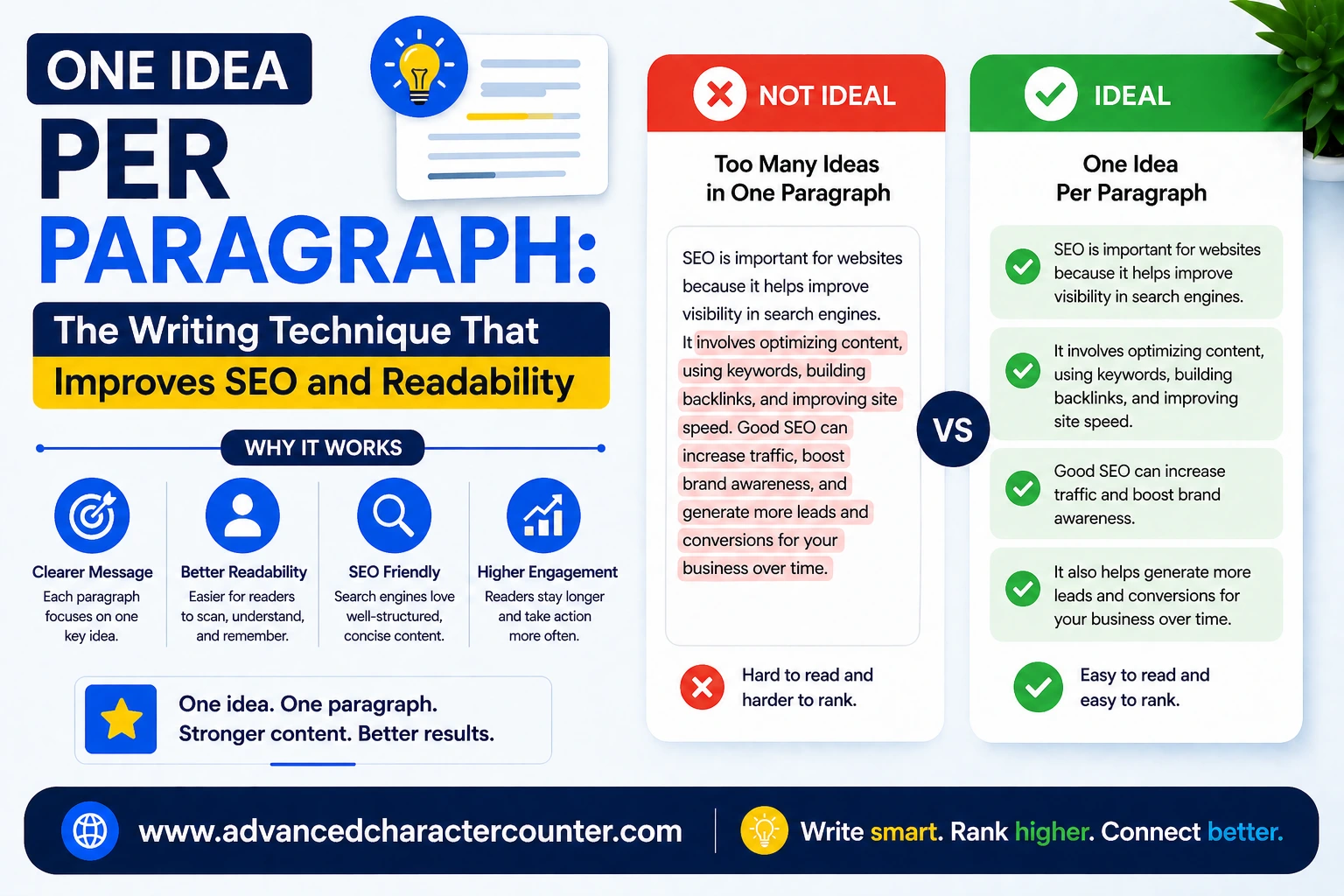
SEO keyword research is very important for any blog because it helps you understand what your audience is searching for, and you should use tools like Google Keyword Planner, Ahrefs, or SEMrush to find the right keywords, keeping in mind that long-tail keywords are often easier to rank for than short competitive ones, especially for new websites, and once you’ve found your keywords you should place them naturally in your headings, first paragraph, and throughout the article without stuffing them, since keyword stuffing can actually hurt your rankings according to Google’s guidelines, which have been updated many times since the Penguin algorithm was first introduced in 2012.
✅ Single-Idea Paragraphs (Strong)
Keyword research is the foundation of effective SEO — it tells you exactly what your audience is searching for before you write a single word.
The bad example contains at least six distinct ideas: the importance of keyword research, specific tools to use, the advantage of long-tail keywords, placement strategy, keyword stuffing risks, and Google’s algorithm history. Crammed into one paragraph, none of these ideas receives the attention it deserves. A reader scanning this paragraph cannot quickly identify its core point. Google’s NLP struggles to classify it accurately.
The good example contains exactly one idea: keyword research tells you what your audience searches for. The next paragraph would cover the tools. The paragraph after that would cover long-tail vs. short-tail keywords. Each idea gets its own space to breathe and be understood.
What a Single-Idea Paragraph Looks Like — And Why It Works
A well-executed single-idea paragraph has a clear, replicable structure that works across any topic, any niche, and any level of complexity.
1. The Topic Sentence — State the Idea Clearly
The first sentence of the paragraph declares exactly what this paragraph is about. It should be a complete, specific statement — not a vague opener. “Keyword research matters” is weak. “Keyword research determines which topics are worth writing about before you invest time in creating content” is strong. A strong topic sentence lets a scanning reader understand the paragraph’s value without reading further.
2. The Supporting Sentences — Develop the Idea
One to three sentences that expand, explain, prove, or illustrate the topic sentence. These should all relate directly to the single idea stated in the topic sentence. If you find yourself starting a supporting sentence with “Also…” or “Another thing to note…” — you are probably introducing a new idea that belongs in a separate paragraph.
3. The Closing Sentence (Optional) — Conclude or Bridge
A strong paragraph either concludes its idea with a summary sentence or uses a bridge sentence to connect to the next paragraph’s idea. This bridge technique — “But understanding search volume is only half the picture; search intent matters just as much” — creates narrative momentum. The reader is pulled naturally into the next paragraph.
The Anatomy of a Perfect Paragraph (With Live Example)
Let’s see the complete structure in practice, with a labelled example:
| Sentence Role | Example Sentence | What It Does |
|---|---|---|
| Topic Sentence | “Long-tail keywords give new blogs a realistic path to their first Google ranking.” | States the paragraph’s single idea precisely |
| Supporting Sentence 1 | “Unlike competitive short keywords — ‘content marketing,’ ‘SEO tips’ — long-tail phrases like ‘how to write SEO content for a Hindi-language audience’ have far lower competition.” | Explains the mechanism with a specific example |
| Supporting Sentence 2 | “Ahrefs data consistently shows that long-tail keywords make up over 70% of all search volume, meaning there is enormous traffic potential in specificity.” | Adds evidence to support the claim |
| Bridge Sentence | “But choosing the right long-tail keyword requires understanding not just its search volume — but the intent behind the search.” | Concludes the idea and bridges to the next paragraph’s topic: search intent |
Notice that every sentence in this paragraph relates to one idea: long-tail keywords offer opportunity for new blogs. The moment the paragraph touches search intent, it stops — because that’s a different idea, belonging in the next paragraph.
“One idea. One paragraph. That’s the entire rule. And applied consistently, it changes everything about how your content reads, ranks, and retains.”
How One Idea Per Paragraph Helps Google Understand Your Content
Beyond readability, this rule has direct technical implications for how Google processes and ranks your content.
Passage-Level Indexing
In 2020, Google introduced passage-level indexing — the ability to rank individual passages within a page, not just the page as a whole. This means a specific paragraph within your article can appear in Google results even if the overall page is not highly ranked. For this to work, the passage must be a clear, self-contained answer to a specific query. A multi-idea paragraph is impossible to extract as a clean passage. A focused, single-idea paragraph is ideal passage material.
Featured Snippets and People Also Ask
Both featured snippets and People Also Ask answers are extracted from focused passages that directly answer a specific question. Study any featured snippet — it is almost always a single, clean paragraph of two to four sentences where one question is asked and one precise answer is given. Consistently writing focused single-idea paragraphs dramatically increases the proportion of your content that is eligible for these placements.
Semantic Coherence
Google’s BERT and MUM language models understand context and meaning within text. When a paragraph is focused on one idea, these models can classify its meaning accurately. When multiple ideas compete in one paragraph, the classification becomes ambiguous. Clean paragraph focus means your content is more accurately understood — and more accurately matched to user queries — by Google’s language processing systems.
Applying the Rule Across Different Content Types
The one-idea-per-paragraph rule applies differently depending on the content format. Here is a practical guide to adaptation:
| Content Type | Paragraph Length | How the Rule Applies |
|---|---|---|
| Informational Blog Posts | 3–5 sentences | Each paragraph covers one sub-point within the section topic; sections are grouped by H2/H3 |
| How-To Tutorials | 2–3 sentences per step | Each step gets its own paragraph; instructions, tips, and warnings are separated into individual paragraphs |
| Product Reviews | 3–4 sentences | Each feature, benefit, or drawback is its own paragraph; comparative analysis is separated from descriptive content |
| News Articles | 1–3 sentences | Inverted pyramid: most important fact first, each subsequent paragraph adds one new piece of information |
| Opinion / Editorial | 3–5 sentences | One argument per paragraph; evidence for that argument within the same paragraph; transition to next argument in bridge sentence |
| Listicles | 2–4 sentences per item | Each list item is its own paragraph; the item’s name is the topic sentence; following sentences explain and illustrate |
| Technical SEO Guides | 3–5 sentences | Technical concepts, implementation steps, and expected outcomes are each given separate paragraphs to prevent information overload |
Common Mistakes When Applying This Rule
Understanding the rule is one thing. Applying it without creating new problems is another. Here are the most common errors writers make when first implementing one-idea paragraphs:
- Creating too many very short paragraphs. One idea doesn’t mean one sentence. Very short paragraphs — one after another — create a choppy, fragmented reading experience. Each idea deserves development. If every paragraph is one sentence, you’re writing bullet points without the bullets, not developing ideas properly.
- Repeating the same idea across multiple paragraphs. Sometimes writers split one idea into many paragraphs by saying the same thing in slightly different ways. This is the opposite problem — idea dilution rather than idea overload. Each paragraph should advance the article’s thinking, not revisit old ground.
- No transitions between paragraphs. When paragraphs are isolated single-idea blocks with no connection to the paragraphs around them, the article feels like a list of disconnected thoughts rather than a flowing argument. Use bridge sentences — the last sentence of each paragraph — to connect ideas and create momentum.
- Applying the rule to the wrong granularity. Each paragraph should contain one idea — but within a section, ideas must build on each other. If your H2 section has eight unrelated paragraphs with eight unrelated ideas, the section has no coherence. Sections are for clustering related ideas; paragraphs are for expressing each idea individually.
- Treating the rule as more important than the reader. Rules exist to serve communication, not the other way around. If a particular passage genuinely requires combining two closely related ideas in one paragraph for the logic to make sense, do it. The goal is clear communication — the rule is a tool to achieve that goal, not a constraint to follow mechanically.
How to Edit Existing Content Using This Rule
Applying the one-idea rule to existing content is one of the fastest and most effective content improvement actions you can take. Here is a practical editing process:
- Read your article and highlight every time the subject shifts. Go through each paragraph and draw a line every time you notice the topic changing — even slightly. Any paragraph with more than one line in it contains more than one idea and needs to be split.
- Split multi-idea paragraphs into focused units. For each idea identified in step one, create a new paragraph. Add a proper topic sentence if one doesn’t exist. This step often increases word count slightly — but the word count is earned, not padded. Each new paragraph contains genuine substance.
- Add bridge sentences where paragraphs feel disconnected. After splitting paragraphs, some may feel abrupt or disconnected from the ones around them. Add a final sentence to each paragraph that transitions naturally to the next paragraph’s idea. This restores the narrative flow that splitting can disrupt.
- Check headings align with paragraph topics. After restructuring paragraphs, verify that each H2 and H3 heading accurately describes the group of paragraphs beneath it. A heading that covers five different sub-topics — because those sub-topics weren’t distinguished in the original paragraphs — may now need to become multiple headings with their own paragraph groups.
- Read the revised article out loud. Reading aloud is the most reliable test of paragraph quality. If you stumble, pause unexpectedly, or feel confused mid-sentence, that paragraph needs more work. If the article flows smoothly from beginning to end — each paragraph a clean, complete thought — the edit was successful.
Advanced Application: Paragraph Flow and Momentum
Once you have mastered the basic one-idea rule, the advanced challenge is creating flow — a reading experience where each paragraph naturally pulls the reader into the next. This is what separates competent writing from compelling writing.
The Problem-Solution-Evidence-Bridge Structure
One of the most effective paragraph sequences in informational content follows this four-paragraph pattern: Paragraph one states a problem. Paragraph two presents the solution. Paragraph three provides evidence that the solution works. Paragraph four bridges to the next section or the implications of what was just established. This pattern gives readers a complete logical unit — they understand the problem, know the solution, trust it, and are ready to move on.
Sentence Rhythm Within Paragraphs
Even within a single-idea paragraph, sentence rhythm matters. Vary your sentence length: follow a long, complex sentence with a short, punchy one. The contrast creates rhythm and prevents the reading from becoming monotonous. A paragraph of five equally-long sentences, even if well-focused, feels like a wall of text. Varying rhythm makes the single idea feel dynamic rather than static.
The Curiosity Bridge
The most powerful bridge sentences create a micro-curiosity gap — they hint at the next idea without fully explaining it. “But search intent matters too — and it’s far less straightforward than keyword volume suggests.” This sentence completes the previous paragraph’s idea while creating immediate interest in the next one. The reader is pulled forward not just by the content, but by the structure.
Conclusion: One Rule to Transform Your Writing
The one idea per paragraph rule sounds deceptively simple. But it requires a fundamental shift in how you think about writing — from thinking in topics to thinking in ideas; from writing sections to writing thoughts.
Most SEO improvements require technical work: crawl audits, backlink building, site speed optimisation. This improvement requires only a shift in writing discipline. And yet its effect on readability, engagement, and ranking performance is as significant as most technical changes — sometimes more so.
Start with your next article. Before you write, commit to the rule: one idea per paragraph, a clear topic sentence first, supporting sentences that develop only that idea, a bridge to the next. Then edit with the same discipline. Within three to four articles, it will become instinct — and your writing will be permanently transformed.
Frequently Asked Questions (FAQs)
Does the one idea per paragraph rule apply to all types of blog content?
Yes, with minor adjustments for format. News articles tend to have very short, one-to-two sentence paragraphs (one fact per paragraph). Long-form guides have slightly longer paragraphs that develop one idea more fully (three to five sentences). The underlying principle — one idea, one paragraph — remains constant regardless of length or format.
How many sentences should a paragraph have for optimal readability?
For online content, two to four sentences is the most widely recommended range for readability. Nielsen Norman Group’s eye-tracking research consistently shows that shorter paragraphs have higher completion rates on screens. However, the right length is determined by how much development the single idea requires — not by a fixed sentence count. Let the idea determine the length.
Will applying this rule make my article longer?
In most cases, yes — slightly. When you split multi-idea paragraphs, you often discover that each idea needs its own topic sentence, which adds words. However, the process also often reveals that some ideas in your original paragraphs were not worth their own paragraph — they were filler. In those cases, the idea is simply removed, keeping the overall length efficient. The net effect is usually a slightly longer article with significantly higher content quality.
Can a one-sentence paragraph work, or is that too short?
Absolutely — one-sentence paragraphs are one of the most powerful tools in a writer’s toolkit when used deliberately. They create emphasis, signal importance, and give the reader a moment to absorb a key point before moving on. Used sparingly (once or twice in an article), a one-sentence paragraph has enormous impact. Used constantly, the effect disappears and the content begins to feel choppy and disconnected.
How does paragraph structure relate to Google’s featured snippet algorithm?
Featured snippets are almost exclusively extracted from focused, single-idea paragraphs. Google’s algorithm identifies passages that directly answer a specific question, then extracts and displays them. Paragraphs that answer one question clearly and completely are ideal featured snippet candidates. Paragraphs that mix multiple ideas are too complex to extract cleanly. Applying the one-idea rule to every paragraph in your article dramatically increases your snippet eligibility.
Should the topic sentence always be the first sentence of the paragraph?
In most cases, yes. For online content in particular, putting the topic sentence first allows skimmers to understand the paragraph’s content immediately without reading further. This is called “front-loading.” In some literary or persuasive contexts, writers build to the main point and place the topic sentence last for effect. For SEO content, front-loading is almost always the better choice — it respects the reader’s time and improves scannability.
How does the one idea per paragraph rule help with passage indexing in Google?
Google’s passage indexing system can rank specific passages within a page for relevant queries, even if the overall page doesn’t rank highly for those queries. For a passage to be indexable as a standalone answer, it must be a coherent, self-contained unit of information. A paragraph that covers one idea completely is a natural passage unit. A paragraph that mixes multiple ideas creates ambiguous passage boundaries that Google’s system struggles to process cleanly. Clean paragraph structure is therefore directly linked to passage indexing eligibility.