Imagine spending three days writing a 2,000-word article. You do the keyword research, optimise the meta title, build the backlinks. The article ranks on page one of Google. People click. And then — within 12 seconds — most of them are gone.
This is the quiet tragedy of most SEO content today. It wins the ranking battle but loses the reading war. Traffic comes in through the front door and walks straight out the back.
The “Scroll Test” is a simple, powerful concept: can your content keep a reader scrolling from the first word to the last? If yes, you win — in rankings, in trust, and in conversions. If no, you’re just renting space on Google’s first page until a competitor takes it.
In this article, we’re going to break down exactly what the Scroll Test means, why it matters more than ever in 2025, and — most importantly — how to write SEO content that people actually finish reading.
What Is the Scroll Test?
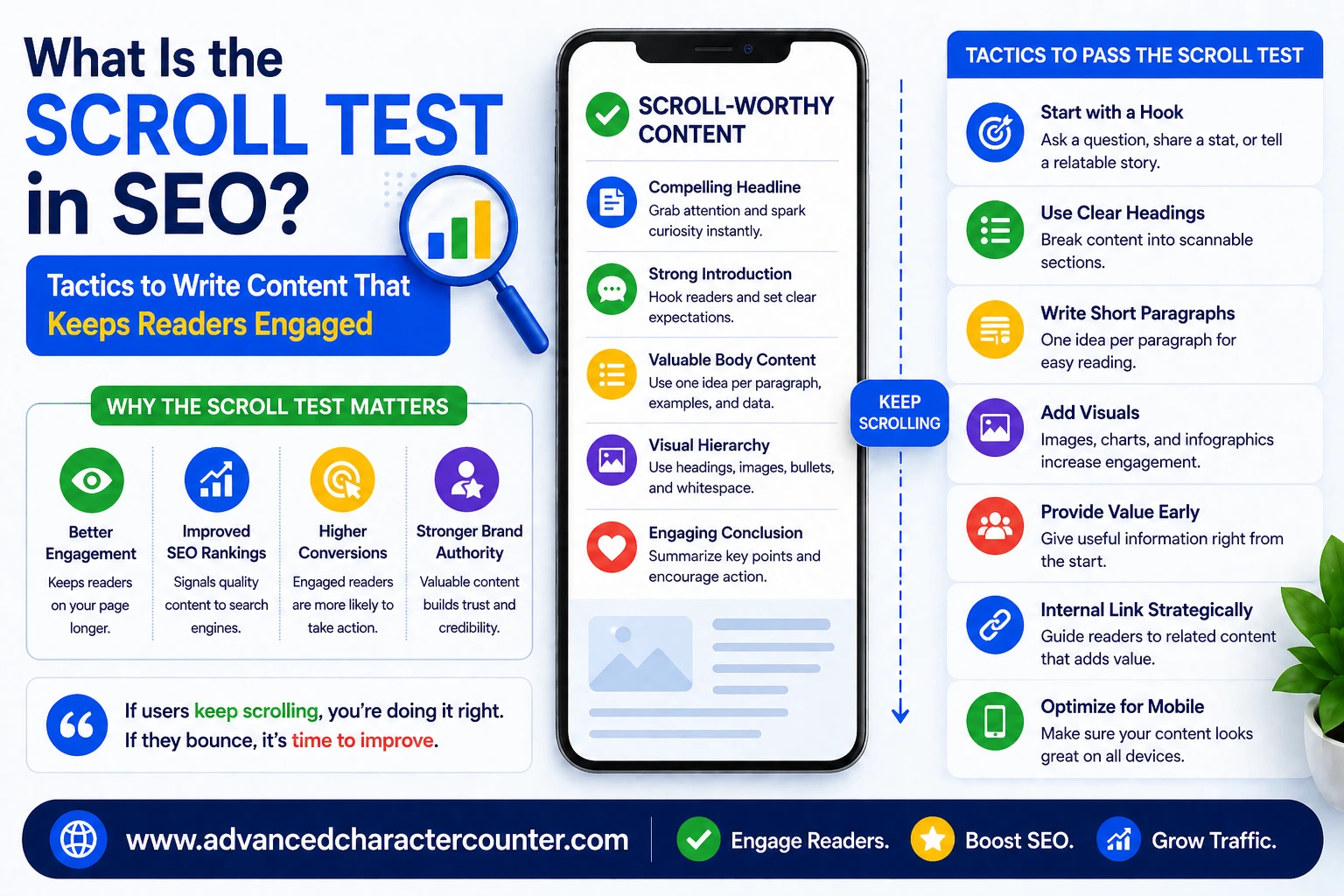
The Scroll Test is not a formal Google metric or an official SEO tool. It is a content quality standard — a way to evaluate whether your writing is strong enough to hold a reader’s attention from the very first sentence to the very last.
Think of it like this: when someone lands on your page, they make a decision within the first 3–5 seconds. They either feel pulled in, or they feel nothing and hit the back button. The Scroll Test asks: does your content earn each scroll? Does every paragraph give the reader a reason to keep going?
The concept is borrowed from the world of video streaming. Netflix calls it the “moment of commitment” — the exact second a viewer decides to keep watching instead of switching shows. Your blog post needs its own moment of commitment, and it needs to happen fast.
Key idea: The Scroll Test is not just about length or word count. A 500-word article can pass the Scroll Test. A 3,000-word article can fail it in the first paragraph. The test is about momentum — forward pull, sentence by sentence.
When a reader scrolls through your full article, something valuable happens beyond the obvious. They absorb your knowledge. They trust your brand. They are more likely to share, bookmark, come back, or convert. These behaviours send real signals back to Google about your content’s quality.
Why Scroll Depth Is an SEO Signal Now
For a long time, SEO was about keywords, backlinks, and page load speed. These things still matter. But in 2023–2025, Google has made its direction clearer than ever: user experience signals are ranking factors.
Google’s Search Generative Experience (SGE) and Helpful Content Updates have both pushed in the same direction — reward content that users find genuinely useful, and punish content that looks good on paper but delivers nothing in practice.
55% of visitors spend fewer than 15 seconds on a page (Nielsen Norman Group)
3.4× more likely to rank well when dwell time exceeds 3 minutes (SEMrush study)
80% of readers never scroll past the headline of an average article (Chartbeat)
74% of content gets zero backlinks — mostly because it isn’t worth finishing (Ahrefs)
Here is what Google is watching, even indirectly through Chrome data and Search Console signals:
- Dwell time — How long does someone stay on your page after clicking from Google?
- Pogosticking — Does the reader immediately return to Google after visiting your page? That’s a bad signal.
- Return visits — Do users bookmark and come back to your content?
- Engagement signals — Do users interact, share, or link to the content?
All of these are directly influenced by how readable, engaging, and well-structured your content is. The Scroll Test, in other words, is your ticket to sustainable rankings.
Why People Leave Your Content Early
Before we fix the problem, we need to understand it. Most readers leave content early for very predictable reasons. If you’ve written any blog posts in the last two years, you have probably committed at least three of these mistakes.
1. The First Paragraph Fails the Trust Test
Your opening paragraph is your handshake. If it starts with “In today’s fast-paced digital world…” — the reader is already gone. These generic openers signal one thing: this writer has nothing original to say. Readers have read this sentence hundreds of times. They recognise it as filler, and they leave.
2. The Content Doesn’t Match the Title’s Promise
Clickbait works once. If someone clicks your headline expecting “10 Ways to Double Blog Traffic” and lands on a 400-word article with no real advice, they feel cheated. They leave — and they probably won’t come back. Every title you write is a promise. Your content must honour it.
3. Walls of Text With No Visual Breaks
Reading on a screen is fundamentally different from reading a book. On screens, people scan first, read second. If your content looks like a university essay — dense paragraphs, no subheadings, no bold text, no breaks — readers’ eyes glaze over. They scroll down, see more walls of text, and give up.
4. Information Arrives Too Late
Many writers build up to their main point. They follow the “academic essay” structure: introduce the topic broadly, provide background, then eventually get to the point. Online readers are impatient. They want the value immediately. If the reader has to scroll through 500 words of context before learning anything useful, they are gone by word 150.
5. The Writing Is Dull
Good SEO content isn’t just about being informative — it needs personality. Passive voice, jargon, overly formal language, and robotic sentence structure all drain the energy out of writing. When reading feels like work, people stop.
Real test: Read your own article out loud. If you feel bored, your readers will too. If you find yourself rushing through a section just to get past it, that section needs to be rewritten or removed.
Anatomy of Content That Passes the Scroll Test
So what does content that actually gets read look like? Let’s break down the structure of a high-scroll-depth article piece by piece.
The Hook (First 100 Words)
Your opening must do three things simultaneously: create curiosity, establish relevance, and signal that value is coming. The best hooks either open with a surprising fact, a relatable problem, a bold statement, or a short story. They do not open with definitions, platitudes, or background context.
Example of a weak hook: “SEO content writing is important for any business that wants to grow online. In this article, we will discuss…”
Example of a strong hook: “Most SEO articles rank on page one and die there. Traffic comes, bounces in seconds, and Google notices. Here’s what’s actually happening — and how to fix it.”
Progressive Value Delivery
Every section of your content must deliver a new piece of value. Think of it like a relay race — each paragraph hands the baton to the next. If a paragraph doesn’t teach something, prove something, illustrate something, or entertain, it needs to go.
Pattern Interrupts
Long-form content needs “pattern interrupts” — visual or structural elements that break the monotony and re-engage the reader’s attention. These include: callout boxes, stat cards, comparison tables, pull quotes, numbered lists, and images. Used correctly, they refresh the reader’s focus and signal: something new is happening here.
A Strong Ending
Most articles just… stop. They answer the question and fade out with a generic sentence like “We hope this article was helpful!” A strong ending does the opposite: it reinforces the key takeaway, gives the reader a clear next action, and leaves them with something memorable. This is what drives shares, bookmarks, and return visits.
10 Writing Tactics That Keep People Reading
These are not theoretical ideas. These are proven techniques used by the world’s top content writers — from long-form journalists at The Atlantic to growth marketers at HubSpot. Apply them and your scroll depth will improve.
- Write short sentences next to long ones: Varied sentence rhythm keeps the brain alert. A long sentence builds context and complexity. Then a short one lands hard. Alternating between the two creates forward momentum.
- Open each section with the most interesting sentence: Don’t warm up. Start cold — with the sharpest, most interesting point in the section. This is called “burying the lede” in journalism, and avoiding it makes every section feel worth reading.
- Use “curiosity gaps” deliberately: A curiosity gap is when you hint at something without fully explaining it yet. “Later in this article, we’ll show you exactly why Google’s algorithm rewards this behaviour — and it’s not what most SEOs expect.” The reader keeps scrolling to find out.
- Write in second person (“you”): Every sentence that uses “you” makes the article feel personal. It sounds like the writer is speaking directly to the reader. This builds connection and keeps people engaged.
- Tell micro-stories“: Humans are wired for stories. A two-sentence anecdote (“Imagine spending three days on an article that ranks on page one — then watching 90% of visitors bounce in seconds”) is more engaging than any statistic. Use them throughout your article, not just at the beginning.
- Make every paragraph earn its place: After writing each paragraph, ask yourself: “If I deleted this, would the reader miss anything?” If the answer is no, delete it. Ruthless editing is what separates good content from great content.
- Use the “So What?” test on every claim: After every important statement, ask: “So what?” If you can’t answer that — if the statement doesn’t lead anywhere, prove anything, or teach anything — cut it.
- Promise the next section: At the end of one section, briefly tease what’s coming next. “Now that we know why readers leave, let’s talk about the specific tactics that keep them.” This simple technique reduces exit rates significantly.
- Use examples from everyday Indian reality (when relevant): For Indian readers specifically, examples that feel local and relatable land far better than hypothetical examples from US companies. “Think of it like an auto-rickshaw driver who always knows the shortest route — your content needs to be that efficient.”
- End with clear, concrete action: Don’t leave readers floating. Give them one specific thing they can do right now: “Go back to your last published article. Look at the first paragraph. Does it have any of the weak-hook patterns we mentioned? Rewrite it using the strong hook formula above.” Specific actions create engagement, shares, and return visits.
“The best SEO content is invisible SEO. The reader doesn’t notice the keywords, the structure, or the strategy — they just feel like they’re reading something genuinely useful.”
Formatting: The Silent Scroll Driver
Here is an uncomfortable truth about online content: most readers scan before they read. Eye-tracking studies from Nielsen Norman Group confirm this. Readers skim the page in an F-pattern — they read across the top, scan down the left side, and only dive in when something catches their attention.
This means your formatting is not decoration — it’s the first version of your content that most readers experience. If the formatting is bad, many readers will decide not to read the actual words at all.
Paragraph Length
Online paragraphs should be 2–4 sentences maximum. Some of the best content writers use one-sentence paragraphs at key moments for impact. Long paragraphs signal effort to the writer, but laziness to the reader.
Subheadings (H2s and H3s)
Subheadings serve two purposes: they help readers navigate, and they help Google understand structure. Every major section needs a descriptive H2. Within long sections, H3s help break up content and re-anchor skimmers. Your subheadings should be descriptive enough to tell a story on their own — a reader should be able to understand 70% of your article’s value just from reading the headings.
Bold Text
Bold text functions like a highlighter pen. Use it to mark the single most important idea in each paragraph. Do not bold random words — this dilutes its effect. If everything is bold, nothing is bold.
Lists
Bullet points and numbered lists are some of the highest-engagement formatting elements in content. They’re easy to scan, easy to remember, and easy to share. Use them when you have 3 or more related items, steps, examples, or tips. But don’t overuse them — if your entire article is a list, it loses all personality.
White Space
White space is not emptiness — it’s breathing room. Dense content is cognitively tiring. Generous white space between paragraphs, sections, and elements makes reading feel easy. This encourages people to keep going.
Good vs. Bad Content: Side-by-Side Comparison
Sometimes the fastest way to understand what not to do is to see both versions in the same place. Here’s an honest comparison of the most common content elements.
| Element | ❌ Bad Practice | ✅ Good Practice |
|---|---|---|
| Opening Paragraph | “In today’s digital age, content is king. In this article, we will explore…” | Opens with a story, a surprising fact, or a bold problem statement that demands attention |
| Paragraph Length | 8–12 lines in a single block with no breaks | 2–4 sentences max; one-sentence paragraphs used for impact at key moments |
| Subheadings | “Introduction”, “Body”, “Conclusion”, “Section 1” | Descriptive, benefit-led: “Why Your First Paragraph Is Costing You Rankings” |
| Keyword Use | Forced into every paragraph, reads unnaturally, keyword stuffed | Placed naturally where it fits; semantic variations used; reads like a human wrote it |
| Depth of Information | Surface-level overview, says what everyone already knows, no new angle | Goes deeper than competitors; uses data, examples, original insight |
| Conclusion | “We hope this article was helpful. Please like and share!” | Reinforces main takeaway, gives one concrete action step, ends memorably |
| Formatting | No bold text, no callouts, no tables, no lists, uniform grey walls of text | Mix of lists, callouts, tables, bold highlights, and visual breaks every 200–300 words |
| Tone | Robotic, overly formal, passive voice throughout, reads like a report | Direct, warm, conversational — like an expert friend explaining something |
| Internal Links | None, or random links with “click here” anchor text | 2–4 contextual links with descriptive anchor text, placed naturally within paragraphs |
| Reading Level | Jargon-heavy, assumes expert knowledge, no explanations | Clear enough for a smart non-expert to follow; jargon is always explained |
Writing for Google Discover vs. Google Search
In 2025, two very different Google surfaces can bring traffic to your content: Google Search (people searching with intent) and Google Discover (Google proactively showing content to users based on their interests). The Scroll Test applies to both, but the path to passing it is slightly different.
| Factor | Google Search | Google Discover |
|---|---|---|
| User Intent | High — they searched for something specific | Low — they weren’t looking for anything, Google showed it |
| First Impression | Title tag + meta description | Hero image + headline — visual impact is everything |
| Keyword Dependency | High — must match search queries | Low — topical authority and engagement matter more |
| Content Type | Evergreen how-tos, comparisons, guides | Trending topics, fresh angles on popular subjects |
| What Drives Performance | Rankings, click-through rate, dwell time | Engagement rate, saves, shares, return visits |
| Scroll Test Priority | Start strong, deliver promised information, end with action | Start with visual + emotional hook, create curiosity, reward at every scroll |
For Google Discover in particular, your hero image plays a massive role. Google requires a high-quality image of at least 1200px width for Discover feature. But more importantly, the image should complement the headline and reinforce curiosity. A reader should see the image + headline combination and immediately want to read more.
💡 Pro Tip
For Google Discover, write about topics where you can offer a fresh angle — not just “what everyone is saying,” but your own analysis, take, or experience. Discover actively rewards content that feels different from what’s already out there.
The Scroll Test Checklist Before You Publish
Use this checklist every time before you hit publish. If you can say yes to every item on this list, your content has a very high chance of passing the Scroll Test — and earning the rankings, time-on-page, and engagement that come with it.
Hook & Opening
- Does your first paragraph avoid generic openers (“In today’s world…”)?
- Does the opening create curiosity, establish a problem, or tell a story within the first 3 sentences?
- Does the intro clearly signal what the reader will gain by reading on?
- Is the first sentence so strong that it would stop a scroller mid-thumb?
Structure & Formatting
- Does every H2 subheading describe a specific value or idea — not just a generic topic?
- Are paragraphs 2–4 sentences maximum throughout?
- Is there at least one visual break (table, list, callout, stat card) every 250–300 words?
- Is bold text used sparingly and purposefully — for the single most important idea per section?
- Does the article have a clear table of contents for long-form content?
Content Depth
- Does every section deliver value that the reader couldn’t get from the top 3 Google results?
- Are all major claims supported by facts, studies, examples, or data?
- Is there at least one original insight, comparison, or framework that only exists in this article?
- Does the article answer the question in the title — completely, not partially?
Writing Quality
- Does the article read naturally when spoken aloud?
- Is passive voice used rarely (not as the default)?
- Are there micro-stories or relatable examples to illustrate abstract concepts?
- Does the writing have a consistent, warm, authoritative voice throughout?
Ending
- Does the conclusion reinforce the single most important takeaway?
- Does it give the reader one specific, actionable thing to do right now?
- Does it end on a memorable note — not with a generic “we hope this helped”?
Quick Test
After writing, read only the first sentence of every paragraph. If those sentences alone tell a coherent, valuable story — your article structure is solid. If they feel random and disconnected, your article needs reorganisation before it’s ready to publish.
Conclusion: Every Scroll Is a Vote
Here is the simplest way to think about all of this: every scroll is a vote of confidence. When a reader scrolls down on your page, they are telling you — and Google — that what you wrote was worth their time. When they stop scrolling and leave, they are telling you the same thing in reverse.
The Scroll Test is not about writing longer content, or adding more keywords, or gaming any algorithm. It is about respecting the reader’s time and intelligence enough to give them something genuinely worth finishing. When you do that consistently, the SEO results follow naturally — because Google’s goal has always been to reward content that real humans actually love.
So here is your one action step from this article: go back to your last published piece. Read the first paragraph. Look at the first sentence of each section. Check if you have any visual breaks in the first 500 words. If it fails the Scroll Test by the standards in this article — rewrite the opening, tighten the structure, and add a pattern interrupt in the first third of the content.
Do that for your top five articles and watch what happens to your dwell time, your rankings, and your return visitor rate over the next 30 days. The Scroll Test is not a nice-to-have. In 2025, it is the standard.
Frequently Asked Questions (FAQs)
What is the Scroll Test in SEO content writing?
The Scroll Test is a method to check whether readers stay engaged and continue scrolling through your content. It focuses on attention, readability, and value, not just word count.
Why is scroll depth important for SEO rankings?
Scroll depth shows how much of your content users read. Higher scroll depth means better engagement, which improves dwell time and sends positive signals to search engines.
How can I make my content pass the Scroll Test?
You can pass the Scroll Test by using strong hooks, short paragraphs, engaging writing style, clear headings, and adding visual breaks like lists and tables.
What is the biggest mistake writers make in SEO content?
The biggest mistake is focusing only on rankings instead of readability. Many articles rank well but fail to keep readers engaged, leading to high bounce rates.
How does the introduction affect reader engagement?
The introduction decides whether a reader stays or leaves. A strong opening creates curiosity and shows immediate value, while a weak intro leads to quick exits.
What are pattern interrupts in content writing?
Pattern interrupts are elements like bullet points, images, tables, and quotes that break monotony and keep readers interested throughout the article.
How does formatting impact content performance?
Good formatting improves readability. Short paragraphs, headings, bold text, and white space make content easier to scan and increase engagement.
Can long-form content fail the Scroll Test?
Yes, even a 3000-word article can fail if it is boring, poorly structured, or lacks value. The Scroll Test depends on engagement, not length.