Your LinkedIn profile has about three seconds to make a first impression. Recruiters scroll fast. Hiring managers skim. Clients decide within a glance whether to read on or move to the next profile. And among all the sections of your LinkedIn profile, the summary — also called the ‘About’ section — is the one that either stops the scroll or loses the reader entirely.
Yet the majority of LinkedIn summaries in India and globally are either blank, copied from a resume, or filled with buzzwords that say nothing meaningful. This guide will change that. You will learn exactly what to write, how to structure it, and why certain approaches work better than others — with real examples you can model.
What Is the LinkedIn About / Summary Section?
The LinkedIn About section (formerly called the Summary) is a 2,600-character text field that appears near the top of your profile, just below your headline and profile photo. It is the first extended piece of writing a visitor sees when they click on your profile.
Unlike your headline — which is limited to a single line — the About section gives you room to tell your professional story: who you are, what you do, why you do it, and what makes you different from everyone else with your job title.
Key Insight: LinkedIn shows only the first 2-3 lines of your About section before a ‘See more’ prompt appears. These first lines must be compelling enough to make the reader click ‘See more’ — otherwise, the rest of your carefully written summary is invisible.
Why Your LinkedIn Summary Matters More Than You Think
| LinkedIn Element | Visibility | Impact on First Impression |
|---|---|---|
| Profile Photo | Always visible | Creates initial trust and approachability |
| Headline | Always visible | Communicates your role and value in one line |
| About / Summary | First 2-3 lines always visible | Deepest opportunity to tell your story and be found in search |
| Experience Section | Requires scrolling | Provides evidence for claims made in the summary |
| Skills & Endorsements | Requires scrolling | Supports searchability and credibility |
| Recommendations | Requires scrolling | Social proof from real people |
LinkedIn’s algorithm uses your About section as one of the key inputs for search rankings. When a recruiter searches for ‘Data Analyst in Mumbai’ or a client searches for ‘SEO consultant India,’ LinkedIn scans the About section for matching keywords. A well-written, keyword-rich summary directly improves how often you appear in relevant searches.
What Makes a Great LinkedIn Summary?
1. A Strong Opening Line
Your first sentence is your hook. It needs to answer one question: why should this person keep reading? The opening should immediately communicate either who you are, what you help people achieve, or what makes your story interesting. It should never start with ‘I am a passionate…’ — that phrase has become so overused it has lost all meaning.
2. Clear Professional Identity
Readers should understand within the first paragraph exactly what you do, for whom, and at what level. This is your professional identity — not just your job title, but the value you bring. Think of it as a longer version of your elevator pitch.
3. Specific Achievements or Proof
Generic summaries make generic impressions. The best LinkedIn summaries include one or two specific achievements — numbers, results, or notable projects — that prove your capabilities rather than just claiming them.
4. Personality and Voice
LinkedIn is a professional network, but it is still a social platform. Profiles that feel human — not robotic — attract more engagement. Your summary should sound like you talking, not like a resume bullet point.
5. A Clear Call to Action
End your summary by telling the reader what you want them to do next: connect with you, message you about a specific type of opportunity, visit your website, or reach out for collaboration. Without a call to action, even a great summary leaves the reader wondering what to do.
LinkedIn Summary: What to Include and What to Avoid
| Include in Your Summary | Avoid in Your Summary |
|---|---|
| Your current role and professional identity | Buzzwords: ‘passionate,’ ‘hardworking,’ ‘results-driven’ without proof |
| One or two specific, quantified achievements | Copying your resume experience bullet points verbatim |
| The type of work you specialise in or enjoy most | Vague mission statements (‘I aim to add value in everything I do’) |
| Keywords relevant to your industry and role | Generic statements that could apply to anyone in any job |
| What you are looking for (job, clients, collaborations) | Excessive length — more than 400 words loses most readers |
| Your unique perspective, background, or approach | Writing in third person (‘Rahul is a driven professional…’) |
| A direct call to action at the end | Contact information that violates LinkedIn’s community guidelines |
LinkedIn Summary Structure: The Proven Framework
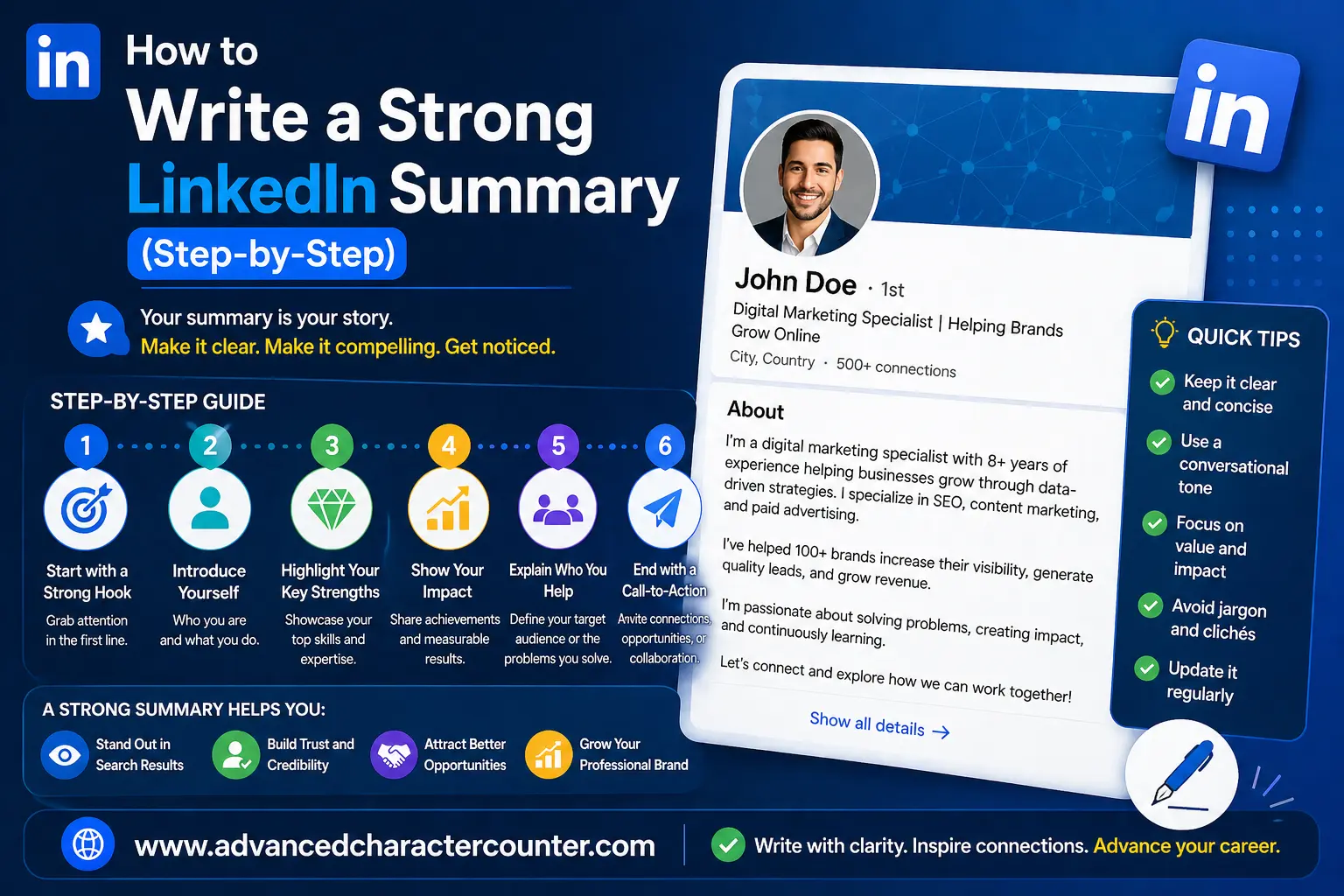
Here is a proven five-part structure that works across industries and career levels:
- Opening Hook (1-2 sentences): A specific, compelling statement that answers: who are you, and why does it matter?
- Professional Identity (2-3 sentences): Your current role, area of specialisation, and the type of value you create.
- Proof / Achievements (2-4 sentences): One or two specific results, projects, or experiences that demonstrate your capability.
- Personality / Why (1-2 sentences): What drives you professionally? What is your approach or philosophy?
Call to Action (1 sentence): Tell the reader exactly what you want them to do — reach out, connect, visit your site.
LinkedIn Summary Examples Across Different Profiles
Example 1 — Software Engineer (3-5 Years Experience)
SOFTWARE ENGINEER EXAMPLE
I build backend systems that handle millions of requests without breaking a sweat.Currently a Senior Software Engineer at a Bengaluru-based fintech startup, I specialise in distributed systems, API design, and cloud infrastructure on AWS. Over the past four years, I have contributed to systems that now process over Rs. 200 crore in daily transactions.I enjoy the complexity of scaling engineering problems and the discipline of writing clean, maintainable code that a team can grow with. I am most energised when I am working on genuinely hard problems with curious, collaborative people.Open to senior engineering roles in product startups. Feel free to connect or message me directly.
Example 2 — Marketing Professional
MARKETING PROFESSIONAL EXAMPLE
I help brands stop being forgettable.As a digital marketing lead with 6 years of experience across D2C and B2B brands, I specialise in building content and paid media strategies that turn cold audiences into loyal customers. I led a campaign that grew a brand from 8,000 to 65,000 Instagram followers in 10 months and reduced cost-per-acquisition by 34% through systematic A/B testing.I believe great marketing starts with understanding people deeply — their frustrations, habits, and motivations — before thinking about channels or creatives.I am currently exploring senior marketing roles or consulting opportunities with brands that are serious about growth. Reach out if you want to talk strategy.
Example 3 — Recent Graduate / Fresher
FRESHER EXAMPLE
Final-year Computer Science student at VIT Vellore | Interested in machine learning and data engineering.During my undergraduate, I completed two internships — one at a health-tech startup where I built a patient prediction model using Python and scikit-learn, and another at a data consultancy where I worked on ETL pipeline optimisation in SQL and Apache Spark.I like building things that solve real problems. Outside academics, I have solved 400+ problems on LeetCode and contributed to two open-source projects on GitHub.Looking for entry-level data engineering or analyst roles starting July 2025. Open to opportunities across Bengaluru, Hyderabad, and Pune.
Example 4 — Freelancer / Consultant
FREELANCER EXAMPLE
I write content that ranks, converts, and actually gets read.Freelance SEO Content Writer with 5 years of experience helping SaaS, fintech, and edtech brands build authority through long-form content. My articles have ranked on Google Page 1 for competitive keywords, and I have helped three clients grow organic traffic by 3x within a year of sustained collaboration.I work with a small number of clients at a time so I can genuinely invest in understanding their audience, product, and voice. I am not a content mill — I care about quality.Currently taking on 1-2 new content partnerships. If you need a reliable writer who understands SEO, let us have a conversation.
Common LinkedIn Summary Mistakes to Fix Right Now
Mistake 1 — Writing in Third Person
‘Priya is a dynamic marketing professional with 8 years of experience…’ This reads like someone else wrote your profile for you. Write in first person. LinkedIn is personal — be direct and human.
Mistake 2 — Starting With Your Job Title
‘I am a Senior Manager at XYZ Company…’ Your headline already says this. Your summary needs to say something your headline cannot. Start with what makes you interesting, not what makes you identifiable.
Mistake 3 — The Buzzword Soup
‘Results-driven, innovative, passionate, dynamic, synergistic…’ These words appear so frequently in LinkedIn summaries that they have become noise. Replace every buzzword with a specific fact. Not ‘innovative’ — ‘launched the company’s first AI-based customer support tool.’
Mistake 4 — No Call to Action
A summary without a call to action is like a job interview where you forget to ask about next steps. Always end with what you want: a connection, a message, a visit to your portfolio, or an invitation to reach out about specific opportunities.
Mistake 5 — Leaving It Blank
LinkedIn’s own data shows that profiles with complete About sections receive significantly more profile views than those with blank ones. If your About section is empty, you are invisible to a significant portion of the people who could be relevant to your career.
LinkedIn Summary Tips for Indian Professionals
Mention Your City (and Flexibility)
Recruiters in India frequently filter by city. Mention your current location and any flexibility you have: ‘Based in Pune, open to remote or Bengaluru-based roles.’ This simple addition dramatically improves your appearance in localised searches.
Use Industry-Specific Keywords Naturally
Think about what terms a recruiter searching for someone like you would type into LinkedIn’s search bar. Include those terms naturally in your summary. If you are in IT, include technology names. If you are in finance, include relevant certifications like CA, CFA, or CPA. If you are in marketing, include the specific platforms and tools you use.
Mention Career Transitions Explicitly
Many Indian professionals are either switching industries, returning after a break, or moving from service companies to product companies. Do not let the reader guess about these transitions. A single sentence of context — ‘After 4 years in IT services, I am now focused on product-focused engineering roles’ — prevents confusion and shows self-awareness.
How to Format Your LinkedIn Summary for Readability
- Use short paragraphs: 2-4 lines maximum per paragraph on a screen.
- Use line breaks: Add a blank line between each section or thought.
- Use emoji sparingly: One or two emoji can help break up sections visually, but overuse looks unprofessional.
- Avoid long, unbroken blocks of text: Nobody reads a wall of text on a mobile screen.
- Bold or capitalise key terms: LinkedIn does not support markdown, but you can use ALL CAPS sparingly for emphasis on key terms.
“Your LinkedIn summary is not a biography. It is a professional argument for why someone should want to know you.”
Frequently Asked Questions (FAQs)
Q: How long should a LinkedIn summary be?
A: LinkedIn allows up to 2,600 characters. However, the ideal length is 150 to 300 words — enough to be substantive without losing the reader’s attention. Since only the first 2-3 lines are visible before the ‘See more’ prompt, those opening lines carry disproportionate importance.
Q: Should I write my LinkedIn summary in first person or third person?
A: Always first person. Third person (‘John is a dedicated professional…’) sounds distant and impersonal on a platform that is meant to facilitate genuine professional connections. Write the way you would speak to someone you had just met at a professional event.
Q: How do I make my LinkedIn summary searchable by recruiters?
A: Include keywords relevant to your role and industry naturally within your summary text. Think about the specific job titles, technologies, tools, certifications, and industry terms a recruiter would search for. LinkedIn’s search algorithm indexes your About section, so relevant keywords directly improve your discoverability.
Q: How often should I update my LinkedIn summary?
A: Review and update your summary every six months, or immediately after a major career change: a promotion, a new role, a completed certification, or a pivot in career direction. An outdated summary that describes your previous role or goals can confuse recruiters and reduce your chances of relevant enquiries.
Q: Can I use my LinkedIn summary to explain a career gap?
A: Yes — briefly. If you have a gap you want to contextualise, your summary is a good place to address it in one or two confident sentences. For example: ‘After a two-year break to care for a family member, I returned to marketing in 2024 with updated skills in digital and content strategy.’ Honest, brief, and forward-looking.
Q: Should freshers also write a LinkedIn summary?
A: Absolutely. For freshers, the summary is even more important because you cannot rely on an extensive work history to sell yourself. Use the summary to highlight your academic projects, internships, certifications, and the type of role you are seeking. A compelling fresher summary can attract recruiters who look beyond work experience.
Q: Is it okay to add contact information in the LinkedIn summary?
A: LinkedIn’s terms of service discourage adding email addresses or phone numbers directly in your profile content as it violates certain community guidelines. Instead, use LinkedIn’s own messaging feature. You can mention that you are open to being contacted without including specific contact details in the summary text.
Before You Finish: Read your summary aloud. Does it sound like you? Is every sentence earning its place? Does the opening make you want to read on? If yes — publish it. If anything sounds stiff, generic, or unclear — revise it. Your summary is a living document. Improve it over time.