Every productive meeting deserves an accurate record. That record is the Minutes of Meeting — or MOM as it is commonly called in Indian corporate and government workplaces. Writing good meeting minutes is a skill that saves time, prevents confusion, and protects everyone in the room from disputes about what was decided.
Yet, most professionals who are asked to write MOM for the first time struggle. They write too much, too little, or capture opinions when they should be capturing decisions. This guide fixes all of that.
What Are Minutes of Meeting (MOM)?
Minutes of Meeting (MOM) are the official written record of what was discussed, decided, and assigned during a meeting. They are not a transcript — they do not capture every word spoken. They are a structured summary of:
- What topics were covered
- What decisions were made
- What actions were assigned and to whom
- What deadlines were set
- Who was present and who was absent
MOM serves as an official document that all attendees can refer to for clarity. In legal, government, and corporate contexts, they can also serve as evidence in disputes.
Remember: MOM is a record of decisions and actions, not a debate transcript. Your job is to capture what was decided, not who said what or how heated the discussion was.
MOM vs. Agenda vs. Action Items: Understanding the Difference
| Document | Purpose | Written When | Who Uses It |
|---|---|---|---|
| Meeting Agenda | Lists topics to be discussed | Before the meeting | All attendees, meeting organiser |
| Minutes of Meeting (MOM) | Records what was discussed and decided | During or immediately after the meeting | All attendees, stakeholders, management |
| Action Items List | Lists tasks assigned with owners and deadlines | During or after the meeting | Team members with assigned tasks |
| Meeting Summary | Brief informal summary of key outcomes | After the meeting | For quick reference; less formal |
Standard Format of Minutes of Meeting
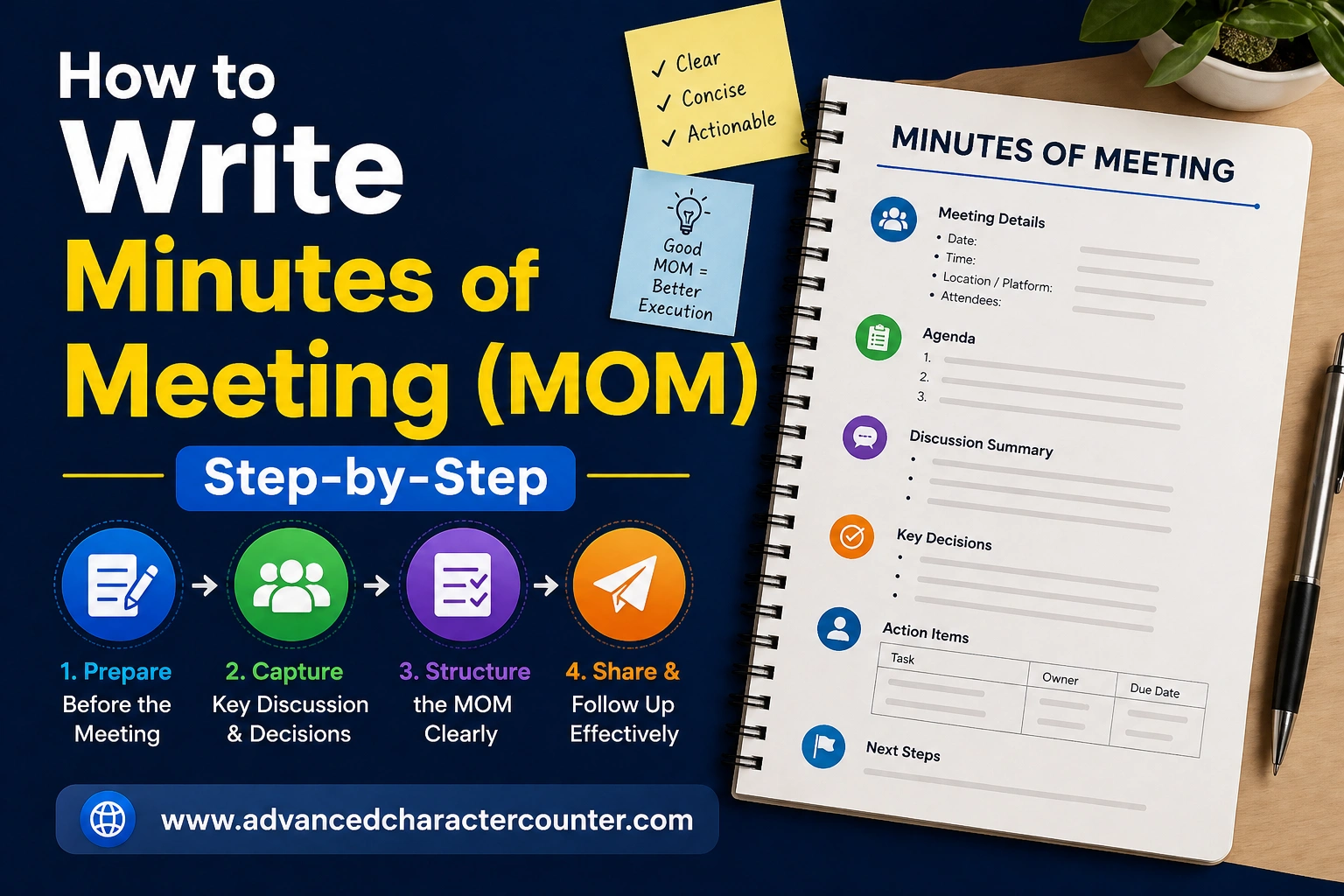
While different organisations may have their own MOM templates, the standard format used across most Indian and international workplaces includes these sections:
1. Meeting Header
This section includes: Meeting title or subject, Date and time, Location (or meeting platform for virtual meetings), Meeting called by (organiser/chairperson).
2. List of Attendees
Names and designations of all attendees. Also note who was absent or who joined late. For large meetings, you can attach a separate attendance sheet.
3. Agenda Items
List the topics that were planned for discussion, in the order they were discussed.
4. Discussion and Decisions
For each agenda item: Briefly summarise what was discussed. Clearly state what was decided. Note any important points raised or concerns mentioned.
5. Action Items
The most critical section. List every task that was assigned: What needs to be done, who is responsible, and by when.
6. Next Steps / Next Meeting
Date and agenda for the next meeting if decided. Any follow-up items not assigned to a specific person.
7. Signature
Name and designation of the person who prepared the MOM, and optionally, the chairperson’s signature for approval.
MOM Template: Ready to Use
MOM TEMPLATE
MINUTES OF MEETINGMeeting Subject: [Title of the meeting]Date: [DD/MM/YYYY]Time: [Start time] to [End time]Venue: [Location / Virtual Platform]Organised by: [Name, Designation]ATTENDEES:[Name] — [Designation] — [Department][Name] — [Designation] — [Department]ABSENT: [Name] — [Reason if known]AGENDA:1. [Agenda Item 1]2. [Agenda Item 2]3. [Agenda Item 3]DISCUSSION & DECISIONS:1. [Agenda Item 1]: [Summary of discussion]. Decision: [What was decided].2. [Agenda Item 2]: [Summary of discussion]. Decision: [What was decided].ACTION ITEMS:| Task | Responsible Person | Deadline ||——|——————-|———-|| [Task] | [Name] | [Date] |NEXT MEETING: [Date and time, if decided]Minutes prepared by: [Name] | Date prepared: [Date]
How to Write MOM: Step-by-Step
Step 1 — Prepare Before the Meeting
Good MOM starts before the meeting. Obtain the meeting agenda in advance. Create a template with the header details already filled in. Know who the attendees are and what their roles are. Being prepared means you can focus on capturing content, not figuring out the format on the fly.
Step 2 — Take Notes During the Meeting
You do not need to write everything down. Focus on: decisions made, tasks assigned, deadlines agreed upon, and key points of disagreement. Use shorthand or abbreviations during the meeting and expand them when you write the final MOM. If you miss something, it is perfectly acceptable to ask for clarification before the meeting ends.
Step 3 — Record Action Items Carefully
This is the most important section. For each action item, note: WHAT needs to be done, WHO is responsible (full name, not just initials), and BY WHEN (specific date, not ‘ASAP’). Vague action items cause meetings to be unproductive. Your job is to ensure each task is clearly assigned.
Step 4 — Write the MOM Immediately After the Meeting
Do not wait until the next day. Write the MOM within two to three hours of the meeting while everything is fresh. Expand your shorthand notes, organise the discussion points, and convert rough notes into clear, professional sentences.
Step 5 — Review and Circulate
Read through the completed MOM before sending it. Check that all action items are accurate, all attendees are listed correctly, and no key decision has been missed. Send the MOM to all attendees and relevant stakeholders within 24 hours. If your organisation requires it, get the MOM approved by the chairperson before circulation.
Step 6 — Archive the MOM
Save the MOM in a shared location that all relevant team members can access. Use a consistent naming convention: ‘MOM_ProjectName_DDMMYYYY’ is a good standard. This makes it easy to retrieve past minutes for reference.
MOM Example: Before and After
Poor MOM Writing
POOR MOM EXAMPLE
Discussion about the website project happened. Everyone shared their thoughts. Ravi said he will handle the design. Priya was asked about the deadline and said she will try to finish soon. We talked about the budget too. Meeting ended at 4 PM.
What is wrong: No specific decisions recorded. ‘Will try to finish soon’ is not a deadline. No formal action item structure. No context about what was discussed or decided on the budget.
Good MOM Writing
GOOD MOM EXAMPLE
Agenda Item 1 — Website Redesign Update:Discussion: The team reviewed the current website layout and identified slow loading times and outdated design as primary concerns.Decision: A complete redesign of the homepage and product pages was approved.Action Items:- Task: Create new homepage wireframes | Owner: Ravi Sharma (UI/UX Lead) | Deadline: 15 May 2025- Task: Content audit of all product pages | Owner: Priya Mehta (Content Head) | Deadline: 10 May 2025- Task: Get revised budget approval from Finance | Owner: Ankit Verma (PM) | Deadline: 5 May 2025
Common MOM Mistakes to Avoid
| Mistake | Why It Is a Problem | What to Do Instead |
|---|---|---|
| Writing a transcript | Makes the document too long and hard to reference | Write decisions and actions only — summarise discussions |
| Vague action items | ‘Someone will handle it’ — creates confusion and no accountability | Name the person, describe the task, set a date |
| Sending MOM too late | People forget what was discussed; action items get delayed | Send within 24 hours of the meeting |
| Using jargon or abbreviations | MOM is shared widely — not everyone knows internal shorthand | Write out full terms on first mention |
| Not recording dissent | If someone disagreed with a decision, it should be noted for record | Note objections briefly and professionally |
| Missing the action item table | Without a clear table, action items are buried in text | Always use a structured table for all action items |
MOM Writing Tips for Different Types of Meetings
For Project Review Meetings
Focus on milestones, delays, and risks. Each action item should link to a specific project phase. Note any scope changes formally — these can prevent disputes later.
For Board or Governance Meetings
These require a more formal tone. All resolutions must be recorded exactly. Names, designations, and vote counts (if applicable) must be noted. Approval by the chairperson before circulation is usually mandatory.
For Team Stand-Up or Status Meetings
MOM can be shorter and more informal. Focus entirely on the action items table. A brief one-liner per agenda item is sufficient for these frequent, short meetings.
For Virtual Meetings
Note the platform used (Zoom, Google Meet, Microsoft Teams). Record if any attendees had connectivity issues that may have caused them to miss parts of the discussion. For large virtual meetings, attendance confirmation via email can supplement the attendee list.
Frequently Asked Questions (FAQs)
Q: Who is responsible for writing the Minutes of Meeting?
A: Usually, the meeting organiser assigns this responsibility to a team member before the meeting. In corporate settings, it is often the junior-most professional in the meeting, a designated secretary, or the project coordinator. For recurring meetings, the responsibility can rotate among team members.
Q: Should MOM be written in first person or third person?
A: Always write MOM in third person. Instead of ‘I noted that the deadline was extended,’ write ‘The team agreed to extend the deadline to 30 May 2025.’ MOM is an official document and must maintain an objective, impersonal tone.
Q: How long should MOM be?
A: There is no fixed length. A short team meeting might produce half a page of MOM. A three-hour board meeting might produce four to five pages. Focus on capturing all decisions and action items accurately, not on meeting a word count.
Q: What if someone disagrees with the MOM after it is circulated?
A: Respond promptly and professionally. Review your notes and the recording (if any). If a correction is valid, issue a revised MOM. Always note the revision date and what was changed. If the disagreement is about a decision — not the record of a decision — that should be raised in the next meeting.
Q: Can MOM be sent via WhatsApp or informal channels?
A: For informal team check-ins, yes. But for official business — client meetings, board meetings, project reviews — MOM should always be sent via official email. This creates a formal record that can be referred to if disputes arise.
Q: Is it necessary to get MOM signed?
A: It depends on the organisation and the type of meeting. Board meetings, AGMs, and legal/compliance meetings typically require the chairperson’s signature. Internal team meetings may not. Check your organisation’s policy and follow it consistently.
Q: How do I take notes effectively during a meeting?
A: Focus on capturing decisions and action items rather than everything that is said. Use a simple two-column system: one column for the discussion point, one for the decision or action. After the meeting, you can expand these notes into proper MOM format.