Leaving a job is one of the most emotionally layered professional experiences. Whether you are excited, relieved, sad, or all three at once, the goodbye email you send on your last day is the final impression you leave on every colleague who reads it.
A well-written farewell email does three important things: it thanks the people who mattered, it leaves your professional relationships intact, and it keeps the door open for future opportunities. A poorly written one — or skipping it entirely — is a small but real mark against your professional reputation. This guide gives you everything you need to get it right.
Why a Goodbye Email Matters More Than You Think
The professional world in India — especially within industries — is far smaller than it appears. The manager you are leaving today may be your client five years from now. The colleague you worked beside may be on the hiring committee at your next dream company. The intern you mentored may one day be your boss.
A gracious, warm farewell email plants a positive memory in minds that will hold your professional reputation long after you have walked out of the office. It costs you fifteen minutes and protects years of goodwill.
Data Point: According to a survey by LinkedIn, 85% of jobs are filled through networking. The people you say goodbye to professionally are part of your long-term network — treat them that way.
When Should You Send Your Goodbye Email?
| Timing | Recommended? | Reason |
|---|---|---|
| Last day of work, morning | Ideal | Gives colleagues time to respond before you leave; you can say goodbye in person too |
| Day before your last day | Also good | Allows longer conversations and wrap-up without time pressure |
| Several days before leaving | Acceptable | Useful if your role involves handover processes and wider communication needed |
| After leaving (days/weeks later) | Not ideal | Loses the momentum and feels like an afterthought to most recipients |
| Never / not sending one | Not recommended | Leaves an unfinished impression; some colleagues may feel dismissed or forgotten |
Who Should Receive Your Goodbye Email?
Send a Group Email To:
- Your immediate team or department
- Cross-functional colleagues you worked with regularly
- The broader office or organisation (if appropriate and customary)
Send Individual, Personal Emails To:
- Your direct manager
- Mentors who invested in your growth
- Close colleagues you built genuine professional friendships with
- Key clients or external contacts (if you managed these relationships)
Tip: The individual emails matter as much as the group one. A personalised note to your manager or mentor — separate from the team-wide farewell — is a meaningful gesture that most people remember.
What to Include in a Farewell Email
| Element | What to Write | Why It Matters |
|---|---|---|
| Clear subject line | ‘Farewell from [Your Name]’ or ‘Thank you and goodbye — [Your Name]’ | People should know immediately what the email is about |
| Warm opening | Acknowledge the date and that you are leaving | Sets the tone and gives context |
| Genuine gratitude | Thank specific people or the team for specific things | Generic thanks lands hollow; specificity is what people remember |
| What you are doing next | Brief mention of your next step (optional but often appreciated) | Satisfies natural curiosity; keeps things transparent |
| Stay-in-touch details | Your personal email and LinkedIn profile URL | Makes reconnection easy; your work email will be deactivated |
| Warm close | A genuine, forward-looking sign-off | Leaves the relationship in a positive state |
Farewell Email Templates for Every Situation
Template 1 — Standard Group Farewell Email
TEAM FAREWELL EMAIL
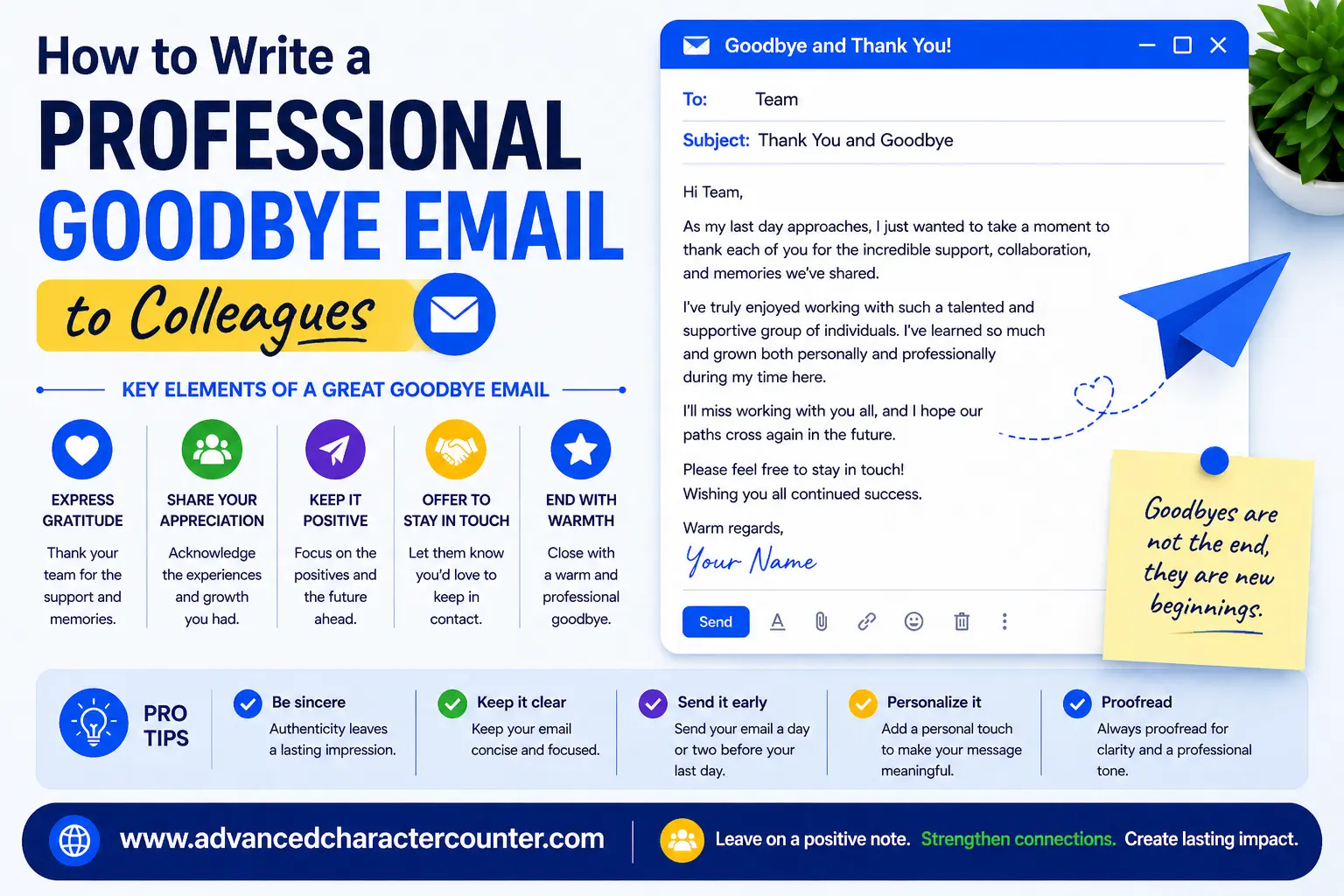
Subject: Farewell and Thank You — [Your Name]Dear Team,Today is my last day at [Company Name], and I wanted to reach out before I go to express how much these [X years/months] have meant to me.Working with this team has been one of the most rewarding chapters of my career. I have learned more than I expected, been challenged in the best ways, and had the privilege of working alongside people who are genuinely excellent at what they do. A special thanks to [mention 1-2 names if appropriate] for their guidance and support.I am moving on to [brief mention of next role/venture], and I am excited for the next chapter — though I will genuinely miss this team.Please stay in touch. My personal email is [email] and you can also find me on LinkedIn at [URL]. I would love to stay connected.Thank you for everything.Warm regards,[Your Name]
Template 2 — Personal Goodbye to a Manager or Mentor
MANAGER / MENTOR FAREWELL EMAIL
Subject: Thank You — [Your Name]Dear [Manager’s Name],As I wrap up my last day at [Company], I wanted to send you a separate note — because a group email does not do justice to what I want to say.Working under your leadership over the past [X years] has shaped the way I think about [relevant skill/approach/leadership]. Specifically, [mention one concrete thing they did or taught you that affected your growth]. That kind of mentorship is something I will carry with me wherever I go.Thank you for trusting me with challenging projects, for your feedback even when it was hard to hear, and for treating my growth as something worth investing in.I hope our paths continue to cross. Please do not hesitate to reach out — professionally or personally. My personal email is [email] and I am always on LinkedIn at [URL].With genuine gratitude,[Your Name]
Template 3 — Farewell When Leaving on Difficult Terms
FAREWELL ON DIFFICULT TERMS
Subject: Farewell — [Your Name]Dear Team,Today marks my last day at [Company Name]. I wanted to reach out before leaving to thank you for the experiences and opportunities I had during my time here.Every workplace teaches you something valuable, and my time here was no exception. I wish the team and the organisation continued success.For anyone who would like to stay in touch, my personal email is [email] and I am on LinkedIn at [URL].Thank you and best wishes,[Your Name](Note: This version is deliberately short and neutral. When leaving on difficult terms, less is more. Avoid any negativity, complaints, or pointed comments — even veiled ones. A short, respectful note is the professional choice.)
Template 4 — Farewell to Clients or External Contacts
CLIENT FAREWELL EMAIL
Subject: A Note from [Your Name] — Transition UpdateDear [Client Name],I wanted to reach out personally to let you know that I will be leaving my role at [Company Name] on [date].It has been a genuine pleasure working with you and your team on [mention specific project or relationship]. You will be in excellent hands going forward — [Colleague’s Name] will be taking over our account and is fully briefed on everything we have worked on together.Thank you for a relationship I have truly valued. I hope our professional paths cross again in the future. In the meantime, please feel free to reach me at [personal email] or [LinkedIn].Best regards,[Your Name][Title] | [Company]
What NOT to Say in a Farewell Email
| Avoid Saying This | Why | Say This Instead |
|---|---|---|
| ‘I am so glad to be leaving’ | Sounds bitter; colleagues who stay will feel judged | Focus on gratitude for the experience, not relief at leaving |
| Detailed complaints about the company or management | Unprofessional; will be remembered negatively and can spread | If you have feedback, share it privately in your exit interview |
| ‘I am going to [Competitor Company]’ | Can create awkwardness; your old team may feel conflicted | ‘I am excited about my next opportunity’ is enough |
| ‘You can always reach me at my work email’ | Your work email will be deactivated — often immediately | Always give your personal email and LinkedIn in farewell emails |
| Tagging specific people in negative comparisons | Even veiled criticism of colleagues is unprofessional and unkind | Either say something genuinely kind or say nothing about that person |
| A very long email full of inside jokes | Feels exclusionary to those who do not share the context | Keep it warm but professional enough for the full distribution list |
Special Situations: Farewell Email Considerations
If You Were Laid Off
Keep the email focused on gratitude and relationships, not on the layoff itself. You do not owe an explanation to the entire company about the circumstances. A short, warm, forward-looking farewell is appropriate and dignified.
If You Are Retiring
A retirement farewell can be slightly longer and more personal. You have the benefit of time and perspective. Reflect on what the career meant to you, thank the colleagues who shaped your journey, and be specific — retired colleagues are often remembered fondly for the warmth of their farewell.
If You Are Leaving for a Competitor
Keep it professional and brief. You do not need to mention where you are going unless you want to. If you do mention it, frame it positively without making comparisons. Your colleagues will find out eventually — what matters is that you left with grace.
Frequently Asked Questions (FAQs)
Q: Is a farewell email mandatory when leaving a job?
A: It is not legally required, but it is strongly recommended as a professional courtesy. Skipping it can make colleagues feel dismissed and leaves your final impression as an abrupt absence. In most professional environments in India — especially corporate offices — a farewell email is the expected norm.
Q: Should I send my farewell email from my work email or personal email?
A: Send it from your work email on your last day – while you still have access. Before sending, mention your personal email in the body of the email so colleagues can reach you after your access is deactivated. Never assume your work email will remain active after you leave.
Q: What should I do if I cannot access my work email on my last day?
A: If your access has already been revoked, reach out via LinkedIn or text to the colleagues most important to you. A personal LinkedIn message is perfectly appropriate for a farewell when email is not available. You can also ask HR if a final email is possible.
Q: How do I handle a farewell email when I have mixed feelings about leaving?
A: You do not need to perform emotions you do not feel. Focus on what is genuinely true: gratitude for the learning, appreciation for specific relationships, and good wishes for the team. You do not need to be enthusiastically positive – just honest and warm.
Q: Can I send a farewell email if I was asked to leave (terminated)?
A: Yes. A professional farewell is appropriate regardless of the circumstances of your departure. Keep it brief and gracious. Focus on gratitude and relationship preservation. What you do not say matters as much as what you do say in this situation.
Q: Should I CC my manager on the farewell email to my team?
A: Yes, unless you have been specifically told not to. Your manager is part of the team’s communication structure, and including them is a professional courtesy. It also prevents the email from feeling like something done behind the company’s back.
Q: Is it appropriate to mention my next employer in the farewell email?
A: It depends on the situation. If you are moving to a competitor, it may create awkwardness and is best omitted. If you are moving to a non-competing organisation, a brief mention is fine and often satisfies people’s natural curiosity. Never make comparisons between your old and new employer.