A strong letter of recommendation can tip the balance in your favour — whether you are applying to a university abroad, seeking a scholarship, changing jobs, or applying for a professional programme. But asking for one feels uncomfortable for most people. You worry about imposing, about being rejected, or about not knowing what to say.
The good news: asking for a recommendation is a normal part of professional and academic life, and most people who have worked with you or taught you are genuinely happy to write one — when asked correctly. This guide tells you exactly how to do it right, from choosing the right person to following up after they have submitted it.
Who Should You Ask for a Letter of Recommendation?
Choosing the right recommender is as important as the letter itself. A weak letter from a famous person is far less valuable than a strong, specific letter from someone who genuinely knows your work and character.
| Recommender Type | Best For | What They Can Speak To | Considerations |
|---|---|---|---|
| Former / Current Manager | Job applications, MBA programmes | Professional skills, work ethic, specific achievements | Best choice for professional applications; avoid if relationship was poor |
| University Professor | Graduate admissions, research programmes, scholarships | Academic ability, intellectual curiosity, specific coursework | Most effective if they know you personally, not just by name |
| Internship Supervisor | Entry-level jobs, grad school apps | Professional aptitude, learning ability, attitude | Ideal for freshers or those applying soon after graduation |
| Mentor / Senior Colleague | Professional applications, awards | Character, potential, industry-specific knowledge | Useful when the recommender is well-respected in your field |
| Client / Business Partner | Entrepreneurship applications, consulting roles | Results delivered, professional relationship quality | Strong choice for non-traditional career paths |
When Should You Ask?
Timing is one of the most important and most overlooked aspects of requesting a recommendation. The general rule is: ask as early as possible, and never at the last minute.
- For university applications: Ask at least 6-8 weeks before the deadline. International applications with multiple recommenders need even more lead time.
- For scholarship applications: Ask 4-6 weeks before the deadline.
- For job applications: If the employer requires a reference, ask 2-4 weeks before you expect to need it, or let your recommender know before you list them.
For accelerated timelines: If you genuinely have less time, be transparent about it upfront. Give the recommender the option to decline without guilt.
Important: Never add someone as a reference without informing them first. Being called unexpectedly by a recruiter for a reference puts your recommender in an uncomfortable position and reflects poorly on you.
How to Ask: In Person, by Phone, or by Email?
| Method | When to Use | Advantages | Disadvantages |
|---|---|---|---|
| In Person / Meeting | When you see the person regularly or can arrange a brief meeting | More personal; allows real-time discussion of what you need | Not always possible if recommender is in a different city |
| Video / Phone Call | When in-person is not possible but you have a warm relationship | Personal, allows nuanced conversation | Requires scheduling; summary email should follow the call |
| When the recommender is busy, remote, or in a formal role | Gives them time to think; easy to reference later | Less personal; must be especially well-written | |
| LinkedIn Message | As a first contact if you have lost touch | Appropriate for informal initial contact | Must be followed by a proper email request |
How to Ask In Person (What to Say)
If you are asking in person or over a call, here is a framework that is direct but respectful:
- Start with context: ‘I am applying for [programme/position/scholarship] and I am putting together my application.’
- Make the ask clearly: ‘I was hoping you would be willing to write a letter of recommendation for me.’
- Explain why you are asking them specifically: ‘I thought of you because of [specific project/course/time you worked together].’
- Give them an easy out: ‘Please feel free to say no if you are not comfortable — I completely understand.’
If they agree, arrange next steps: ‘Can I send you more details about the programme and some points about my work together that might be helpful?’
How to Write a Recommendation Request Email
What Your Email Must Include
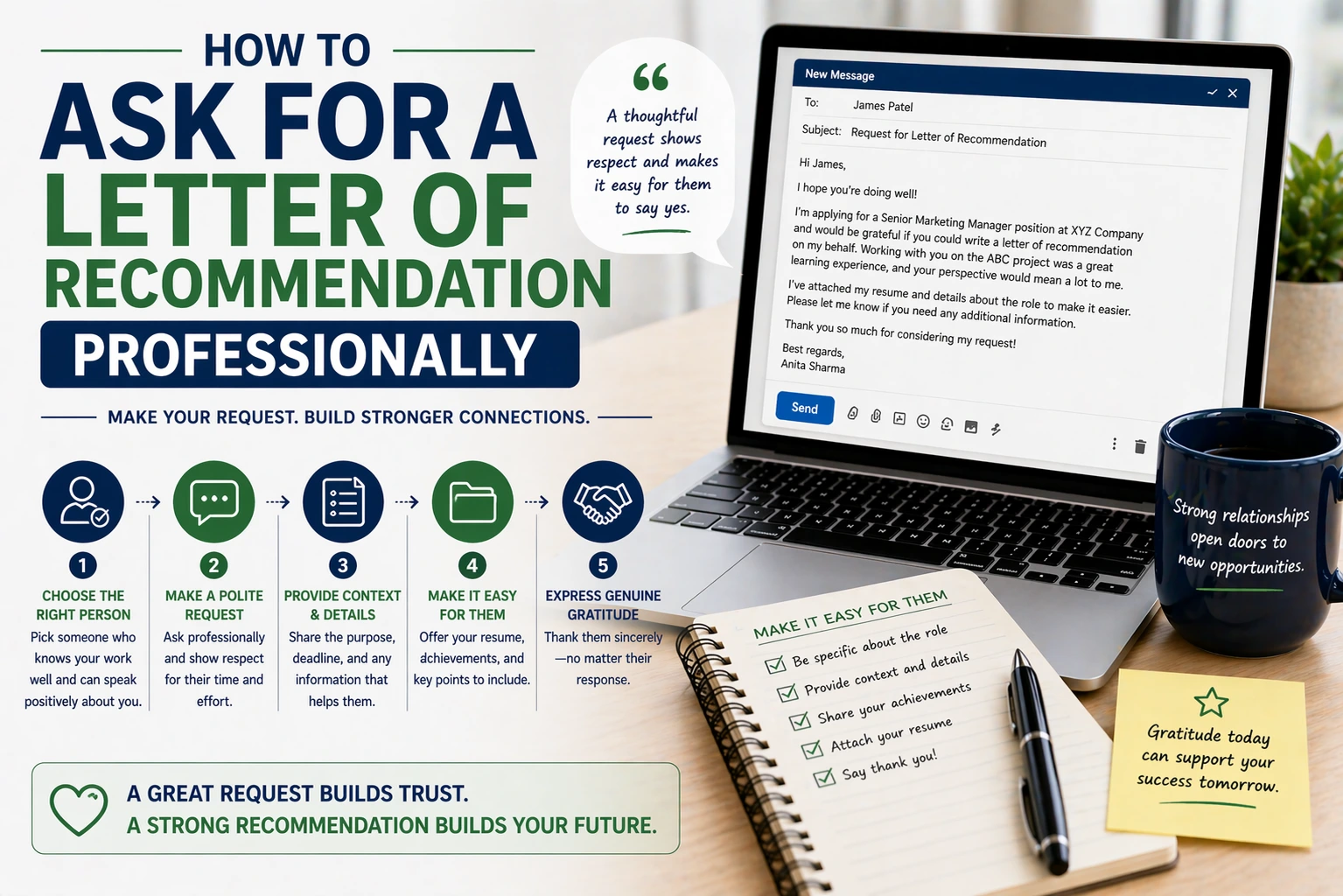
- A direct, specific subject line that tells them why you are writing
- A warm opening that acknowledges your relationship
- The specific purpose of the recommendation (job, university, scholarship)
- Why you chose them as your recommender
- A clear deadline and submission instructions
- Supporting materials you will provide (resume, SOP, project summaries)
- An easy and gracious exit if they cannot do it
- A genuine thank-you regardless of their answer
Email Template 1 — For a Former Manager (Job Application)
JOB APPLICATION RECOMMENDATION EMAIL
Subject: Request for a Letter of RecommendationDear [Manager’s Name],I hope you are doing well. It has been a few months since I moved on from [Company Name], and I have thought often about the things I learned during my time on your team.I am currently applying for a Senior Analyst position at [Target Company] and the application requires a professional letter of recommendation. Given our work together on [specific project], I can think of no one whose perspective would be more relevant or meaningful.Would you be willing to write a recommendation on my behalf? The deadline is [date], and the letter can be submitted [format — email/online portal/physical letter]. I will send you my updated resume, a description of the target role, and a brief summary of our key projects together to make this as easy as possible for you.Please do not feel any obligation — I completely understand if your schedule does not allow it. Either way, I am grateful for your time and mentorship.Thank you so much,[Your Name][Phone] | [Email] | [LinkedIn URL]
Email Template 2 — For a Professor (University Application)
UNIVERSITY APPLICATION RECOMMENDATION EMAIL
Subject: Letter of Recommendation Request — [Your Name], [Programme Name]Dear Professor [Last Name],I hope this message finds you well. I am [Your Name], a final-year student in [Department] who took your [Course Name] during [Semester, Year]. Your class was one of the most intellectually stimulating experiences of my undergraduate degree, particularly [mention a specific topic or moment].I am applying to the [Programme Name] at [University Name], which focuses on [brief description]. Given your expertise in [related field] and your knowledge of my academic work in your course — particularly [specific assignment or project] — I believe you would be uniquely positioned to speak to my suitability for this programme.Would you be willing to write a letter of recommendation for me? The deadline is [date], and letters are submitted via [platform/email]. I will send you my Statement of Purpose, academic transcript, and a summary of the specific skills the programme is looking for, so you have everything you need.I completely understand if you are not able to at this time. Thank you for considering this, and for all you have contributed to my academic journey.Warm regards,[Your Full Name][Student ID] | [Email] | [Phone]
Email Template 3 — Reaching Out After Losing Touch
RECONNECTION + RECOMMENDATION EMAIL
Subject: Reconnecting + Recommendation Request — [Your Name]Dear [Name],I hope you are doing well. It has been a while since we last connected — the last time we spoke was during [specific project/period] at [Company/Institution].I am reaching out because I am applying for [purpose] and I am assembling a small group of recommenders whose perspective would be genuinely meaningful. Our collaboration on [specific work] was something I learned enormously from, and I hoped you might be willing to share your observations of my work from that period.If this is possible, I would be happy to share more details about what the recommendation needs to cover and the deadline involved. I completely understand if the timing does not work, and either way I would love to hear how you have been.Thank you for reading this, and I hope to catch up regardless.Warm regards,[Your Name]
What to Send Your Recommender After They Agree
Once your recommender says yes, your job is to make writing the letter as easy as possible for them. Send a well-organised support package within 24-48 hours of their agreement.
| Document / Information to Send | Why It Helps |
|---|---|
| Your updated resume | Gives them a full picture of your professional background |
| Statement of Purpose or Cover Letter | Helps them align their letter with the story you are telling |
| Job description / programme details | Lets them tailor the letter to specific requirements |
| Summary of your work together | Reminds them of specific projects, results, or moments to reference |
| Key skills or qualities the application values | Helps them emphasise what the decision-maker cares about most |
| Submission deadline and format instructions | Prevents confusion and last-minute stress |
| Submission link or address | Makes the logistical step frictionless for them |
How to Follow Up (Without Being Annoying)
A gentle follow-up is not only appropriate — it is expected. Recommenders are busy people with other priorities. A timely nudge is a professional courtesy, not an imposition.
- One week before the deadline: Send a brief, warm reminder if the letter has not been submitted. Do not make it feel urgent or accusatory.
- Three days before the deadline: If you have heard nothing, follow up again. Offer to answer any questions or provide additional materials.
- After submission: Send a genuine thank-you email. Mention that you will keep them updated on the outcome.
FOLLOW-UP REMINDER EMAIL
Subject: Gentle Reminder — Recommendation for [Your Name] (Deadline: [Date])Dear [Name],
I just wanted to send a quick note as a reminder that the recommendation deadline for [programme/position] is [date]. Please let me know if you need any additional information from me or if there is anything I can help clarify.Thank you again for your support — it means a great deal. [Your Name]
Frequently Asked Questions (FAQs)
Q: What if someone declines to write a recommendation for me?
A: Thank them graciously and move on. Being declined does not necessarily mean they think poorly of you — they may be genuinely busy, or they may feel they do not know your work well enough to write a strong letter. A weak recommendation written reluctantly is far worse than no recommendation at all. Have 2-3 potential recommenders in mind before you begin asking.
Q: How many people should I ask for a recommendation?
A: Ask for one or two more than you need, in case someone declines or is unable to complete the letter in time. If you need two letters, ask three people. Always confirm with each person that they have submitted before your deadline.
Q: Can I write the recommendation myself and ask someone to sign it?
A: No. This is unethical and considered academic or professional fraud. While you can provide supporting materials that make writing easier — a bullet-point summary of your achievements, a description of what the application needs — the recommender must write the letter in their own words.
Q: Is it okay to ask someone I have not worked with in several years?
A: Yes, if they knew your work well enough during the time you worked together and can still speak to it credibly. When reaching out to someone after a long gap, give more context about what you have been doing since then, and what the current application is for.
Q: Should I tell the recommender what to write?
A: Never tell them what to write, but you can and should provide supporting information that helps them write a strong, relevant letter. A summary of your key achievements together, the specific qualities the application looks for, and the programme or role you are applying for are all helpful context — not instructions.
Q: How do I ask for a recommendation on LinkedIn?
A: LinkedIn has a built-in recommendations feature. You can request a recommendation by going to your profile, scrolling to the Recommendations section, and clicking ‘Ask for a recommendation.’ You will be prompted to choose the relationship type and provide context. For formal applications (university, jobs), a direct email is more appropriate than a LinkedIn recommendation.
Q: What should I do if my recommender misses the deadline?
A: Contact them immediately with urgency but without blame. Explain that the deadline is [date] and ask if it is still possible to submit. If the deadline has passed, contact the institution to explain the situation — most are understanding when communicated with promptly. And always have a backup recommender in mind.