Google has been talking about “helpful content” for years. But in August 2022, it stopped just talking and started enforcing — with an algorithm update that explicitly targeted unhelpful, people-unpleasing content and rewarded sites that genuinely serve their readers. If you create content for the web, this update affects you more than almost any other change in recent SEO history.
In this guide, we break down exactly what Google means by helpful content, how the system evaluates your writing, what separates content that passes from content that fails — and how to audit and improve your existing work to align with these standards.
What Is Google’s Helpful Content System?
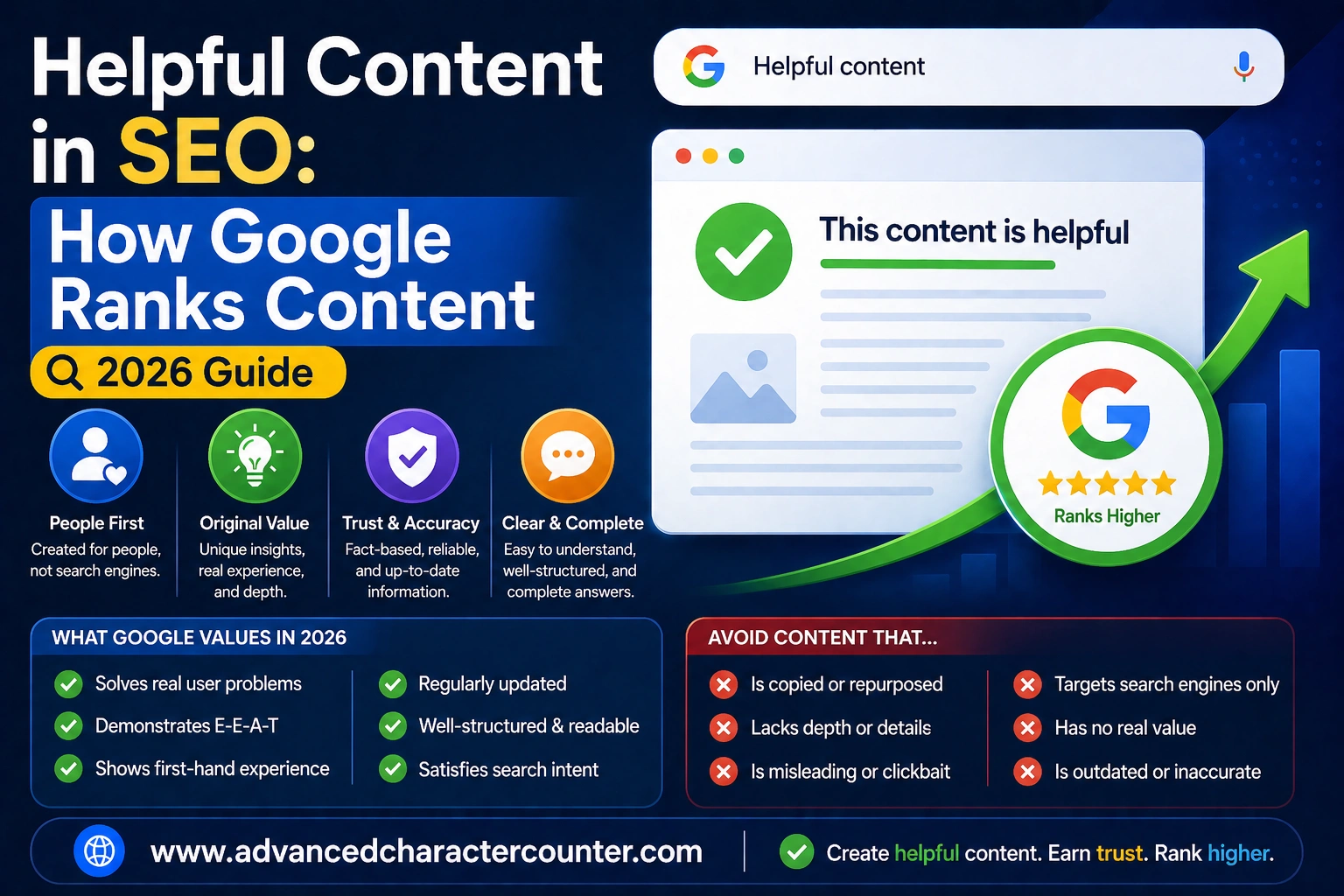
Google’s Helpful Content system is an automated, site-wide ranking signal that evaluates whether a website’s content is created primarily to help people, or primarily to rank well in search engines.
Unlike a traditional algorithm update that affects individual pages, the Helpful Content system operates at the site level. This means that if a significant proportion of your website’s content is deemed unhelpful, even your best articles can be dragged down in rankings — because the system applies a classifier to the entire website, not just individual URLs.
Google’s own documentation describes it this way: the system aims to reward content where visitors feel they’ve had a satisfying experience, while content that does not meet a visitor’s expectations will not perform as well.
Key fact: The Helpful Content system is a machine-learning classifier. It continuously evaluates sites and can improve or worsen a site’s signal over time based on changes to the content. Recovery from a Helpful Content downgrade is possible — but it takes time, sometimes months.
Aug ’22: When Google first launched the Helpful Content system
Site-Wide: The signal applies to the whole website — not just individual pages
4+: Major Helpful Content Updates since 2022, including integration into core updates
YMYL: Health, finance, legal topics face the strictest helpfulness evaluation
The History: Why Google Built This System
To understand what Google is trying to achieve with the Helpful Content system, it helps to understand the problem it was designed to solve.
By 2021–2022, a significant portion of the content ranking on Google was written not for readers — but for algorithms. SEO writers had learned to reverse-engineer ranking patterns: use the keyword X times, include these related terms, match competitor word counts, get enough backlinks. The result was an internet full of articles that ranked well but served readers poorly.
This content shared a set of common characteristics: it was generic, it did not draw on personal expertise, it covered topics the site had no genuine authority on, and it left readers unsatisfied — often returning to Google to search again because their question was not really answered.
Google’s mission is to organise the world’s information and make it universally accessible and useful. Content written for algorithms directly undermines that mission. The Helpful Content system was Google’s systematic answer to this problem.
“Our systems automatically identify content that seems to have little value, low-added value, or is otherwise not particularly helpful to those doing searches.” — Google Search Documentation
Google’s Own Questions: The Self-Assessment Framework
Google has published a set of questions that content creators should ask themselves to evaluate whether their content qualifies as “helpful.” These questions come directly from Google’s own Search documentation — this is as close to the algorithm’s reasoning as we can get publicly.
Questions About Your Content’s Quality
- Does the content provide original information, research, reporting, or analysis?
- Does it provide a substantial, complete, or comprehensive description of the topic?
- Does the content provide insightful analysis or interesting information that is beyond the obvious?
- Would you be comfortable citing this content as a reference in a professional context?
- Does it have any spelling or factual errors?
- Is it produced with great care and attention to quality?
Questions About Trust and Expertise
- Does the content present information in a way that makes you want to trust it?
- Is it clearly from an expert with deep knowledge of the topic?
- Does the site have a clearly identifiable author with appropriate credentials?
- Is there an accessible About page, Contact information, and clear editorial standards?
Questions About the Reader’s Experience
- After reading the content, will someone feel they’ve learned enough to help achieve their goal?
- Will someone reading this feel they’ve had a satisfying experience?
- Is this the kind of content someone would want to bookmark, share, or recommend?
- Does the content deliver on what the headline and introduction promise?
Important: These are not rhetorical questions — they directly map to what Google’s classifiers look for. If your honest answer to most of these is “not really,” your content is at risk under the Helpful Content system.
What “People-First” Content Actually Looks Like
Google uses the phrase “people-first content” to describe what it wants to see. But what does this actually mean in practice — on the page, in the writing, in the structure?
Characteristic 1: It Demonstrates Real Experience
People-first content shows evidence that the writer has actually used the product, visited the place, applied the technique, or lived the experience they’re writing about. This is the “Experience” in E-E-A-T — and it is the newest addition Google made to its quality guidelines.
A product review written by someone who actually tested the product reads differently from one written by a content writer who read other reviews. The difference is in the specific, personal details — the minor inconvenience that wasn’t mentioned in official specs, the unexpected benefit discovered during use, the comparison to a previous product the writer personally owned.
Characteristic 2: It Has a Clear, Satisfied Audience in Mind
People-first content is written for a specific audience — not “anyone who might search for this keyword.” The writer knows who they are addressing: a first-time homebuyer in India, a freelance graphic designer looking for tax guidance, a parent choosing between two school board curricula. This specificity shapes every decision — vocabulary, examples, depth, format.
When content is written for a defined audience, it naturally satisfies that audience. Generic content, written for everyone, tends to satisfy no one deeply.
Characteristic 3: It Gives Complete Answers — Not Just Enough to Rank
One of Google’s clearest signals of unhelpful content is the “pogo-stick” behaviour — when a user clicks your result, reads it, and then immediately returns to Google to search again because the answer was incomplete. People-first content is thorough enough that this doesn’t happen. The reader gets what they came for.
This does not mean the article must be long. It means the article must be complete. A 400-word article that fully answers “how do I calculate EMI on a home loan in India” is more helpful than a 2,500-word article that wanders around the topic without providing the formula.
“Content that is helpful is not content that tries to be helpful. It is content that leaves the reader with fewer questions, more confidence, and a genuine sense of having gained something.”
What “Search Engine-First” Content Looks Like
Understanding what to avoid is just as important. Google’s documentation describes several patterns that signal content is written primarily for search engines — and these are the patterns the Helpful Content system is designed to identify and demote.
| Pattern | What It Looks Like | Why It’s a Problem |
|---|---|---|
| Keyword-led writing | Content structured around keywords rather than around what the reader actually needs to understand | Creates unnatural reading experience; Google detects semantic anomalies |
| Topic chasing | Writing about trending topics or new niches that have no connection to the site’s actual expertise | Signals opportunistic content creation; lacks authentic authority |
| AI summaries without original value | Content that aggregates and summarises information from other sources without adding analysis, experience, or new insight | Pure aggregation without added value is explicitly called out by Google’s guidelines |
| Arbitrary length padding | Adding sections, bullet points, or examples to hit a word count rather than to serve the reader’s understanding | Reduces content quality; increases bounce from disappointed readers |
| False “completeness” | A table of contents and many H2 headings that suggest comprehensive coverage, but each section is shallow and underdeveloped | Structure signals depth; shallow execution contradicts the promise |
| Clickbait misalignment | Headlines that promise information the article does not actually deliver | High bounce rate; direct negative user experience signal |
| No clear authorship | Articles with no author, no byline, or a generic “editorial team” credit on YMYL topics | Fails E-E-A-T requirements; erodes trust |
The Role of E-E-A-T in Helpful Content
E-E-A-T stands for Experience, Expertise, Authoritativeness, and Trustworthiness. It is Google’s quality rater framework — originally E-A-T, with the extra “E” for Experience added in December 2022 specifically in conjunction with the Helpful Content push.
Experience
Has the author genuinely experienced what they’re writing about? For a travel article, this means actually having visited the destination. For a product review, it means having owned and used the product. Experience signals are found in specific personal details that could not be fabricated by someone working from research alone.
Expertise
Does the author have formal or informal expertise in the subject? Formal expertise means recognised credentials — a doctor writing about medication, a chartered accountant writing about GST compliance. Informal expertise means deep practical knowledge built over time — a home baker who has tested 500 bread recipes and runs a dedicated baking blog.
Authoritativeness
Is the site recognised by others as an authority in its field? Authoritativeness is largely built externally — through backlinks from other credible sources, citations in reputable media, references from industry organisations. It is also built internally through consistent, high-quality coverage of a defined topic area over time.
Trustworthiness
Trustworthiness is the most fundamental of the four. Google considers a page untrustworthy if it lacks basic transparency (no about page, no contact information), has significant factual errors, makes unsupported claims, or appears designed to mislead. Trust is the foundation on which experience, expertise, and authority rest.
Note: E-E-A-T is not a direct ranking factor in the sense of a code variable — it is a framework used by Google’s human quality raters to assess search quality. However, the patterns that correlate with high E-E-A-T (original expertise, proper authorship, transparent sourcing) are heavily factored into the algorithmic signals that do directly affect rankings.
How the Helpful Content Signal Works Technically
Google has been relatively transparent about the mechanics of the Helpful Content system compared to most of its algorithm components. Here is what we know with reasonable confidence:
- It is a site-level classifier. The signal is applied to the entire domain or subdomain, not to individual pages. One highly helpful page cannot rescue a site full of low-quality content. The system evaluates the proportion of helpful vs. unhelpful content across the site.
- It is a machine-learning model. Google trains a classifier on examples of helpful and unhelpful content. This model then scores new content automatically, without human intervention for each page. This means the criteria evolve as the model learns.
- It is a weighted signal in the overall ranking algorithm. The Helpful Content signal is one of many signals Google uses. A site with a negative Helpful Content signal will see its other ranking signals — backlinks, page speed, structured data — become less effective. A strong Helpful Content signal can amplify the effect of other positive signals.
- Recovery is possible but slow. If Google’s classifier determines that a site has improved its content quality — by removing or improving unhelpful content — the signal can improve. However, Google has indicated that this recovery process can take weeks to months, as the classifier needs enough data to confirm the sustained improvement.
- It has been integrated into core updates. From September 2023 onwards, Google integrated the Helpful Content system into its broader core ranking system, making its effect more pervasive and consistent across all searches.
Industries Most Affected by Helpful Content Updates
While the Helpful Content system affects all content, certain industries have been disproportionately impacted — largely because these sectors had accumulated the most search-engine-first content before the system launched.
| Industry | Why It Was Affected | What Helpful Content Looks Like Here |
|---|---|---|
| Health & Medical | High volume of generic symptom/treatment articles written without medical expertise | Content written or reviewed by qualified medical professionals with proper sourcing |
| Personal Finance | Many affiliate-driven “best credit card” / “best loan” articles without genuine product experience | Transparent methodology, genuine user experience, clear disclosure of affiliate relationships |
| Travel | Destination guides written by people who had never visited, aggregated from existing guides | First-person experience, specific local details, up-to-date practical information |
| Product Reviews | Review sites publishing affiliate content without actual product testing | Genuine first-hand testing, specific performance data, honest pros and cons |
| Education / Tutorials | How-to content that describes processes without fully understanding them | Step-by-step guidance that works, written by someone who has done the process themselves |
| News & Current Events | Sites scraping or lightly rewriting news without original reporting | Original reporting, clear sourcing, journalist bylines, transparent publication standards |
How to Audit Your Content for Helpfulness
If you’re concerned that some of your existing content may be flagged by the Helpful Content system, here is a practical audit process you can run without any paid tools.
Step 1: Identify Your Lowest-Performing Pages
Open Google Search Console and sort your pages by clicks or impressions. Look for pages that rank but receive very few clicks (low CTR) or pages that previously ranked but have dropped significantly after a core update. These are your candidates for a helpfulness audit.
Step 2: Read Each Page as a Stranger
Read your flagged pages as if you have never seen them before and are searching for the answer to the core question the page covers. Ask yourself: by the end of this page, do I have a complete, satisfying answer? Or do I still have unanswered questions? If the latter, the page needs work.
Step 3: Check for People-First Signals
Look for the presence or absence of: original research or data, personal experience markers, specific examples, named and credentialed authorship, cited sources, and a defined target audience. If most of these are absent, the page is likely search-engine-first.
Step 4: Decide — Improve, Merge, or Remove
For each flagged page, you have three options:
- Improve: If the topic is valuable and salvageable, rewrite the page with genuine depth, original insight, and proper authorship signals.
- Merge: If you have multiple thin pages on related subtopics, combine them into one comprehensive, deeply helpful article.
- Remove (or noindex): If the page covers a topic your site has no genuine authority on and the content cannot be significantly improved, removing it can improve your site’s overall Helpful Content signal.
How to Write Helpful Content From Scratch in 2025
Now that we understand what Google means by helpful content, here is how to build it intentionally from the start — not retrofit it later.
- Write within your genuine expertise. Only create content on topics where you or your contributors have real knowledge or experience. The easiest test: could you answer a follow-up question from an expert reader without Googling first? If yes, you have genuine expertise. If no, you don’t — and it will show in the writing.
- Define your audience before you start. Write the reader profile before the article: who are they, what do they already know, what specific problem brought them to this article, what does success look like for them after reading? Every writing decision follows from this profile.
- Add what competitors don’t have. Read the top-ranking articles for your keyword before writing. Find the gaps — the sub-questions they skip, the nuances they gloss over, the examples they don’t provide. Your unique value comes from filling those gaps.
- Source everything important. Link to your data sources. Reference the studies or reports you cite. If you’re making a claim based on personal experience, say so explicitly. Transparency is a trust signal — and trust is a core component of E-E-A-T.
- Identify the author clearly. Every article should have a named author with a brief biography. For YMYL topics (health, finance, legal), the bio should include relevant credentials or experience. Anonymous content signals risk to Google’s quality evaluators.
- Update content regularly. Helpful content is current content. An article published in 2021 with no updates may now contain outdated information — which is a form of unhelpfulness. Set a regular audit schedule: quarterly for fast-changing topics, annually for evergreen content.
Conclusion: Be Genuinely Useful, Not Strategically Helpful
Google’s Helpful Content system is not a technical hurdle to clear with the right keyword density or word count. It is a quality standard — and it asks a genuinely important question of every piece of content on the web: did you write this for the person reading it, or for the algorithm ranking it?
The sites that have thrived through every Helpful Content update share a common characteristic: they were already creating content that genuinely served their readers before the system existed. They did not need to change their approach — they simply needed to keep doing what they had always done.
That is the clearest possible signal of what Google wants. Write for your reader. Build genuine expertise. Be transparent. Deliver on your promises. The algorithm will follow.
Frequently Asked Questions (FAQs)
Does the Helpful Content system affect every website or only large ones?
It affects every website, regardless of size. In fact, smaller niche sites built primarily on search-engine-first content have often been more severely impacted than larger sites, which tend to have editorial standards already in place. The system evaluates content quality relative to what it finds on the site, not relative to site authority.
Can AI-generated content be considered “helpful” by Google?
Google’s official position is that it does not penalise content simply for being AI-generated. What it evaluates is whether the content is helpful, accurate, and people-first — regardless of how it was produced. AI-generated content that is reviewed, verified, personalised, and enriched with genuine expertise can be helpful. AI-generated content that is published unedited, at scale, as a traffic farming strategy is precisely what the Helpful Content system targets.
How long does recovery take after a Helpful Content downgrade?
Recovery timelines vary. Google has indicated that the Helpful Content classifier re-evaluates sites periodically — not in real time. In practice, sites that have significantly improved their content have reported seeing recovery take anywhere from 2 to 6 months after the improvements were made. Removing thin content and improving key pages simultaneously tends to produce faster results than improving pages alone.
Is there a specific “helpful content score” I can check?
No. Google does not expose a Helpful Content score in any tool — not in Search Console, not in any API. The signal’s effect can be inferred from ranking changes before and after major core updates, but there is no direct measurement available to site owners. The best proxy is user behaviour data: dwell time, bounce rate, scroll depth, and return visits — all available in Google Analytics 4.
Should I delete all my thin content to recover?
Not necessarily. For pages that have some value but are thin, improving them is better than deleting them — especially if they have any backlinks or existing traffic. Deleting a page permanently removes whatever equity it has accumulated. The better approach is: improve what you can, merge related thin pages into one comprehensive article, and only remove pages that cover topics entirely outside your site’s expertise with no salvageable value.
Does writing for Google Discover require a different approach to helpful content?
Discover and Search share the same helpfulness standards but differ in how content is discovered. For Discover, timeliness, visual appeal (high-quality hero image), and emotional resonance of the headline play larger roles. But the core helpfulness requirements — original insight, genuine expertise, reader satisfaction — are identical. Content that is helpful for Search is generally also suitable for Discover; the difference lies in discoverability signals, not quality standards.
How does the Helpful Content system interact with backlinks?
A strong backlink profile cannot fully offset a negative Helpful Content signal. Before the system existed, sites with many backlinks but mediocre content could maintain high rankings. Post-2022, the Helpful Content signal can suppress the ranking effect of backlinks when the content itself is deemed unhelpful. Backlinks remain important — but they amplify helpful content; they cannot rescue unhelpful content in the way they once could.