
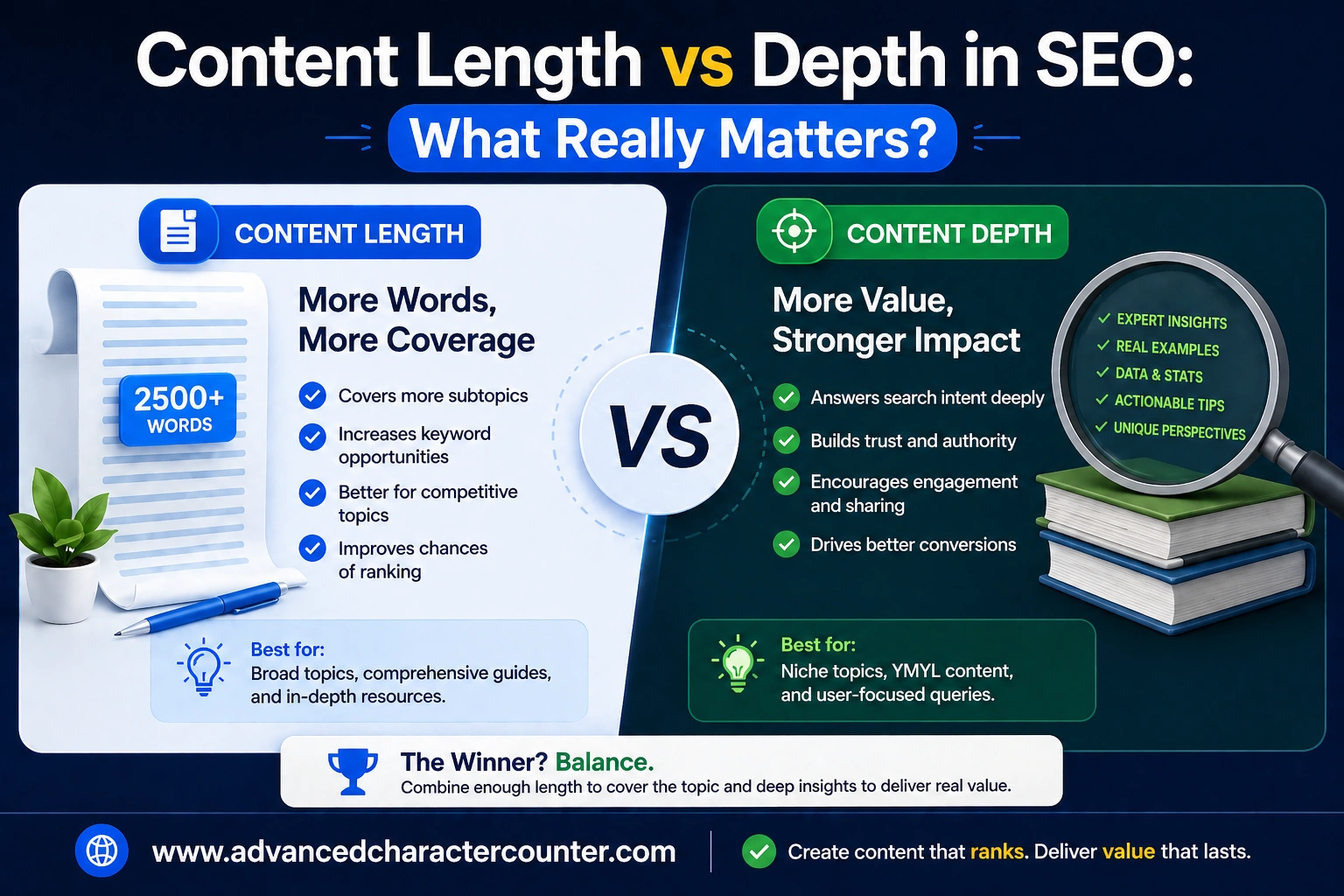
Every week, someone publishes a new “study” claiming that the ideal blog post length is exactly 1,890 words — or 2,450 — or 3,000. And every week, bloggers and SEO writers chase that number, padding their articles with filler just to hit a word count. It doesn’t work. And this article explains precisely why.
The real question in SEO content writing is not how long your article is. It is how deep it goes. These are two very different things, and confusing them is one of the most common and costly mistakes in content marketing today.
In this guide, we’re going to settle the debate once and for all — with evidence, with examples, and with a clear framework you can apply to every piece of content you write from today onwards.
Defining the Terms: Length vs. Depth
Before we can compare them, we need to be precise about what each term means in the context of SEO.
Content length is simple: it is the total number of words in a piece of content. It is a quantitative measure. You can count it with a tool. It tells you nothing about quality, usefulness, or relevance.
Content depth is harder to measure but far more meaningful. It refers to how thoroughly a piece of content covers its topic — how many sub-questions it answers, how much context it provides, how original its insights are, and how completely it satisfies the reader’s intent when they searched for a topic.
A 500-word article can have tremendous depth if it answers the reader’s exact question completely, with precision and clarity. A 4,000-word article can have almost no depth if those words are mostly filler, repetition, or tangentially related content stuffed in to hit a word count target.
Key distinction: Length is what you can count. Depth is what the reader experiences. Google has increasingly learned to measure the latter — and rank based on it.
The Word Count Myth — Where Did It Come From?
The idea that longer content ranks better is not a complete myth — it has a real origin, and in certain contexts it still holds some truth. But it has been widely misunderstood and misapplied.
The reasoning goes like this: longer articles tend to cover more aspects of a topic, naturally include more keywords and semantic variations, attract more backlinks because they’re more comprehensive, and keep readers on the page longer. All of this is true — when the length reflects genuine depth. The problem arose when marketers started treating word count as a proxy for quality.
Several large-scale studies from companies like HubSpot, Backlinko, and SEMrush in the 2017–2020 period found correlations between longer content and higher rankings. Bloggers interpreted this to mean: write more words and you will rank better. This is a classic correlation-vs-causation error. The content ranked well because it was thorough — not because it was long.
2,100 Average word count of top-ranking Google results (Backlinko, 2023)
74% Of content marketers say depth of content is more important than length (CMI Survey)
3× More backlinks earned by in-dept content vs. surface-level content of similar length
0 – Official Google guidelines mentioning a minimum word count for ranking
Google has never, in any official guideline or documentation, specified a minimum word count for ranking. That number — whatever it is — exists only in SEO folklore. What Google has specified, repeatedly and explicitly, is that content must be helpful, reliable, and people-first.
What Google Actually Says About Content Length
It is worth going directly to the source here, because there is a lot of confusion about what Google’s guidelines actually say.
Google’s Search Essentials (formerly Webmaster Guidelines) state clearly: “Google doesn’t count words on a page to determine if it’s high quality.” This is not a grey area. It is a direct statement from Google’s own documentation.
What Google does evaluate includes:
- Experience, Expertise, Authoritativeness, Trustworthiness (E-E-A-T): Does the content demonstrate real knowledge and experience? Is the author credible? Is the source trustworthy?
- Helpful Content: Is the content written for people — not for search engines? Does it fully answer the question? Does it leave readers satisfied or sending them back to Google?
- User Signals: Do users engage with the content? Do they stay on the page, return to it, share it? Or do they immediately bounce back to the search results?
- Topical Coverage: Does the content cover the topic comprehensively enough that related questions are also answered? This is about semantic completeness — not word count.
None of these criteria mention word count. All of them point to depth, quality, and user satisfaction. Google’s algorithm has become progressively better at evaluating these dimensions — especially after the Helpful Content Updates of 2022, 2023, and 2024.
Important: Google’s Helpful Content system introduced a site-wide quality signal. If a significant portion of your content is thin, low-depth filler padded to a word count, it can negatively affect the rankings of your other, better content. This is how seriously Google treats depth over length.
What Content Depth Really Means (With Examples)
Depth is an abstract concept, so let’s make it concrete. Content depth can be broken down into several measurable dimensions:
1. Completeness of Answer
Does the content fully answer the user’s query — including the follow-up questions they would naturally have? A search for “how to fix crawl errors in Google Search Console” doesn’t just want the steps — it also wants to know why crawl errors happen, which ones to prioritise, and what the consequences of ignoring them are. Content that answers all of this is deeper than content that only covers the steps.
2. Originality of Insight
Does the content offer something the reader cannot find on the first five results of Google? This could be original data, a case study from personal experience, a new framework for thinking about a problem, or an analysis that connects ideas others haven’t connected. Originality is perhaps the most powerful form of depth.
3. Semantic Richness
Does the content naturally use the vocabulary of its topic — related terms, subtopics, expert terminology explained in plain language? Google’s natural language processing can identify topically rich content. An article about “email marketing” that also naturally covers open rates, subject line testing, list segmentation, and deliverability is semantically richer — and therefore deeper — than one that just uses the phrase “email marketing” fifty times.
4. Accuracy and Specificity
Vague statements have no depth. “Social media can help your business grow” is shallow. “Businesses in the D2C sector that post 4–5 times per week on Instagram see an average 23% higher follower growth rate than those posting fewer than twice a week, according to a 2023 Sprout Social report” — that is deep. Specificity, supported by evidence, is what depth looks like in practice.
“A 500-word article that completely answers a specific question ranks better than a 3,000-word article that partially answers a broad one.”
Length vs. Depth: A Side-by-Side Comparison
Let’s put both concepts directly next to each other across the dimensions that matter most for SEO.
| Dimension | Content Length (Word Count) | Content Depth (Thoroughness) |
|---|---|---|
| What it measures | Number of words in the article | How completely the topic is covered |
| Google’s official stance | Not a ranking factor — never mentioned | Core to E-E-A-T and Helpful Content evaluation |
| Effect on user behaviour | Longer ≠ better; padded content increases bounce | Depth reduces bounce — readers stay when satisfied |
| Effect on backlinks | Minimal direct effect | Deep, original content earns 3× more backlinks |
| Effect on featured snippets | No correlation | Direct: concise, accurate answers get featured |
| Effect on time-on-page | Longer content = longer time IF quality maintained | Depth drives time-on-page regardless of length |
| Ease to fake/game | Easy — add filler, padding, repetition | Hard — requires real knowledge and effort |
| Sustainable ranking factor | No — algorithm updates punish thin-padded content | Yes — quality signals grow stronger over time |
| Best use case | Use as a rough benchmark, not a target | The primary metric to optimise for |
When Length Does Matter in SEO
It would be dishonest to say length never matters. In certain scenarios, longer content naturally outperforms shorter content — but always because depth follows from length, not because of the length itself.
Pillar Pages and Topic Clusters
When you are building a content cluster around a broad topic — say, “digital marketing for small businesses in India” — your pillar page genuinely needs to be long because it must cover many subtopics: SEO, social media, email marketing, paid ads, content strategy, and more. Here, length is a side effect of comprehensive coverage. It is earned, not manufactured.
Competitive, High-Volume Keywords
For very competitive keywords, your competitors’ content is typically long and comprehensive. To out-rank them, you must at minimum match their depth — which in practice often means matching or exceeding their length. But again, the driver is depth. If you can write a 1,500-word article that is deeper and more useful than their 3,000-word version, the shorter article will win.
Step-by-Step Technical Guides
Some topics genuinely require length because they have many steps, configurations, or nuances. A complete guide to setting up a WordPress website, migrating a site to HTTPS, or implementing structured data markup cannot be done justice in 600 words. Length here is not a choice — it is a necessity of the subject matter.
When Length Helps
- Pillar pages covering broad topics
- Multi-step technical tutorials
- Competitive keywords requiring comprehensive coverage
- Comparison guides with many variables
- Resource pages meant to be bookmarked
When Length Hurts
- Informational queries with clear, short answers
- News and trending content (timely, concise wins)
- Local SEO pages (specificity beats length)
- Product pages (conversion copy, not essays)
- FAQ pages (direct answers, no padding)
When Depth Matters More Than Length
For most content, depth is the primary competitive advantage — especially in an era where AI-generated content has made it trivially easy to produce long, surface-level articles at scale.
Voice Search and Conversational Queries
More and more searches happen through voice — on phones, on smart speakers, through Google Assistant. These queries are conversational: “What is the best protein powder for vegetarians?” “How do I reduce my electricity bill at home?” Voice search rewards short, precise, deeply accurate answers. A 3,000-word article may rank for the broad keyword, but a concise, deeply accurate paragraph within it will be the featured snippet that gets read aloud.
Google’s “People Also Ask” Boxes
Depth wins People Also Ask placements. These are not won by long articles — they are won by specific paragraphs within articles that directly answer a sub-question with precision. This is depth at the paragraph level. It means every section of your article needs to be a complete, accurate, self-contained answer — not just a contribution to a long whole.
Niche Topics With Specialist Audiences
If your blog serves doctors, engineers, lawyers, or financial analysts, these readers will immediately detect shallow content. They have professional knowledge of the subject. A 5,000-word article that misses important nuances will perform worse with this audience than a 1,200-word article that demonstrates genuine expertise. For expert audiences, depth is everything and length is almost irrelevant.
The Right Formula: How to Balance Both
The answer to “length vs. depth” is not either/or. It is a sequencing question: depth first, then whatever length that depth requires.
Here is the framework professional content strategists use:
- Start with search intent. What does the person actually want? Are they looking for a quick answer, a step-by-step guide, or a comprehensive resource? Intent determines the appropriate format and length before you write a single word.
- Map the sub-questions. Open Google and search your target keyword. Read the “People Also Ask” section. Read the top 5 results. What questions are being asked that the existing content doesn’t fully answer? Those gaps are where your depth comes from.
- Write to cover — not to count. Cover every sub-question. Add examples. Include original insight. Reference real data. When you have genuinely covered the topic, stop. Do not add paragraphs to reach a word count.
- Edit for clarity. Remove everything that doesn’t add value. Good depth is also efficient. Every sentence that doesn’t earn its place reduces the overall depth of the article by diluting its quality.
- Check the SERP benchmark. After writing, check how long the top-ranking articles for your keyword are. If they average 2,500 words and yours is 900 words, you may not be covering the topic as completely as you think. Use length as a sanity check — not a target.
Real-World Examples From High-Ranking Pages
Theory is useful. Examples are better. Here are three real-world patterns that illustrate how depth outperforms raw length in practice.
Case 1: The Short Article That Outranks Long Ones
Search for many specific how-to queries — “how to add alt text in WordPress,” for example — and you’ll often find a 600–900 word article ranking above 2,000+ word guides. Why? Because the shorter article gets directly to the point, provides accurate steps with screenshots, and leaves the reader with no unanswered questions. The longer articles are more comprehensive on WordPress generally, but less focused on this specific query. The 600-word article has deeper intent-alignment — which is a form of depth.
Case 2: The Long Article With Zero Featured Snippets
Many long blog posts — 3,000+ words — earn zero featured snippets despite covering the right keywords. This is because the depth is spread too thin. The article touches on many things but dives into nothing. Google cannot find a clean, precise answer to extract. Contrast this with a shorter article that has one crystal-clear paragraph answering the main question directly — that paragraph becomes the featured snippet.
Case 3: The 500-Word News Article That Ranks for a Year
Breaking news articles on authoritative sites often rank for extended periods despite being short. The reason? They are depth-first: they cover the most important facts precisely, they are accurate, they are timely. Length is irrelevant when the content perfectly matches the user’s need at that moment.
The pattern is clear: When depth and intent-alignment are high, length becomes secondary. When depth is low, no amount of extra words will save the ranking.
Action Plan: How to Write Deep, Well-Sized Content in 2025
Here is a practical checklist to apply to every piece of content before you publish:
| Step | Action | Depth or Length Focus |
|---|---|---|
| 1. Intent Research | Identify whether query needs a quick answer, a guide, or a comprehensive resource | Depth |
| 2. Competitor Audit | Read the top 5 results — find what they miss or get wrong | Depth |
| 3. Sub-Question Mapping | List every related question from PAA, autocomplete, and forums | Depth |
| 4. Outline Building | Structure the article to answer all sub-questions in a logical order | Depth |
| 5. First Draft | Write to cover completely — don’t count words, cover the topic | Depth |
| 6. SERP Benchmark | Compare finished length to average competitor length as a sanity check | Length |
| 7. Edit for Depth | Add specifics, data, examples wherever claims are vague | Depth |
| 8. Edit for Efficiency | Remove filler, repetition, and anything that doesn’t add value | Length |
| 9. Semantic Check | Ensure related terms and subtopics are naturally covered throughout | Depth |
| 10. Publish and Monitor | Track dwell time and bounce rate — these reveal depth quality in practice | Depth |
Wrap Up: Write Deep, Write Right
The debate between content length and depth is, at its core, a false choice. Depth is the goal. Length is a consequence of depth. When you write truly comprehensive, original, and accurate content on a topic, it will naturally be as long as it needs to be — no more, no less.
Stop chasing word counts. Start chasing completeness. Ask yourself, after every article: “If a reader came to this page with a genuine question on this topic, did we leave any important question unanswered?” If yes — go deeper. If no — publish it, at whatever length it happens to be.
That is the formula Google has been rewarding, and will continue to reward, for the foreseeable future. Depth wins. Always.
Frequently Asked Questions (FAQs)
Does Google have a minimum word count for ranking?
No. Google has explicitly stated that it does not count words on a page to determine quality. There is no official minimum word count. The length of your content should be determined by what is needed to fully answer the topic — nothing more, nothing less.
Is a 300-word article enough to rank on Google?
It depends entirely on the query. For a simple, specific question — “What is the capital of Maharashtra?” — 300 words is more than enough. For a complex topic like “how to build an e-commerce SEO strategy,” 300 words would be far too shallow to compete with the comprehensive guides that already rank. Match length to topic complexity and search intent.
Why do long articles tend to rank better if word count doesn’t matter?
Correlation, not causation. Long articles tend to cover topics more comprehensively — that depth is what earns the ranking. If you took the same depth and expressed it in fewer words (without losing information), the shorter version would rank equally well or better. The length is a side effect of depth, not the cause of ranking.
How do I measure content depth?
Useful proxies for depth include: dwell time (how long people stay on your page), scroll depth (how far down people read), bounce rate (how many immediately leave), featured snippet wins, and backlinks earned. Deep content earns more of all of these. Tools like Google Search Console, Google Analytics 4, and Hotjar can help you track these signals.
Can I improve my existing content’s depth without rewriting it completely?
Yes. Start by identifying the sub-questions your article currently does not answer. Add a new section addressing each one. Replace vague statements with specific data and examples. Add a comparison table if appropriate. Link to related articles that cover subtopics in more detail. These targeted additions can significantly improve depth without a complete rewrite.
What is “thin content” in SEO and how does it relate to this debate?
Thin content refers to pages that have little or no added value for users — content that is too short, too vague, duplicated from elsewhere, or auto-generated without substance. Google’s Helpful Content system penalises thin content at the site level, meaning a large number of thin pages can drag down your entire site’s performance, including your better articles. Thin content is the opposite of depth — and it is heavily penalised.
How does content depth affect Google Discover performance?
Google Discover favours content that users genuinely engage with — saves, full reads, return visits, and shares. Deep content drives all of these behaviours. Shallow content may get an initial Discover impression but quickly loses favour as engagement signals come in low. For sustained Discover presence, depth is non-negotiable.