Here’s the thing about “experience” that nobody tells you at the start: clients don’t actually care about your history. What they care about is whether you can solve their problem. Experience is just one of many ways to prove that you can — and it’s far from the only one.
Thousands of people start freelancing from absolute zero every year and build thriving careers within twelve months. They don’t do it by waiting until they feel “ready.” They do it by understanding what clients actually need, building credibility through smart strategies, and taking consistent action before they feel confident.
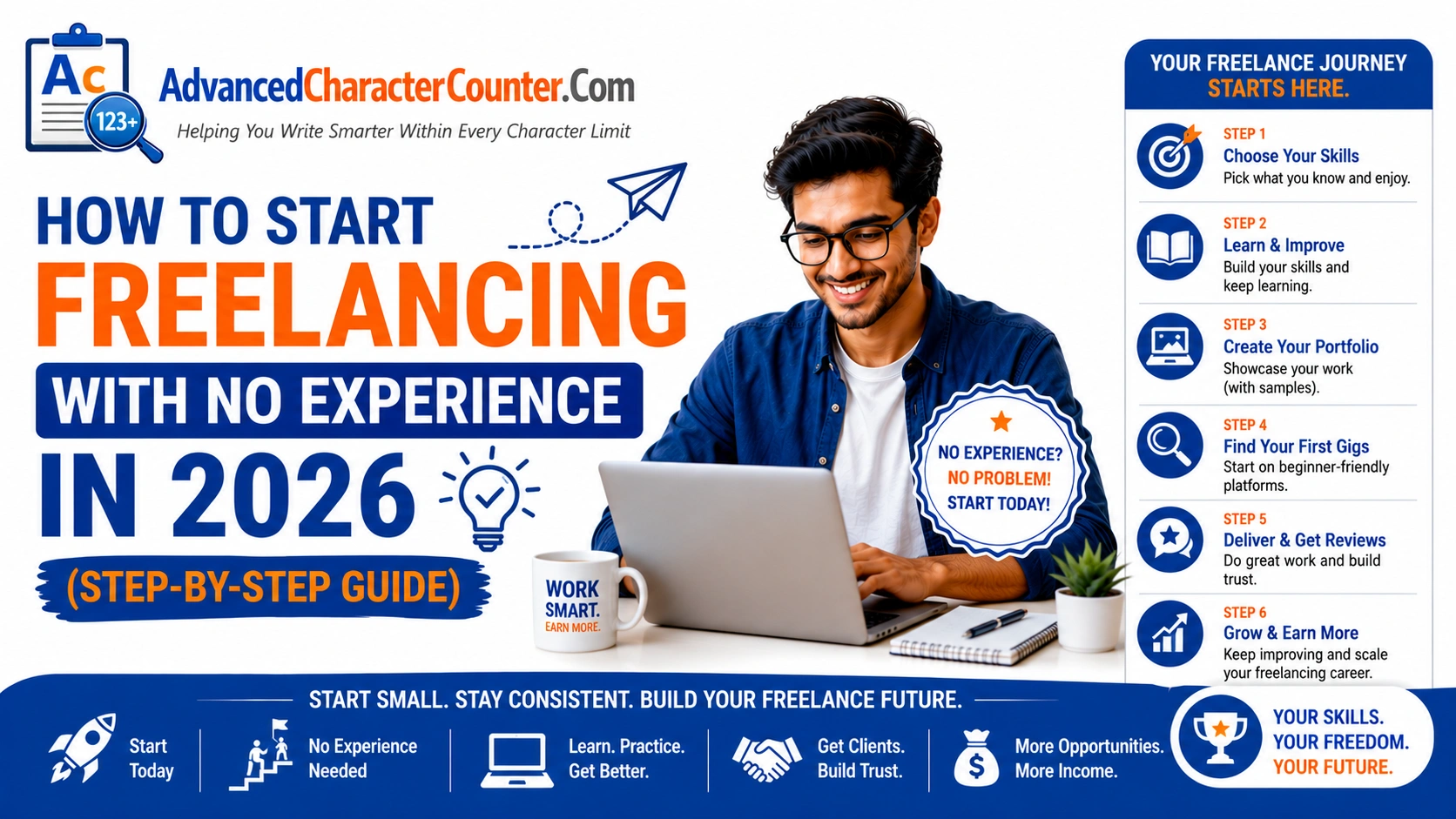
This is your complete roadmap for starting a freelance career in 2026 with no prior experience, no client history, no formal portfolio, no established network in the industry. Just you, your skills (or the skills you’re about to build), and a plan.
Step 1: Identify What You Already Know
“No experience” rarely means “no skills.” It usually means no paid work history in a particular field. Before you decide you have nothing to offer, take a serious inventory of what you already know and do well.
Ask yourself:
- What do people ask you for help with regularly?
- What topics could you teach someone else?
- What did you study formally, even if you never worked in that field professionally?
- What tools, platforms, or software are you comfortable using?
- What have you built, written, designed, or created — even just for yourself?
The answer to these questions reveals your starting skills. A marketing graduate who’s never worked in an agency is still capable of writing copy, running a social media account, or doing basic SEO research. Someone who’s spent years managing their family’s finances might be able to offer bookkeeping services. A gamer who creates content on YouTube has video editing experience. Every background has transferable skills.
Step 2: Pick One Skill and Go Deep
Once you’ve identified your starting skills, resist the urge to list them all. Pick one to lead with — the one where your competence is strongest and where there’s a market willing to pay. Then invest in it.
In 2026, a few skill areas are particularly accessible to beginners and have high market demand:
Content Writing and Copywriting — The demand for quality written content has never been higher. AI has flooded the internet with mediocre text, which means skilled human writers who can produce genuine, compelling, well-researched content are more valuable than ever. You can develop this skill entirely through practice.
Graphic Design — Tools like Canva, Adobe Express, and Figma have lowered the barrier to entry significantly. With a few weeks of focused learning, you can produce professional-quality social graphics, presentations, and brand materials.
Social Media Management — Small businesses need a consistent presence on Instagram, LinkedIn, TikTok, and other platforms but rarely have the time or knowledge to manage it themselves. If you’re naturally fluent in these platforms, that fluency is a marketable skill.
Web Development — Platforms like Wix, Squarespace, Webflow, and WordPress have created enormous demand for people who can build and maintain websites without deep coding expertise. Full-stack development takes longer but commands much higher rates.
Video Editing — Short-form video content is the dominant content format of 2026. Creators, businesses, and brands all need editors who can turn raw footage into polished content. Tools like CapCut, DaVinci Resolve, and Adobe Premiere are learnable within weeks.
AI-Augmented Services — Prompt engineering, AI workflow consulting, chatbot setup, and AI content strategy are emerging skills with massive demand and very few established experts. Beginning here puts you ahead of most.
Once you’ve chosen a skill, spend four to eight focused weeks getting genuinely competent. Free resources, YouTube tutorials, Google’s free certifications, Coursera, HubSpot Academy, and others — are more than enough to get started.
Step 3: Build a Portfolio From Scratch
No paid work history doesn’t mean no portfolio. Here’s how to build one from zero:
Create spec work. A spec piece is a sample you create specifically to showcase your skill, without a client paying for it. Write a blog post in the voice of a brand you admire. Design a social media kit for a fictional restaurant. Edit a travel vlog from public domain footage. Build a mock landing page for a product you invented. These samples demonstrate your capability just as well as paid work — what matters is the quality.
Do a free or discounted project for a cause. Nonprofits, local community organizations, small churches, youth sports teams, and local charities almost always need help with websites, social media, design, or content — and rarely have budget. Offer your services in exchange for a testimonial and portfolio permission. You gain real-world project experience, a real client reference, and a real sample all at once.
Build personal projects. Start a blog. Create a brand identity for yourself. Build a personal website. Edit short YouTube videos on a topic you care about. These projects are entirely under your control, show initiative and passion, and can be impressive portfolio pieces.
Take on one or two heavily discounted starter projects. On platforms like Fiverr, you can offer introductory pricing specifically to accumulate your first few reviews. Be transparent about it — don’t pretend to have a track record you don’t have. Five genuine five-star reviews from real clients, even at low rates, can dramatically accelerate your growth.
Aim for three to five strong portfolio samples before you start actively pitching clients. They don’t all need to be from paid work.
Step 4: Set Up Your Presence on the Right Platforms
In 2026, your digital presence is your storefront. Here’s where to establish yourself:
LinkedIn — Update your profile to reflect your new freelance identity. Add your skill in the headline (“Freelance Content Writer | Blog & SEO Copywriting”), write an About section that speaks to the clients you want to serve, and start sharing knowledge-based content. Post two to three times a week in your area of expertise. Consistency compounds.
Upwork — One of the highest-volume freelance platforms globally. Complete your profile at 100%, pass the available skill tests, and start applying to entry-level projects. The Upwork algorithm favors active accounts, so apply consistently in the first 30 days.
Fiverr — A service-listing model where clients come to you. Create two to three highly specific service listings (called “gigs”) with clear, benefit-focused titles and optimized descriptions. Good gig imagery and competitive starter pricing can generate your first few inquiries within days.
Contra — A portfolio-focused freelance platform that has grown significantly since 2024. It’s particularly good for creatives and designers and allows you to build a professional portfolio page at no cost.
A personal website — Not essential in the first weeks, but worth building early. Carrd.co, Notion, or a basic Webflow page is enough. It gives you a permanent home online that you own and control, independent of any platform’s policies.
Step 5: Define Your Service Offering Clearly
One of the most common mistakes new freelancers make is being vague about what they offer. “I write content” is a category, not an offer. “I write SEO-optimized blog posts for B2B SaaS companies, 1,000–2,000 words, delivered in 5 business days with one round of revisions” is an offer.
The more precisely you define your service, the easier it is for the right clients to recognize you as the right fit. Think about:
- What specific deliverable do you produce?
- Who is it for?
- What outcome does it create for the client?
- What’s included (and what’s not)?
- How long does it take?
Write this out clearly. Use it in your profiles, your proposals, and your pitches. Clarity is one of the most powerful things a new freelancer can project.
Step 6: Find and Approach Your First Clients
With a skill, a portfolio, and a clear offering, you’re ready to pursue clients. Use multiple channels simultaneously:
Your existing network. Tell everyone you know that you’ve started freelancing. Post about it on social media. Send direct messages to relevant connections. You’d be surprised how many first clients come from the most unexpected connections.
Cold outreach. Identify businesses that could clearly benefit from your service and reach out directly. Keep your message short, specific, and focused on their problem. Don’t lead with your lack of experience — lead with what you’ve built and how it applies to them.
Freelance job boards. Beyond the major platforms, check ProBlogger (for writers), We Work Remotely, Remote.co, and niche-specific boards in your industry. Many of these have less competition than Upwork or Fiverr.
Social media communities. Facebook groups, LinkedIn communities, Reddit communities (r/forhire, r/freelance), and Discord servers in your niche regularly have clients posting project requests. Monitor these and respond quickly.
Content marketing. Posting knowledge and insight in your area of expertise — on LinkedIn, a blog, or TikTok — attracts inbound inquiries over time. It takes longer to pay off than direct outreach, but it compounds into a reliable source of leads.
Step 7: Nail Your Onboarding and Delivery
Once you land your first client, the real work begins — and it’s not just the deliverable. First impressions in freelancing are set by how professionally you handle the onboarding and delivery process.
Send a welcome message confirming the scope, timeline, and next steps. Use a simple contract — even a one-page PDF works. Send the invoice upfront (or 50% upfront for larger projects). Keep the client informed throughout. Deliver by or before the deadline.
These operational basics are what separate a freelancer who gets referrals from one who gets forgotten. Professionalism at this stage, especially when you’re new, signals that you’re not a risk — you’re a reliable professional they can count on.
Step 8: Build Momentum Through Reviews and Referrals
After your first successful project, ask for a review or testimonial. Ask if there’s anyone else they might refer you to. These two asks, done once per project, are the most efficient growth mechanism available to a new freelancer.
Three genuine testimonials will do more for your credibility than any portfolio piece. A single warm referral will convert faster than a hundred cold outreach messages. Build this feedback loop deliberately from your very first client.
Handling the Mental Game
Starting anything from zero is psychologically hard. Rejection, slow starts, and imposter syndrome are normal, and they hit harder in freelancing because there’s no team around you and no manager to validate your progress.
A few things that help:
Set process goals, not outcome goals. “I will send five proposals this week” is something you control. “I will land a client this week” is not. Focus on the actions, and the results will follow.
Track your progress visibly. Keep a simple log of proposals sent, responses received, and clients landed. Watching those numbers grow is motivating, even when conversions are slow.
Connect with other freelancers. Online communities (r/freelance, Twitter/X freelance communities, Discord servers) provide camaraderie, advice, and perspective from people who understand exactly what you’re going through.
Remember that “no experience” is temporary. Every experienced freelancer was once where you are. What separates them isn’t talent — it’s the decision to start and the commitment to keep going.
Final Advice
Starting freelancing with no experience in 2026 is genuinely possible — and in some ways easier than it’s ever been. The tools are free or cheap, the learning resources are abundant, and the market for skilled independent workers is enormous and growing.
What it requires is a willingness to build in public, to be honest about where you are while demonstrating where you’re headed, and to take consistent action even before you feel ready. The “right time” to start will never come. The only time is now.
Pick your skill. Build two samples. Set up one profile. Reach out to three potential clients this week. That’s the entire starting plan. Everything else will reveal itself as you go.
Frequently Asked Questions (FAQs)
Q1: Can I start freelancing with absolutely zero skills?
You can start learning a skill and begin building a portfolio simultaneously. Skills like copywriting, social media management, and basic graphic design can be developed to a marketable level within four to eight weeks of focused practice. Zero experience today doesn’t mean zero capability next month.
Q2: Which freelance skill is easiest to learn from scratch?
Content writing and social media management have the lowest technical barriers to entry. Copywriting requires more study of persuasion principles but pays significantly higher rates. Video editing has a moderate learning curve but high demand in 2026.
Q3: How much money can I realistically make in my first three months of freelancing?
Most beginners earn anywhere from $0 to $2,000 in their first three months, depending on how actively they pursue clients. By month six, consistent freelancers who deliver good work are typically earning $1,500–$5,000/month, depending on skill and niche.
Q4: Do I need to register as a business before I start freelancing?
In most countries, you can start freelancing as a sole proprietor without formal business registration. Once your earnings become consistent, register your business and consult a local accountant about tax obligations. Requirements vary by country.
Q5: Should I use my real name or a business name?
Either works. Using your real name is simpler and builds personal brand equity. A business name can add a layer of professionalism and is easier to sell or transfer if you ever scale. Many solo freelancers start with their name and create a business entity later.
Q6: How do I explain having no experience in a proposal?
Don’t lead with the absence of experience — lead with what you do have: skills, portfolio samples, enthusiasm, and a clear plan. If it comes up directly, address it honestly and pivot to what you bring: “I’m newer to freelancing, but here are three samples that show exactly what I’d deliver for you.”
Q7: Is it too late to start freelancing in 2026?
Absolutely not. The freelance economy continues to grow year over year. Remote work normalization, the rise of project-based hiring, and the growth of global online marketplaces all point to a freelance market that will keep expanding for years to come. The best time to start is always now.